United States Navy — Destroyer escort
USS Sims (DE-154) — service history
This is the full service history. For the vessel's particulars, photograph and specifications, see the entry.
In the words of the US Navy. The account below is reproduced verbatim from the Dictionary of American Naval Fighting Ships, compiled by the Naval History and Heritage Command — a work of the United States Government, in the public domain, and the only text on this site not written here.
Second World War 1939–1945
1942
The second Sims (DE-154) was laid down on 7 September 1942 at Portsmouth, Va,., by by the Norfolk Navy Yard; launched on 6 February 1943; sponsored by Mrs. Anne H. Sims; and commissioned on 24 April 1943, Lt. Cmdr. Charles G. Raible in command.
After fitting out, Sims completed her shakedown off Bermuda. She was then assigned to Task Group (TG) 21.6 escorting tankers from Curacao to Londonderry, Northern Ireland. After two such runs, the western terminus was changed to New York, and the escort made eight more trips escorting tankers from New York to Londonderry. In the 20 crossings, only one tanker was sunk by a U-boat.
1944
On 23 September 1944, Sims entered the Boston Navy Yard, Charlestown, Mass., for conversion into a high-speed transport. The work completed, Sims (now designated APD-50) departed Boston on 6 December 1944 for Norfolk, Va. She served as a training ship there until 24 January 1945 when she put to sea. After transiting the Panama Canal, and a brief shakedown period at San Diego, the transport arrived at Pearl Harbor, Territory of Hawaii, on 20 February.
1945 Okinawa
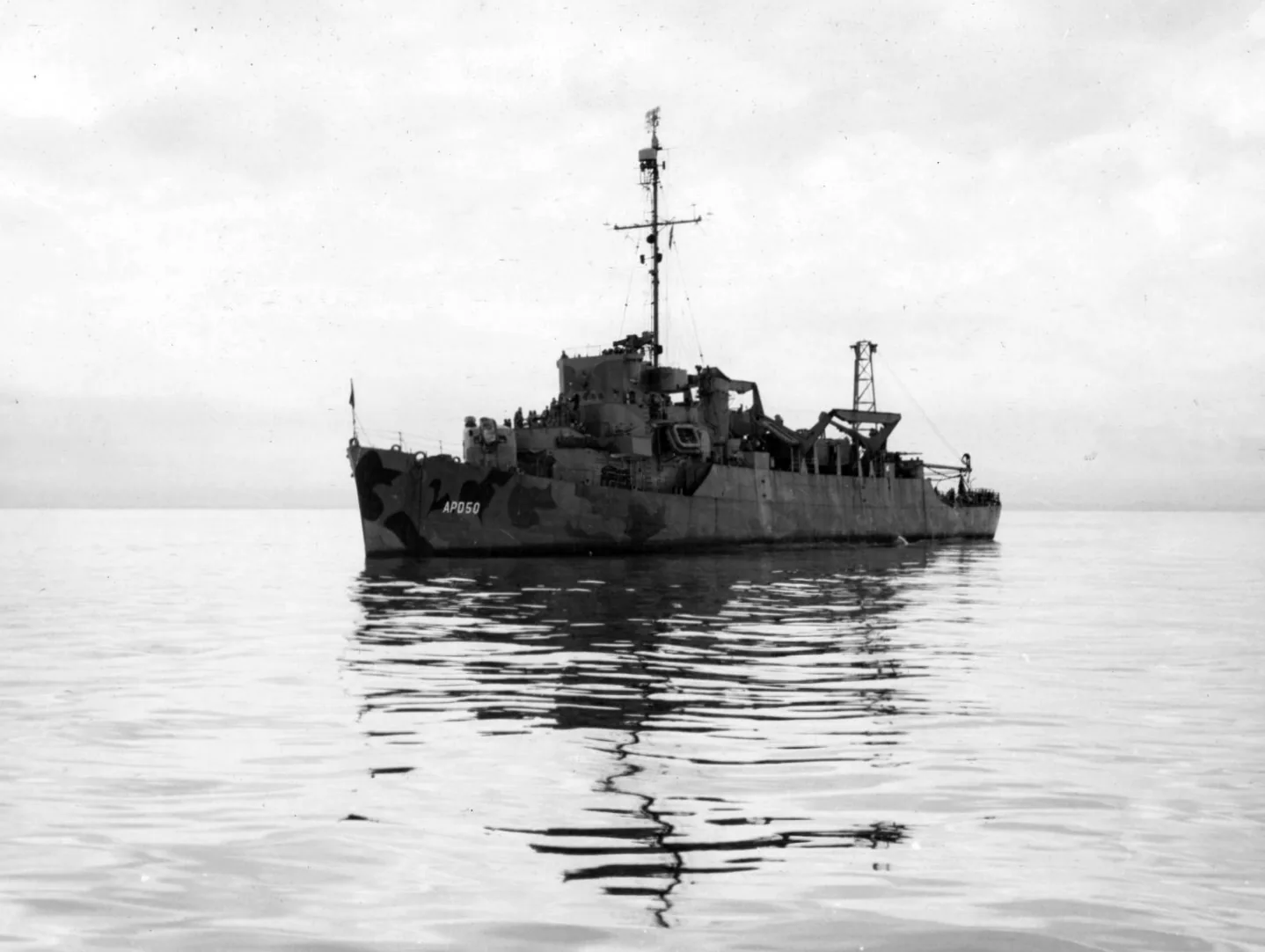
Sims sailed for the Philippine Islands on 5 March 1945 and arrived there on the 21st. A week later, the transport stood out of Leyte Gulf as part of Task Unit 51.13.16, bound for the invasion of Okinawa. Except for two fast convoy trips to Ulithi, she remained off Okinawa from 1 April to 27 May. During this period, the ship was part of the antiaircraft and antisubmarine screen around the island. She shot down an attacking Japanese bomber on 16 April. On 3 and 4 May and again on 13 and 14 May, Sims assisted in the search for survivors of picket destroyers hit by kamikaze aircraft.
On the evening of 18 May 1945, two kamikaze planes made a combined attack. Both planes, hit by antiaircraft fire, crashed into the water on her port side with a violent explosion that lifted and shook the entire ship. The shock caused serious oil leaks and considerable damage to machinery and equipment. The crew repaired the damage, and Sims continued patrolling. On the 24th, she was again attacked by a kamikaze . The plane, even though hit by antiaircraft fire, crashed close aboard to starboard. Sims was sprayed with shrapnel which wounded 11 of her crew. Later that day, a fire and rescue party was sent on board Barry (APD-29) which had been hit by a kamikaze . Fires prevented flooding her magazine, and she had been abandoned. Sims' party helped bring the fires under control, and Barry was taken under tow by a tug. Sims departed Okinawa on 27 May with a convoy which she escorted to Saipan before continuing on to Leyte for damage repairs.
The transport was back on patrol off Okinawa on 26 June 1945. On 14 August, Sims rendezvoused at sea with the Tokyo Bay Occupation Force south of Japan. The ship landed a group of British Royal Marines and Royal Navy sailors at the Yokosuka Naval Base on 30 August. The following day, she landed a company of U.S. Marines at the Tateyama Naval Air Station and stood by and took them off again when they were relieved by 8th Army units on 3 September. Sims then made a voyage to Iwo Jima, after which she operated in the Japanese home waters until 28 November. On that date, she stood out of Tokyo Bay en route to the eastern seaboard of the United States. The transport disembarked 208 passengers at San Diego on 17 December 1945, and continued to New York for preinactivation overhaul.
Post-war 1946–1949
1946
Sims was decommisisoned at Green Cove Springs, Fla., on 24 April 1946 and placed in the Atlantic Reserve Fleet. She remained inactive until stricken from the Navy List on 1 June 1960. Her hulk was sold to the North American Smelting Co., Wilmington, Del., on 14 April 1961 and scrapped.
References
Every work this entry draws on. There are no numbered markers in the text above: what we hold is the provenance of the page — this history, this article, these photographs.
- History Sims II (DE-154) Dictionary of American Naval Fighting Ships, Naval History and Heritage Command. A work of the United States Government, in the public domain — the only text on this site reproduced verbatim.
- Facts USS Sims (DE-154) Structured facts only — dates, dimensions, armament and fate. No wording is taken from it. Harvested 1 August 2026.
- Photograph USS Sims (DE-154) underway in the Atlantic Ocean on 26 August 1944 (80-G-282693) Unknown author — U.S. Navy photo 80-G-282693 — Public domain — Wikimedia Commons
- Photograph USS Sims (APD-50) at anchor, circa in 1945 U.S. Navy — U.S. Navy photo [1] from Navsource.org — Public domain — Wikimedia Commons