USS Skipjack (SS-184)
Salmon-class composite diesel-hydraulic and diesel-electric submarine
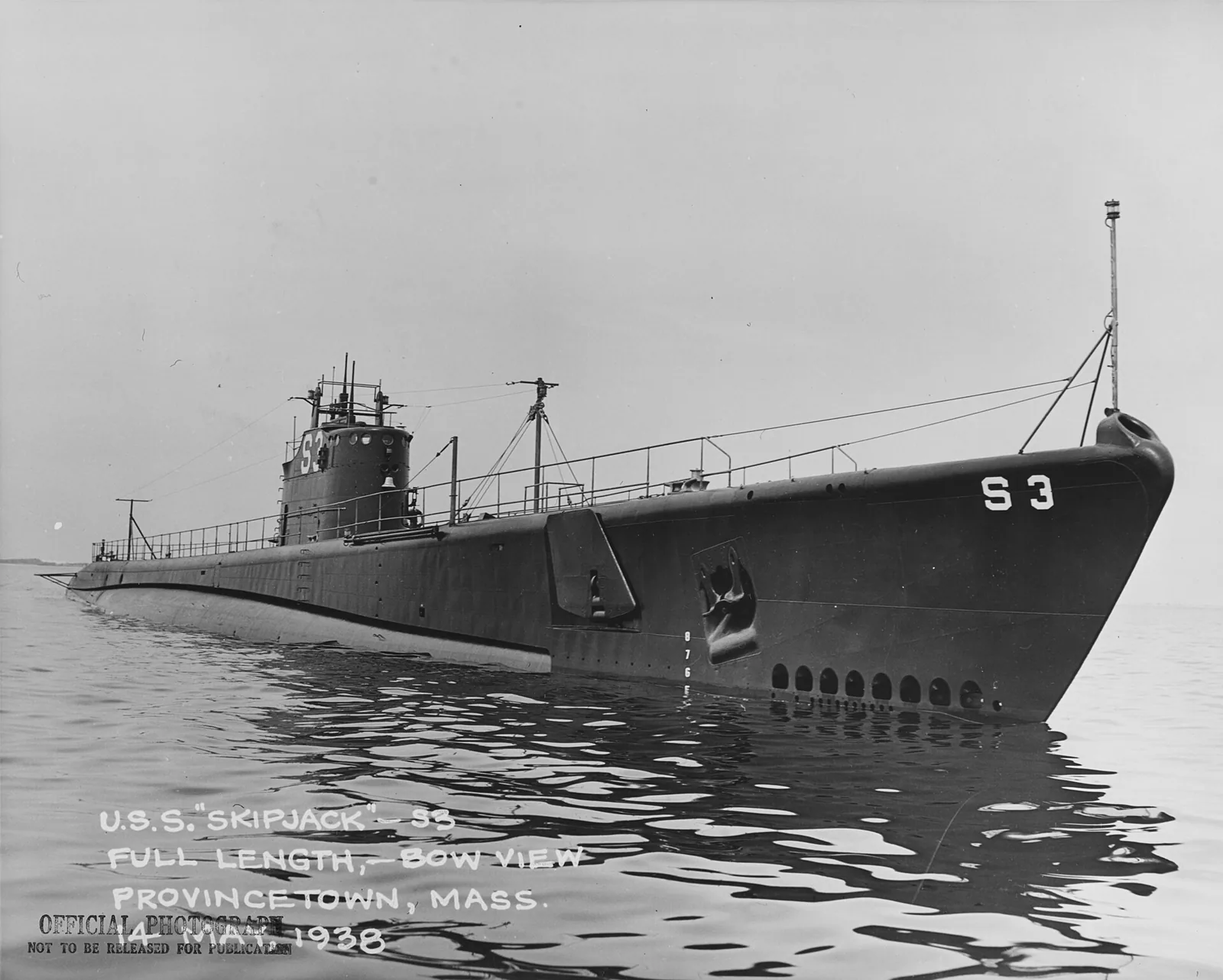
Service
- as Skipjack30 June 1938 — 28 August 19462,193 days of the war
- Name
- USS Skipjack
- Pennant / hull number
- SS-184
- Builder
- Electric Boat Company, Groton, Connecticut
- Laid down
- 22 July 1936
- Launched
- 23 October 1937
- Commissioned
- 30 June 1938
- Decommissioned
- 28 August 1946
- Struck
- 13 September 1948
- Fate
- Sunk in Operation Crossroads atomic bomb test, 25 July 1946; raised 2 September 1946; sunk as a target off southern California, 11 August 1948 (1946)
- Status
- Wreck
Specifications
- Length
- 93.88 m (308 ft)
- Beam
- 7.92 m (26 ft)
- Draught
- 4.57 m (15 ft)
- Speed
- 21 knots (38.9 km/h, 24.2 mph)
- Range
- 11,000 nmi (20,372 km)
- Complement
- 59
- Main gun
- 76 mm (3 in)
Skipjack (SS-184) was laid down by the Electric Boat Co., Groton, Conn., on 22 July 1936; launched on 23 October 1937; sponsored by Miss Frances Cuthbert Van Keuren; and commissioned on 30 June 1938, Lt. Herman Sail in command.
Following shakedown in the Atlantic and Caribbean, and post-shakedown repairs at New London, Conn., Skipjack was assigned to Submarine Squadron (Sub-Ron) 6 and departed for fleet maneuvers in the Caribbean and South Atlantic. Following her return to New London on 10 April 1939, she sailed with Snapper (SS-185), and Salmon (SS-182), for the Pacific; transited the Panama Canal on 25 May; and arrived at San Diego on 2 June. During July, she cruised to Pearl Harbor as part of Sub Ron 2; returned to San Diego on 16 August; and remained on the west coast engaged in fleet tactics and training operations until 1 April 1940, when she again got underway for the Hawaiian area for training exercises there. Following her return to San Diego, Skipjack underwent overhaul at the Mare Island Navy Yard, Vallejo, Calif.; and then proceeded back to Pearl Harbor, operating in that area until again undergoing overhaul at Mare Island in July and August 1941. Skipjack arrived back at Pearl Harbor on 16 August and commenced patrols in areas off Midway, Wake, and the Gilbert and Marshall Islands. When the Japanese attacked Pearl Harbor on 7 December, Skipjack was in the Philippines undergoing repairs at the Cavite Navy Yard.
On 9 December, Skipjack departed Manila on her first war patrol, with all unfinished repair work completed by her crew en route to the patrol area off the east coast of Samar. The submarine conducted two torpedo attacks during this patrol. On Christmas Day, she fired three torpedoes without success at an enemy aircraft carrier and a destroyer. On 3 January 1942, three torpedoes were fired at an enemy submarine, resulting in two explosions, but a sinking could not be confirmed. She refueled at Balikpapan, Borneo, on 4 January and arrived at Port Darwin, Australia, for refit on 14 January.
Continue to the full service history About 855 words
From the Dictionary of American Naval Fighting Ships, compiled by the Naval History and Heritage Command (Skipjack I (SS-184)). A work of the United States Government, in the public domain.
Armament and machinery
Armament and machinery
- Propulsion
- 4 × Hooven-Owens-Rentschler (H.O.R.) 9-cylinder diesel engines (two hydraulic-drive, two driving electrical generators)
- 2 × 120-cell batteries
- 4 × high-speed Elliott electric motors with reduction gears
- two shafts
- 5,500 shp (4.1 MW) surfaced
- 2,660 shp (2.0 MW) submerged
- Armament
- 8 × 21 inch (533 mm) torpedo tubes
- (four forward, four aft)
- 24 torpedoes
- 1 × 3 in / 50 caliber deck gun
- four machine guns
Sister ships
Sources
- Facts harvested from USS Skipjack (SS-184) on Wikipedia. Figures only — no wording is taken from it.
- Service history reproduced verbatim from Skipjack I (SS-184) , Dictionary of American Naval Fighting Ships — public domain, a work of the United States Government.
- Photograph: Unknown author — This image has been extracted from another file — Public domain — Wikimedia Commons