USS South Dakota (BB-57)
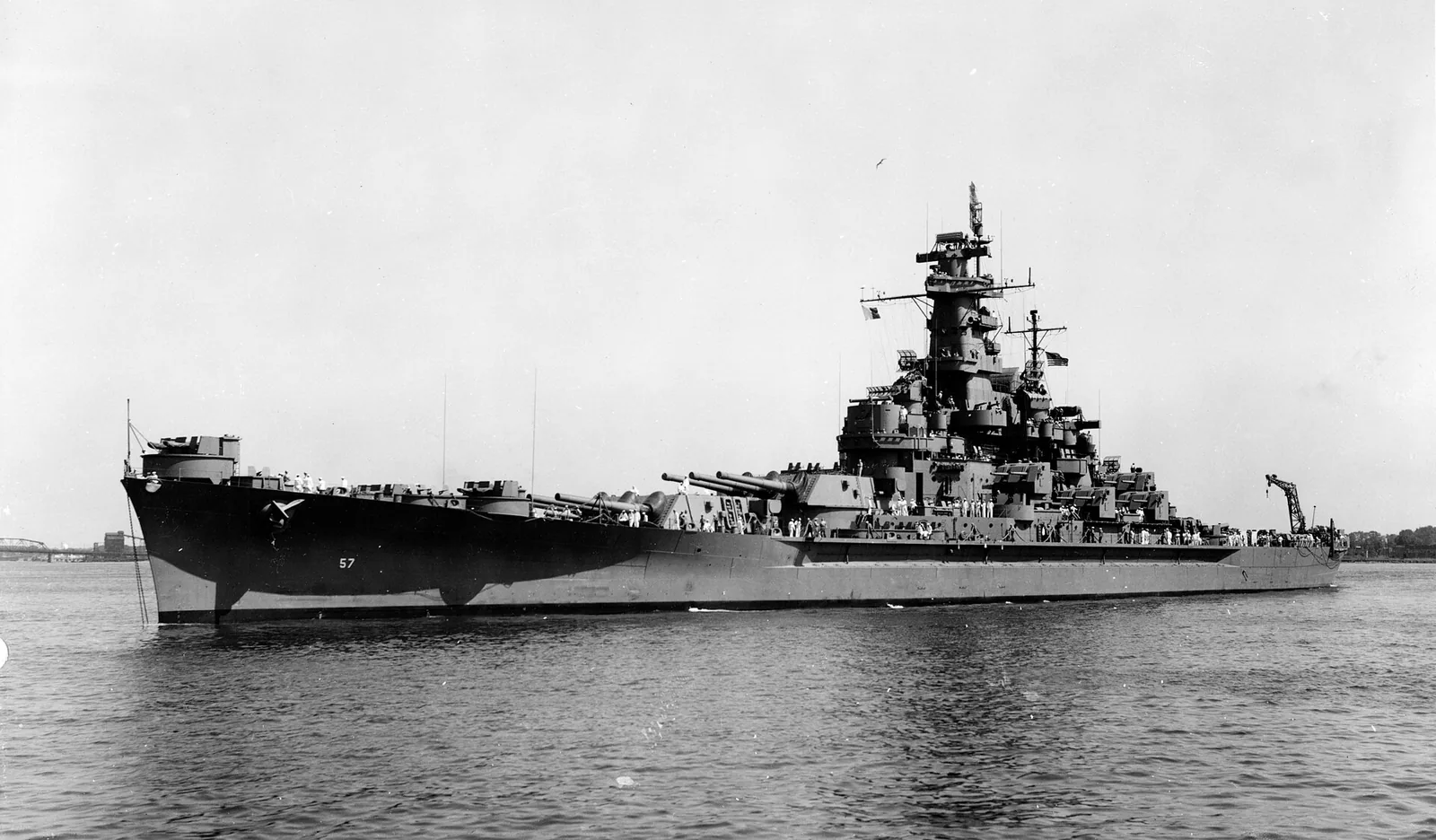
Service
- 20 March 1942 — 31 January 19471,262 days of the war
- Name
- USS South Dakota
- Pennant / hull number
- BB-57
- Namesake
- South Dakota
- Builder
- New York Shipbuilding Corporation
- Ordered
- 15 December 1938
- Laid down
- 5 July 1939
- Launched
- 7 June 1941
- Commissioned
- 20 March 1942
- Decommissioned
- 31 January 1947
- Struck
- 1 June 1962
- Fate
- Broken up, 1962 (1962)
- Status
- Scrapped
Specifications
- Displacement, standard
- 37,970 long tons (38,579 t)
- Displacement, full load
- 44,519 long tons (45,233 t)
- Length
- 207.26 m (680 ft) OA
- Beam
- 32.92 m (108 ft)
- Draught
- 10.67 m (35 ft)
- Speed
- 27.5 knots (50.9 km/h, 31.6 mph)
- Range
- 15,000 nmi (27,780 km)
- Main gun
- 406 mm (16 in)
North Dakota and South Dakota both attained their admittance to the Union on 2 November 1889. South Dakota yielded the state’s place to North Dakota because of its position in alphabetical order, with South Dakota entering the Union as the 40th state.
The second South Dakota (BB-57) was laid down on 5 July 1939, by the New York Shipbuilding Corp., Camden, N.J.; launched on 7 June 1941; sponsored by Vera C. Bushfield, wife of Governor Harlan J. Bushfield of South Dakota; and commissioned at the Philadelphia Navy Yard, Pa., on 20 March 1942, Capt. Thomas L. Gatch in command. Gatch proved a popular commanding officer with his crew. He was a natural leader. A devout Christian, Gatch often read the lessons during divine services, and recommended to his men to make their peace with God prior to going into action. Gatch studied the American Civil War, concluding that a number of the ships he investigated that emphasized ‘spit and polish’ performed poorly in battle, whereas a number of other ships that paid greater attention to realistic training achieved enviable combat records. The skipper thus directed his crew to focus upon the skills they required for battle, such as gunnery practice and damage control. The consequent (apparent) neglect of polishing brass and lack of cleanliness of certain areas on board South Dakota often offended newly-reported officers unfamiliar with Gatch’s demeanor, but the ship attained a high degree of efficiency under his command.
The design of South Dakota included the provision for her service as a division flagship. The Commandant, Fourth Naval District and Navy Yard, Philadelphia, placed the ship in commission, commencing at 1800 on 20 March 1942. The Washington High School band from Sioux Falls, S.D., played Anchors Aweigh and the Star Spangled Banner as the ship slid into the Delaware River. Tugs towed South Dakota across the river for the battleship’s fitting out at the Navy Yard.
Continue to the full service history About 20,124 words
From the Dictionary of American Naval Fighting Ships, compiled by the Naval History and Heritage Command (South Dakota II (BB-57) Chapter 1). A work of the United States Government, in the public domain.
Armament and machinery
Armament and machinery
- Propulsion
- 4 × General Electric steam turbines
- 4 × screw propellers
- Power
- 130000 shp
- 8 × Babcock & Wilcox boilers
- Armament
- 9 × 16 in/45 caliber Mark 6 guns
- 16 × 5 in/38 caliber DP guns
- 7 × quad 40 mm Bofors guns
- 7 × quad 1.1 in guns
- 34 × 20 mm Oerlikon cannons
- 8 × .50-cal machine-guns
- Armour
- Belt: 12.2 in
- Deck: 6 in
- Turrets: 18 in
- Barbettes: 17.3 in
- Conning tower: 16 in
- Aircraft
- 3 × "Kingfisher" floatplanes
Sister ships
Sources
- Facts harvested from USS South Dakota (BB-57) on Wikipedia. Figures only — no wording is taken from it.
- Service history reproduced verbatim from South Dakota II (BB-57) Chapter 1 , Dictionary of American Naval Fighting Ships — public domain, a work of the United States Government.
- Photograph: Unknown author — U.S. Navy photo NH 97264 — Public domain — Wikimedia Commons