United States Navy — Light cruiser
USS St. Louis (CL-49) — service history
This is the full service history. For the vessel's particulars, photograph and specifications, see the entry.
In the words of the US Navy. The account below is reproduced verbatim from the Dictionary of American Naval Fighting Ships, compiled by the Naval History and Heritage Command — a work of the United States Government, in the public domain, and the only text on this site not written here.
Interwar 1919–1938
1936
The fourth St. Louis (CL-49) was laid down on 10 December 1936 by the Newport News Shipbuilding and Dry Dock Co., Newport News, Va.; launched on 15 April 1938; sponsored by Miss Nancy Lee Morrill; and commissioned on 19 May 1939, Capt. Charles H. Morrison in command.
Second World War 1939–1945
1940
Fitted out and based at Norfolk, St. Louis completed shakedown on 6 October; then commenced Neutrality Patrol operations which, during the next 11 months, took her from the West Indies into the North Atlantic. On 3 September 1940, she put to sea with an inspection board embarked to evaluate possible sites, from Newfoundland to British Guiana, for naval and air bases to be gained in exchange for destroyers transferred to the British government. She returned to Norfolk on 27 October and, on 9 November, sailed for the Pacific.
Transiting the Panama Canal five days later, St. Louis reached Pearl Harbor on 12 December. She participated in fleet maneuvers and conducted patrols during the winter of 1940 and 41; then steamed to California for an overhaul at Mare Island. She returned to Pearl Harbor on 20 June and resumed operations in Hawaiian waters.
Two months later, she sailed west with other cruisers of the Battle Force; patrolled between Wake, Midway, and Guam; then, proceeded to Manila, whence she returned to Hawaii at the end of September. On the 28th of that month, she entered the Pearl Harbor Navy Yard for upkeep; and, on 7 December , she was moored to the pier in Southeast Loch.
That Sunday morning at 0756, Japanese planes were sighted by observers on board St. Louis. Within minutes, the ship was at general quarters, and her operable antiaircraft guns were manned and firing on the attackers. By 0806, preparations for getting underway had begun. At about 0820, one of the cruiser's gun crews shot down its first enemy torpedo plane. By 0900, two more enemy aircraft had joined the first. At 0931, St. Louis moved away from the pier and headed for South Channel and the open sea. Fifteen minutes later, her 6-inch guns, whose power leads had been disconnected, were in full operating order.
As the cruiser moved into the channel entrance, she became the target of a midget submarine. The enemy's torpedoes, however, exploded on striking a shoal less than 200 yards from the ship. Destroyers then pounded the bottom with depth charges and St. Louis continued out to sea where she joined in the search for the Japanese fleet. After failing to locate the enemy strike force, the hunters returned to Pearl Harbor on 10 December, and St. Louis turned to escorting transports carrying casualties to San Francisco and troops to Hawaii.
1942
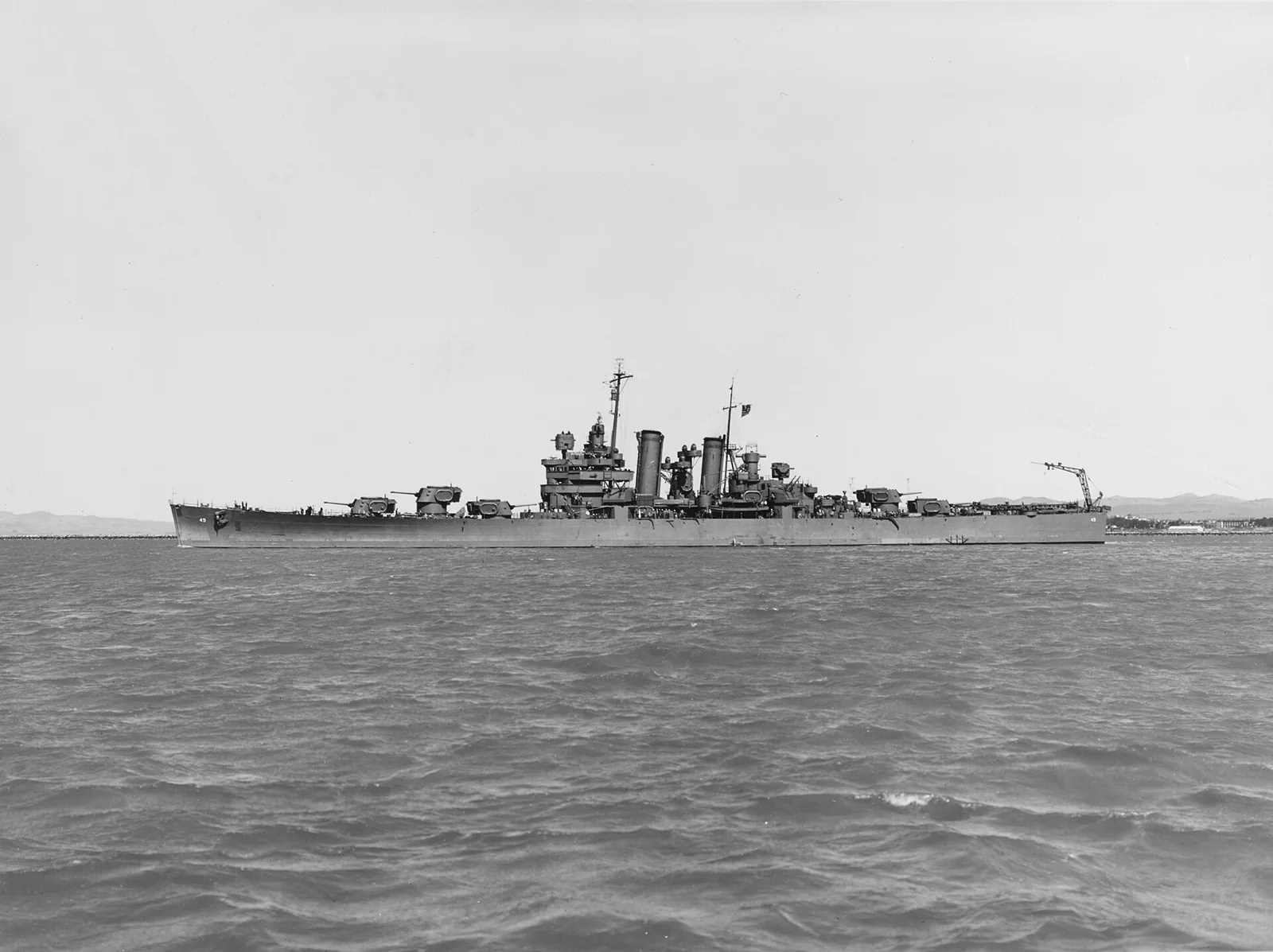
On 6 January 1942, she departed San Francisco with Task Force (TF) 17, centered on carrier, Yorktown, and escorted the ships transporting the Marine Expeditionary Force to Samoa to reinforce defenses there. Between 20 and 24 January, the Yorktown group covered the offloading at Pago Pago; then moved to conduct air strikes in the Marshalls and the Gilberts before returning to Pearl Harbor on 7 February.
Upon her return to Pearl Harbor, St. Louis resumed escort duty with Hawaii-California convoys. In the spring, after a trip to the New Hebrides, she escorted SS President Coolidge, which was carrying President Quezon of the Philippines to the west coast, arriving at San Francisco on 8 May. The following day, she was again bound for Pearl Harbor. There, she switched to a reinforcement group carrying Marine aircraft and personnel to Midway in anticipation of Japanese efforts to take that key outpost. On the 25th, she delivered her charges to their mid-ocean destination; then moved north as a unit of TP 8 to reinforce Aleutian defenses.
On 31 May, St. Louis arrived at Kodiak; refueled; and got underway to patrol south of the Alaskan Peninsula. Through July, she continued the patrols, ranging westward to intercept enemy shipping. On 3 August, she headed for Kiska for her first shore bombardment mission. Four days later, she shelled that enemy-held island; then retired, returning to Kodiak on the 11th.
After that mission, the cruiser continued patrols in the Aleutian area and covered the Allied occupation of Adak. On 25 October, she proceeded via Dutch Harbor to California for an overhaul at Mare Island.
1943 Kula Gulf

On 4 December, she departed San Francisco with transports bound for New Caledonia. She shepherded the convoy into its Noumean anchorage on the 21st, then shifted to Espiritu Santo, New Hebrides, whence she proceeded into the Solomons. She commenced operations there in January 1943 with bombardments of Japanese air facilities at Munda and Kolombangara; and, during the next five months, repeated those raids and patrolled the "Slot" in the Central Solomons in an effort to halt the "Tokyo Express" reinforcement and supply shipping that sought, almost nightly, to bolster Japanese garrisons.
Shortly after midnight on 4-5 July, she participated in the bombardment of Vila and Bairoko Harbor, New Georgia. Her division, Cruiser Division 9 (CruDiv 9) and its screen, Destroyer Squadron 21 (DesRon 21), then retired back toward Tulagi to replenish as troops were landed at Rice Anchorage. Early on the morning of the 6th, however, the cruiser-destroyer force located and engaged ten enemy destroyers headed for Vila with reinforcements embarked. In the ensuing Battle of Kula Gulf , Helena (CL-50) and two enemy ships were sunk.
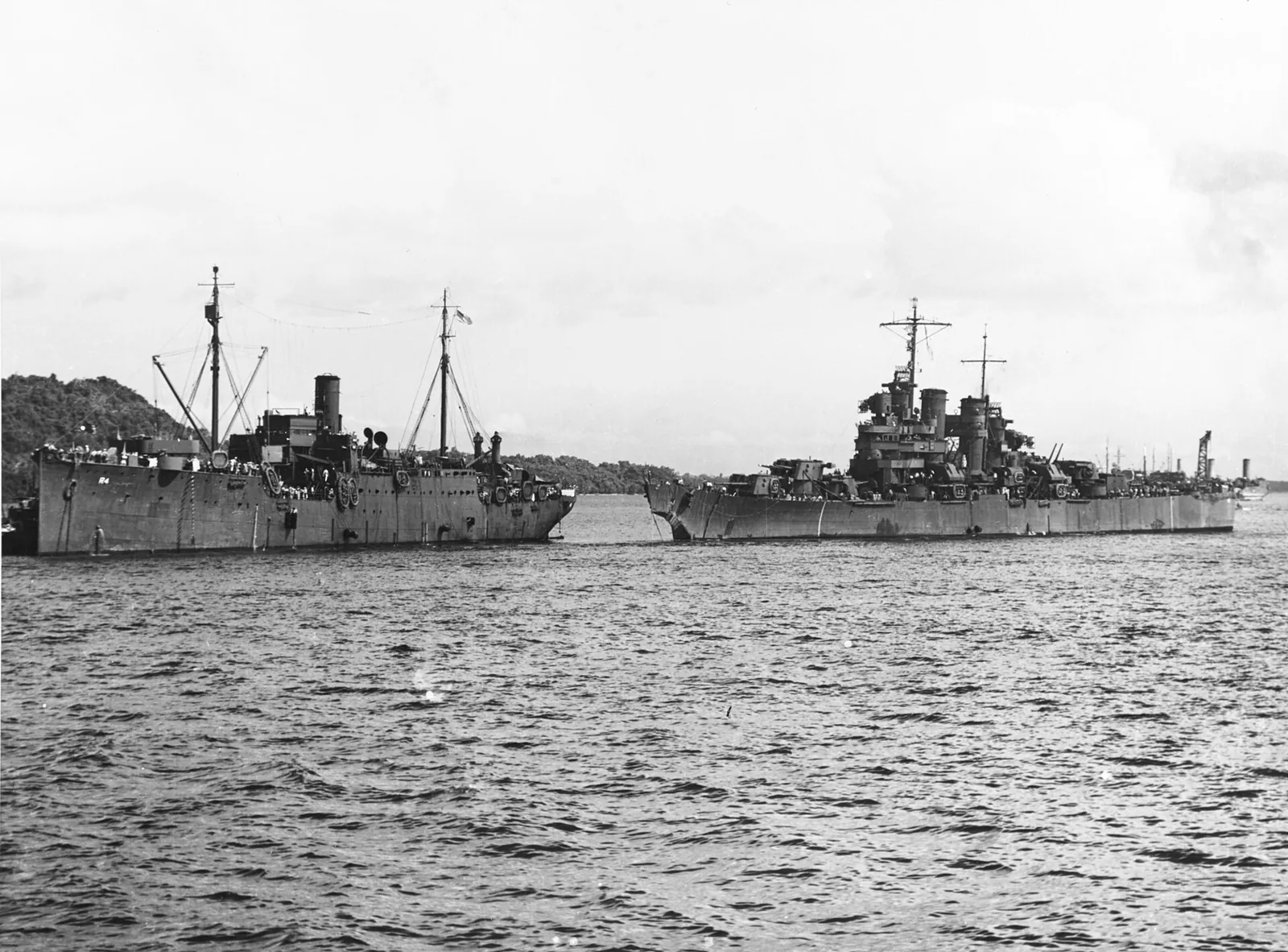
Six nights later, the force, TF 18, reinforced by DesRon 12, moved back up the "Slot" from Tulagi and, soon after 0100 on the 13th, engaged an enemy force of one light cruiser, Jintsu, and five destroyers in the Battle of Kolombangara. During the battle, which raged for over an hour, Jintsu and Gwin (DD-433) were sunk and New Zealand light cruiser Leander, Honolulu (CL-48), and St. Louis were damaged. St. Louis took a torpedo which hit well forward and twisted her bow, but caused no serious casualties.
1944 Philippine Sea
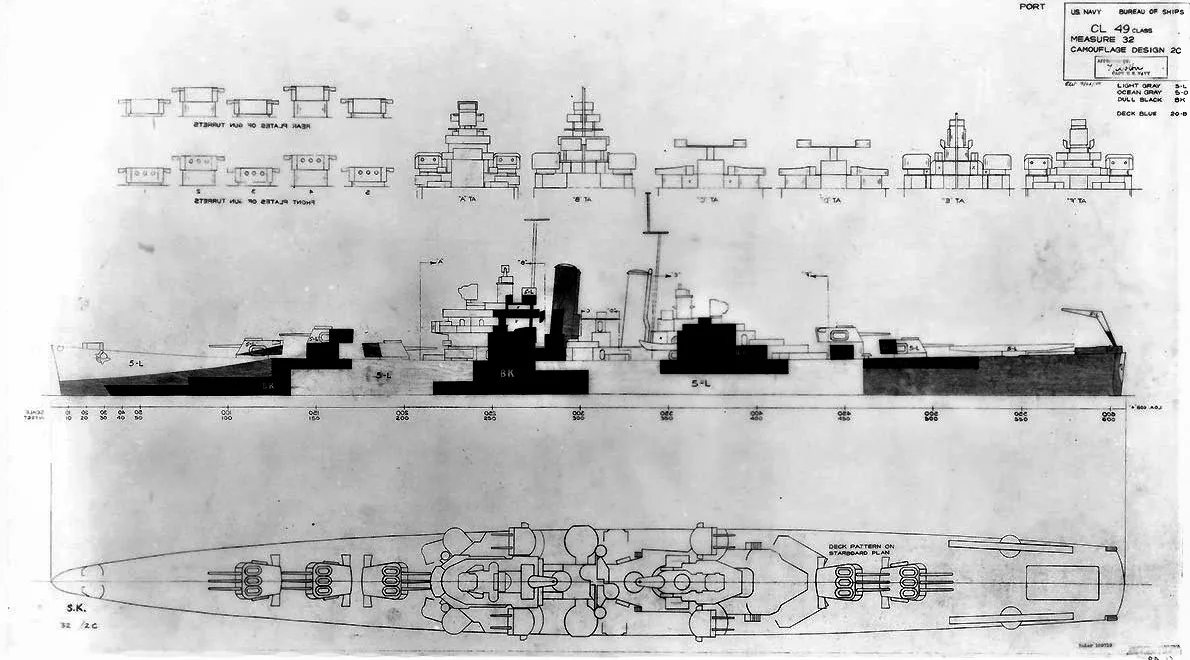
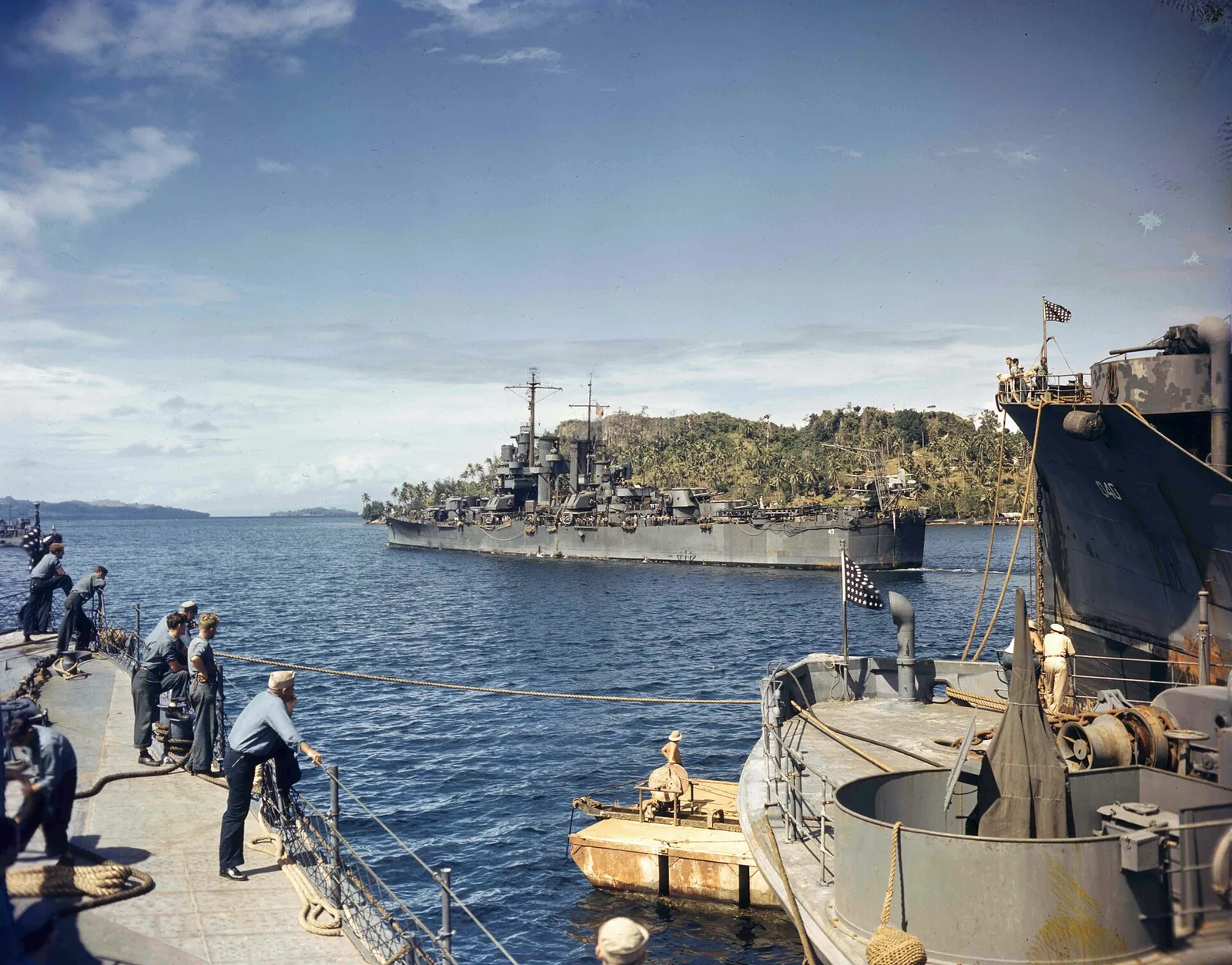
She returned to Tulagi on the afternoon of the 13th. From there, she moved on to Espiritu Santo for temporary repairs; then steamed east, to Mare Island, to complete the work. In mid-November, she returned to the Solomons and, from the 20th to the 25th, covered Marines fighting for Bougainville . In December, she returned to that island to shell troop concentrations and, in January 1944, shifted southward to bombard enemy installations in the Shortland Islands. Thence, she moved back to Bougainville to cover the landing of reinforcements at Cape Torokina. On 10 January, she headed back to Florida Island. In February, she again moved northwest, this time into the extreme northern Solomons and the Bismarcks. On the 13th, she arrived in the area between Buka and St. George Channel to support landing operations in the Green Islands off New Ireland.
At 1855 on the 14th, six Vals were sighted approaching St. Louis's group. Crossing astern of the ships, the enemy planes went out to the southeast, turned, and reapproached. Only five remained in the formation which split into two groups. Two of the planes closed St. Louis.
The first plane dropped three bombs, all near misses. The second released three more. One scored on the light cruiser; the other two were near misses just off the port quarter. The bomb which hit St. Louis penetrated the 40 millemeter clipping room near the number 6 mount and exploded in the midship living compartment. Twenty-three died and 20 were wounded, 10 seriously. A fire which had started in the clipping room was extinguished. Both of her planes were rendered inoperable; her ventilation system was damaged. Communication with the after engine room ceased, and the cruiser slowed to 18 knots. On the 15th, she survived another air attack and was then ordered back to Purvis Bay.
Repairs were completed by the end of the month; and, in March, St. Louis resumed operations with her division. Through May, she remained in the Solomons. Then, on 4 June, she moved north to the Marshalls, whence, on the 10th, she sailed for the Marianas in TF 52, the Saipan assault force. Four days later, she cruised off southern Saipan. On the 15th, she shelled the Charan Kanoa area; retired as the landings took place; then moved back to provide call fire support and to shell targets of opportunity. On the 16th, she proceeded south and bombarded the Asan beach area of Guam . She then returned to Saipan and, on the 17th, shifted to an area north of that island where she remained through the Battle of the Philippine Sea . On the 22d, she returned to Saipan and, after screening the refueling group for two days, proceeded to the Marshalls.
On 14 July, St. Louis again headed for the Marianas. The next day, she damaged her number 3 propellor and lost 39 feet of the tail shaft. Nevertheless, two days later, she arrived off Guam as scheduled; and, during the afternoon, covered underwater demolition teams working the proposed landing beaches. Pre-invasion shore bombardment followed; and, after the landings on the 21st, she provided support fire and call fire. On the 29th, St. Louis departed the Marianas for Pearl Harbor, whence she was routed on to California for overhaul. In mid-October, she steamed back to Hawaii; trained until the end of the month; then moved on across the Pacific, via Ulithi and Kossol Roads, to the Philippines, arriving in Leyte Gulf on 16 November.
During the next 10 days, she patrolled in the gulf and in Surigao Strait, adding her batteries to the antiaircraft guns protecting shipping in the area. Shortly before noon on the 27th, a formation of 12 to 14 enemy planes attacked the cruiser's formation. St. Louis was unscathed in the brief battle. A request was made for CAP cover, but Japanese planes continued to command the air. At 1130, another 10 enemy planes filled the space vacated by the first flight and broke into three attack groups of four, four, and two. At 1138, a Val, hit and aflame, made a suicide dive on St. Louis from the port quarter and exploded with its bomb on impact. Fires broke out in the cruiser's hangar area and spaces. All crew members of 20 millimeter guns 7 through 10 were killed or wounded.
At 1139, a second burning enemy plane headed at her on the port beam. Flank speed was rung up and the rudder was put hard right. The plane passed over number 4 turret and crashed 100 yards out.
At 1146, there was still no CAP cover over the cruiser's formation; and, at 1151, two more enemy planes, both burning, attacked St. Louis. The first was splashed off the port quarter; the second drove in from starboard and crashed almost on board on the port side. A 20-foot section of armor belt was lost and numerous holes were torn in her hull. By 1152, the ship had taken on a list to port. At 1210, another suicide-minded Japanese pilot closed St. Louis. He was stopped 400 yards astern. Ten minutes later, enemy torpedo planes moved in to attack. St. Louis, warned by a PT boat, barely avoided contact with a lethal package dropped by one of the planes.
By 1236, the cruiser was back on an even keel. Thirty minutes later, all major fires were out; and salvage work had been started. Medical work was well under way: 15 were dead, 1 was missing; 21 were seriously wounded; 22 had sustained minor injuries. On the 28th, St. Louis's seriously injured were transferred; and, on the 30th, she put into San Pedro Bay for temporary repairs which allowed her to reach California toward the end of December.
1945
On 1 March 1945, St. Louis departed California; and, at mid-month, she joined the fast carrier force at Ulithi. By the end of the month, she had participated in strikes against the southern Japanese home islands; then moved south to the Ryukyus to join TF 54, bombarded Okinawa , and guarded minesweepers and underwater demolition teams clearing channels to the assault beaches. On the 31st, she put into Kerama Retto to replenish; then returned to the larger island to support the forces landed on the Hagushi beaches on 1 April.
Five days later, the cruiser covered minesweepers off Iwo Jima, then resumed fire support and antiaircraft duties off Okinawa. On 18 May, she departed Hagushi for a brief respite at Leyte; and, in mid-June, she resumed support operations off Okinawa. On 25 July, she shifted to TF 95; and on the 28th, she supported air strikes against Japanese installations on the Asiatic mainland. Sweeps of the East China Sea followed; and, in early August, she anchored in Buckner Bay, where she remained through the end of hostilities on 15 August.
Postwar duties kept the cruiser in the Far East for another two and one-half months. In late August, while in the Philippines, she was assigned to TF 73, the Yangtze River Patrol Force. During September, as other ships joined the force, she was at Buckner Bay; and, in October, she moved on to Shanghai. In mid-October, she helped to lift Chinese Army units to Formosa; then she joined the "Magic Carpet" fleet to carry veterans back to the United States.
Post-war 1946–1949
1946
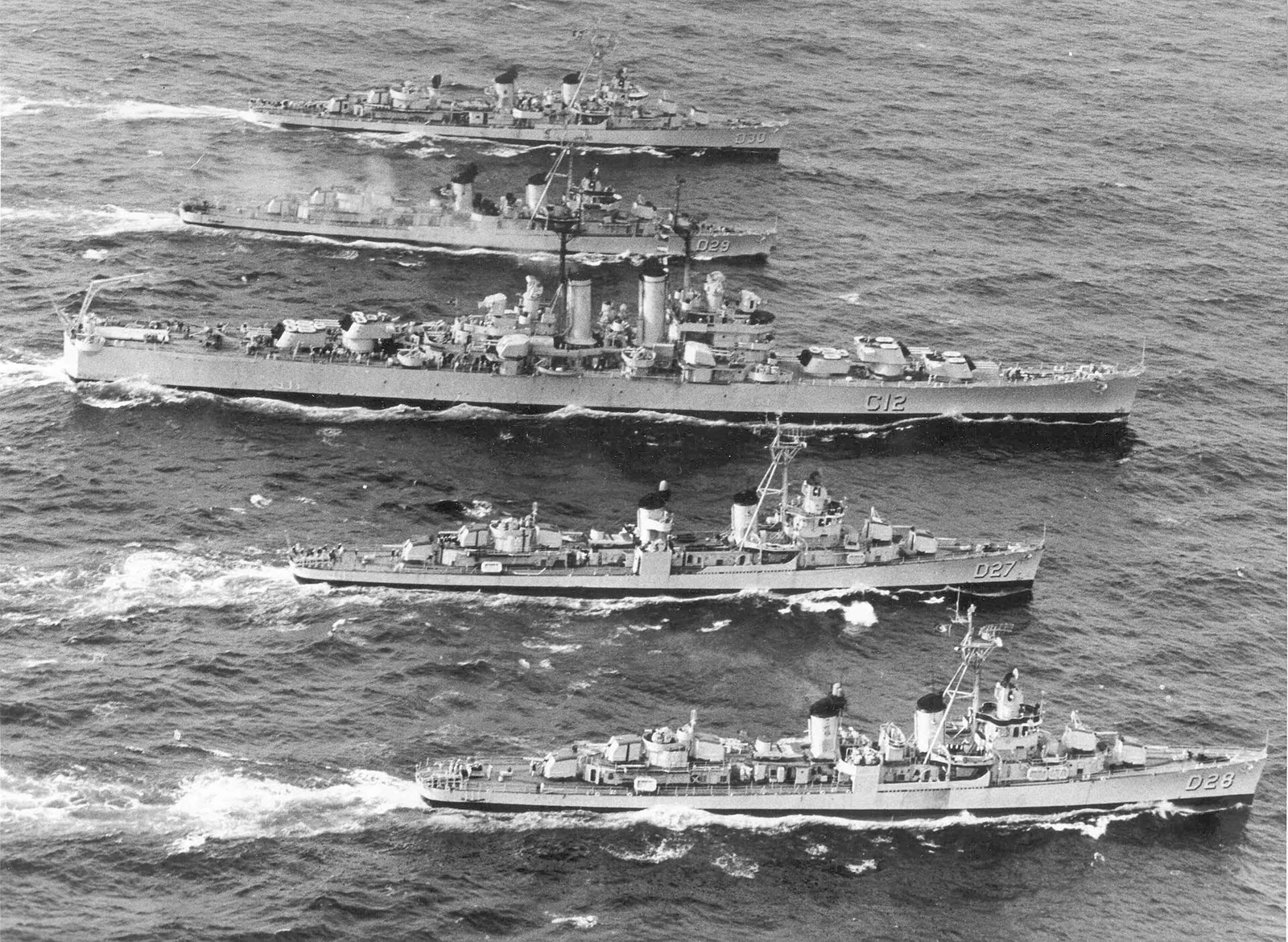
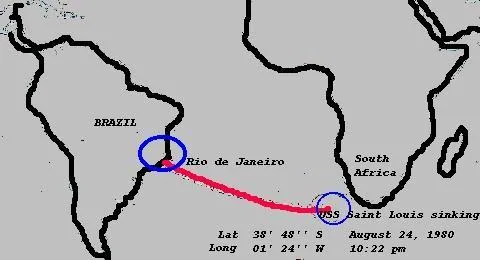
St. Louis completed her first "Magic Carpet" run at San Francisco on 9 November; and by mid-January 1946, made two more runs, both to islands in the Central and Southwest Pacific. In early February, she sailed for the east coast and arrived at Philadelphia for inactivation on the 25th. She was decommissioned on 20 June and berthed at League Island with the 16th (Inactive) Fleet through the decade. Early in the 1950's, she was designated for transfer to the government of Brazil. Her name was struck from the Navy list on 22 January 1951; and, on the 29th, she was commissioned in the Brazilian Navy as Tamandare.
Other photographs
Held for this vessel, and not tied to any part of the account above.
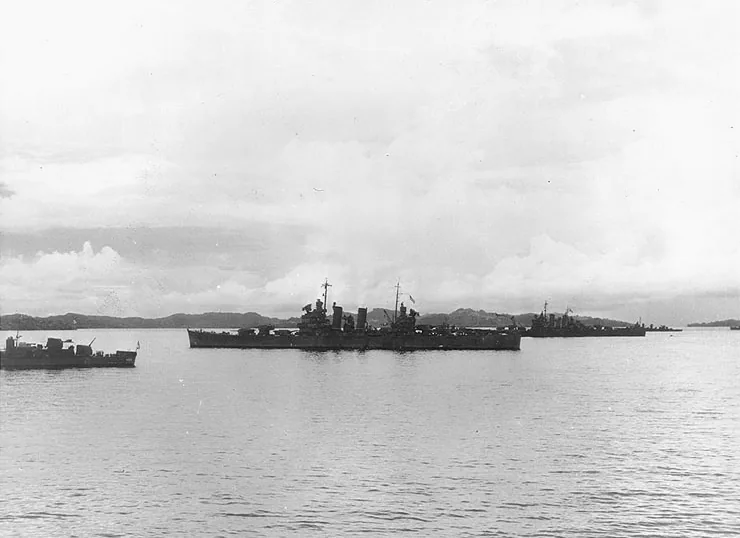

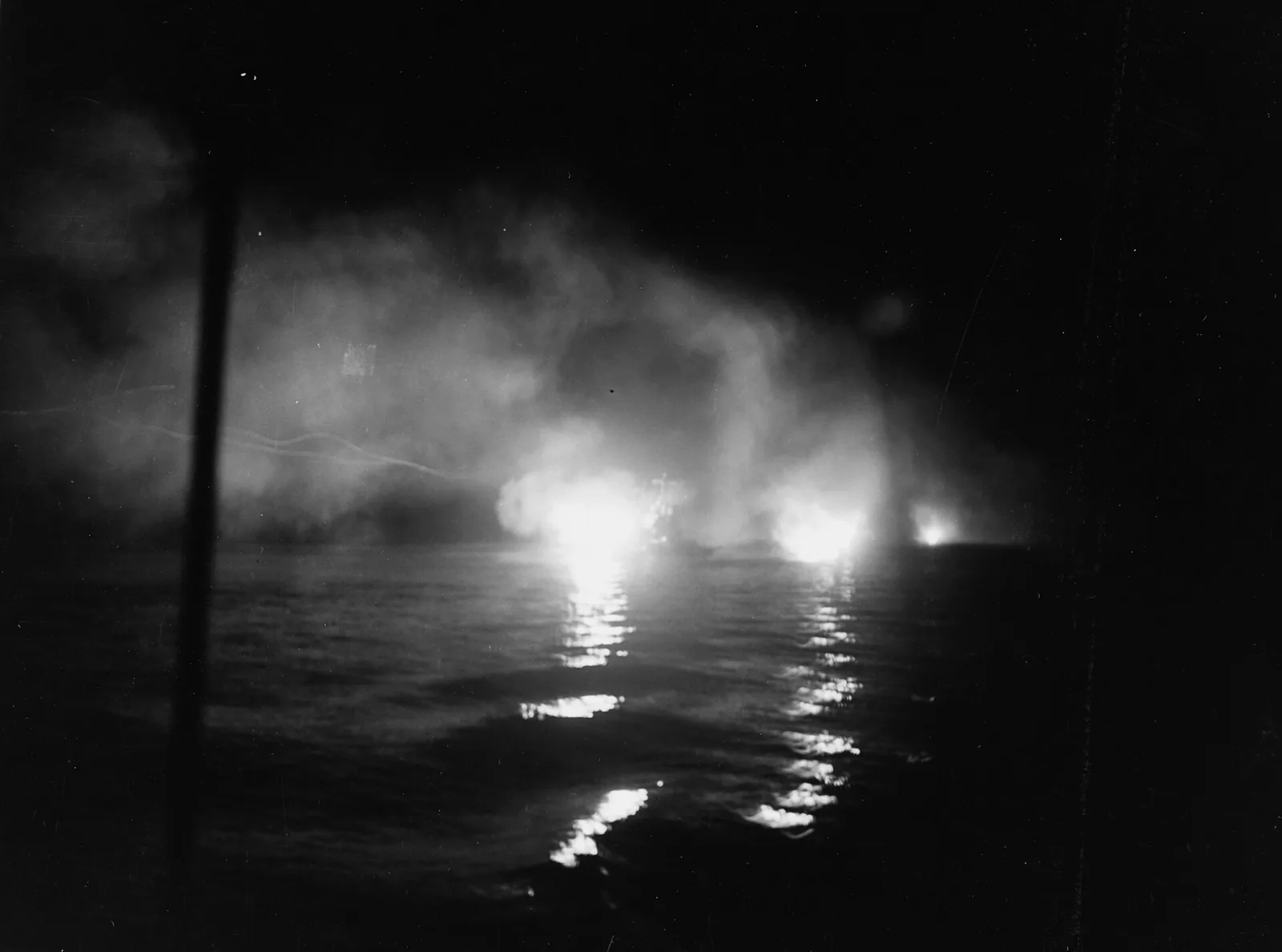

References
Every work this entry draws on. There are no numbered markers in the text above: what we hold is the provenance of the page — this history, this article, these photographs.
- History St. Louis IV (CL-49) Dictionary of American Naval Fighting Ships, Naval History and Heritage Command. A work of the United States Government, in the public domain — the only text on this site reproduced verbatim.
- Facts USS St. Louis (CL-49) Structured facts only — dates, dimensions, armament and fate. No wording is taken from it. Harvested 1 August 2026.
- Photograph USS St. Louis (CL-49) off San Pedro, California (USA), on 5 October 1944 (19-N-72219) Unknown author — U.S. Navy photo 19-N-72219 — Public domain — Wikimedia Commons
- Photograph USS St. Louis camouflage measure 32 design 2C 80-G-109719 Unknown author — history.navy.mil — Public domain — Wikimedia Commons
- Photograph USS St. Louis (CL-49) off Mare Island on 6 March 1942 (19-N-28229) Unknown author — This image has been extracted from another file — Public domain — Wikimedia Commons
- Photograph US warships at Tulagi in April 1943 Photographed from USS Fletcher (DD-445). — Official U.S. Navy photo NH 97810 from the U.S. Navy Naval History and Heritage Command — Public domain — Wikimedia Commons
- Photograph USS Helena, St. Louis, and Honolulu underway 80-G-57074 Unidentified USN photographer — history.navy.mil — Public domain — Wikimedia Commons
- Photograph USS Helena (CL-50) firing during the Battle of Kula Gulf, 6 July 1943 (80-G-54553) Photographed from USS Honolulu (CL-48) — U.S. Navy photo 80-G-54553 — Public domain — Wikimedia Commons
- Photograph USS Honolulu (CL-48) and USS St. Louis (CL-49) returning from the Battle of Kula Gulf on 6 July 1943 (NH 83012) photographed from USS Nicholas (DD-449). — U.S. Navy photo NH 83012 — Public domain — Wikimedia Commons
- Photograph USS St. Louis (CL-49) comes alongside USS Vestal (AR-4) at Tulagi in July 1943 Unknown author — U.S. Navy photo 80-G-258905 — Public domain — Wikimedia Commons
- Photograph USS St. Louis (CL-49) at Tulagi, circa in 1943 (80-G-K-3971) Unknown author — U.S. Navy photo 80-G-K-3971 — Public domain — Wikimedia Commons
- Photograph USS St Louis (CL-49) United States Navy — [1] Direct — Public domain — Wikimedia Commons
- Photograph USS St. Louis hit by kamikaze Unidentified USN photographer — U.S. Navy photo, available through Navsource here — Public domain — Wikimedia Commons
- Photograph Brazilian cruiser Tamandaré (C12) underway with destroyers during the 1961 Lobster War Brazilian Navy — http://www.zonamilitar.com.ar/ , photo [1] from Navsource.org — Public domain — Wikimedia Commons
- Photograph Sink- USS CL-49 Captain Gottlieb — Own work — CC BY-SA 4.0 — Wikimedia Commons
- Photograph 4ux039vgfoye1 US Navy — https://www.history.navy.mil/our-collections/photography/numerical-list-of-images/nara-series/80-g-k/80-G-K-03000/80-G-K-3971.html — Public domain — Wikimedia Commons
- Photograph 80-G-55501 (16693151853) National Museum of the U.S. Navy — 80-G-55501 — Public domain — Wikimedia Commons
- Photograph 80-G-55510 (17287461656) National Museum of the U.S. Navy — 80-G-55510 — Public domain — Wikimedia Commons
- Photograph 80-G-55514 (16690960774) National Museum of the U.S. Navy — 80-G-55514 — Public domain — Wikimedia Commons
- Photograph 80-G-55515 (16690961454) National Museum of the U.S. Navy — 80-G-55515 — Public domain — Wikimedia Commons
- Photograph 80-G-55521 (16690961924) National Museum of the U.S. Navy — 80-G-55521 — Public domain — Wikimedia Commons
- Photograph 80-G-55522 (16693157323) National Museum of the U.S. Navy — 80-G-55522 — Public domain — Wikimedia Commons