United States Navy — Destroyer
USS Tarbell — service history
This is the full service history. For the vessel's particulars, photograph and specifications, see the entry.
In the words of the US Navy. The account below is reproduced verbatim from the Dictionary of American Naval Fighting Ships, compiled by the Naval History and Heritage Command — a work of the United States Government, in the public domain, and the only text on this site not written here.
Before commissioning
Joseph Tarbell, born at Norfolk, Va., sometime around 1780, was appointed midshipman on 5 December 1798. He served in the U.S. frigate Constitution and other ships of the Mediterranean Squadron from 1800 to 1804, at the height of America's war with Tripoli. He was present, under Commodore Edward Preble, during the demonstration before Tripoli in 1804 and stood among those honored by Congress for services rendered during that action.
From 19 to 23 June 1813, during the War of 1812, Tarbell commanded a boat expedition against the British squadron off Craney Island and in the James River. His flotilla of 15 armed craft fought the enemy for an hour and one-half and succeeded in forcing him to flee. In those actions, his men sank three British boats, took 43 prisoners, and killed 90 of the enemy. Tarbell received a commendation from his superior, Commodore Stephen Cassin, and by the army officers ashore for his gallantry and assistance in the defense of Craney Island. Just over a month later, on 24 July 1813, he was promoted to the rank of captain. Captain Tarbell died at Norfolk on 24 November 1815.
Great War and before
1917
Tarbell (Destroyer No. 142) was laid down on 31 December 1917 at Philadelphia, Pa., by William Cramp & Sons Ship & Engine Building Co.; launched on 28 May 1918; sponsored by Miss Virgie Tarbell, ; and commissioned on 27 November 1918, Cmdr. Halsey Powell in command.
Tarbell operated along the eastern seaboard until September of 1919, when she was reassigned to the Pacific Fleet. Based at San Francisco, she served with Destroyer Division 15, of Destroyer Flotilla 5 and Destroyer Squadron 4, until late January of 1920 when she joined Division 13 of the same flotilla and squadron. In February, her home yard was changed to Cavite in the Philippines; and, the following month, the destroyer joined the U.S. Asiatic Fleet.
Interwar 1919–1938
1920

Tarbell , redesignated DD-142 in the adoption of alphanumeric hull numbers on 17 July 1920, served on the Asiatic Station through the spring of 1921. On 13 May 1921, Tarbell' s motor sailer, while traveling from the shore to the ship lying anchored off the Philippine port of Damurtis, swamped in the choppy sea and sank about one mile from the beach. Two of the boat's passengers, thrown into the water, could not swim. CMM Jesse E. Melton, with the aid of the boat's back board, kept the men afloat, sustaining them until a boat from the tug Piscataqua (AT-49), rescued them. Melton was later awarded a Silver Life Saving Medal on 17 February 1922.
1922
Tarbell remained in the Asiatic Fleet until the summer of 1921, when she returned to the Pacific Fleet with her home yard at Puget Sound. She operated with the Pacific Fleet until she was decommissioned on 8 June 1922 and berthed at San Diego, Calif.
1930
On 29 May 1930, Tarbell was recommissioned, Lt. Cmdr. Charles K. Osborne in command, and was assigned to Destroyer Division 11, Destroyer Squadron 10, Destroyer Squadrons, Battle Fleet. Her home port remained San Diego until January 1931, when it was changed to Charleston, S.C. However, she remained assigned to the same administrative organization until March, when she was reassigned to Destroyer Division 3, Scouting Force. Sometime between July and October of 1934, the destroyer changed home ports back to San Diego, but remained a part of the Scouting Force Destroyers. Late in 1936, Tarbell returned to the east coast to prepare for her second decommissioning, this time at Philadelphia.
Second World War 1939–1945
1939
She remained there until after war broke out in Europe on 1 September 1939. To keep the war out of the Americas, President Franklin Delano Roosevelt issued two Neutrality Proclamations on the 5th and ordered the Navy to form a Neutrality Patrol. A month later, on 4 October 1939, Tarbell was recommissioned at Philadelphia, Lt. Cmdr. Edward W. Rawlins in command. She operated in the Atlantic with the Neutrality Patrol for over two years before the Japanese attack on the U.S. Pacific Fleet at Pearl Harbor and upon neighboring naval and army installations [7 December 1941] jolted the United States into hostilities. On 8 December 1941, Tarbell , along with destroyers Niblack (DD-424) and Benson (DD-421), part of Task Unit 4.1.3, escorting convoy HX 163, depth-charged sound contacts later evaluated as "non-submarine."
1942
Tarbell continued to escort convoys and perform antisubmarine work in the North Atlantic, in the course of which she stood ready to rescue survivors of torpedoed ships as the German U-boat onslaught began in earnest in February 1942 against shipping in American coastal waters. One such rescue occurred on 26 March 1942, in the wake of German submarine U-71 's sinking the unarmed Socony oil tanker Dixie Arrow off Cape Hatteras, N.C. Directed to the scene by a U. S. Coast Guard plane, Tarbell sighted Dixie Arrow 's distress flares a little before 0900. The destroyer instantly rang up full speed, and, 30 minutes later arrived at the scene of the attack. She dropped a depth-charge barrage to drive off any U-boats lurking in the vicinity and then picked up the 22 survivors; 11 of the merchant sailors had either drowned or been burned to death, however, when the torpedo explosions ignited the ship's cargo of 86,136 barrels of crude oil. After a futile search for the enemy submarine, she put in to Morehead City, N.C., to disembark Dixie Arrow 's survivors.
In May 1942, Tarbell began conducting surveillance of Vichy French warships in the Caribbean. To ensure that those ships were not turned over to the Germans and that, in accordance with the Panama Declaration, there be no transfer of European possessions in America to any non-American power, she was assigned a patrol area around Pointe-a-Pitre, Grand Terre Island, Guadeloupe. Her specific charge was the training cruiser Jeanne D'Arc.
On 16 May 1942, Tarbell rescued 23 survivors of the U.S. freighter Lammont Du Pont, torpedoed four days out of New York on 23 April by U-125 . Sadly, eight men from the merchantman's crew had died of exposure or wounds in the interval between the loss of the ship and Tarbell 's arrival. On the evening of 25 May, when word reached her at San Juan of U-156 's torpedoing sister ship Blakeley (DD-150) off Martinique, Tarbell got underway so rapidly that she left behind two officers and 13 crewmen ashore in Puerto Rico. The following day, she picked up eight wounded Blakeley crewmen at Martinique and then participated in the search for the U-boat until the afternoon of the 27th. On 2 June, Tarbell rescued 19 survivors of SS Alegrete. Two days later [4 June], the destroyer sighted 30 survivors from the U.S. tanker M. F. Elliott , that had been torpedoed and sunk by U-502 off the Florida Keys the previous day, and brought them on board. The Brazilian tanker Santa Maria rescued two additional M. F. Elliott survivors on 8 June. Following additional escort duty in the Caribbean and in the Gulf of Mexico, Tarbell began screening transatlantic convoys in mid-May 1943, beginning with convoy UGS-9, that reached Casablanca safely on 15 June. Tarbell returned to the United States at New York, underwent repairs, and conducted training before joining another Casablanca-bound convoy in August. Upon her return to New York, the destroyer conducted local escort work until 22 October, when she sailed in company with escort carrier Croatan (CVE-25) and destroyers Lea (DD-118) and Upshur (DD-144) to cover the passage of another convoy. The unit steamed via Bermuda, where it was joined by seaplane tender Albemarle (AV-5), and reached Casablanca on 3 November. Following a short voyage to Gibraltar, Tarbell headed back across the Atlantic on 10 November. The return convoy entered New York harbor on the 21st.
1944
The following month brought an availability, refresher training, and time spent in training prospective crews for destroyer-type warships. The day after Christmas of 1943, she departed Norfolk in company with escort carrier Mission Bay (CVE-59) and Destroyer Division 61 to cover convoy UGS-28 to North Africa, thence to operate as a hunter/ killer group in the vicinity of the Azores. On 31 December, sister ship Lea received severe damage when she was accidentally rammed by freighter Elihu Yale , and Tarbell took her crippled sister ship in tow, and stood toward Bermuda. On 3 January 1944, fleet tug Cherokee (AT-66), accompanied by destroyer Twiggs (DD-591), relieved Tarbell of her towing duties, then caught up with the convoy at Horta in the Azores on the 7th.
After hunting submarines along the convoy routes, Tarbell 's group reached Norfolk, Va., on 7 February 1944, and the destroyer set out for a 10-day availability at Boston. Following that, she was assigned to the Air Force, Atlantic Fleet (AirLant) to serve as a target for air crew training operations off Provincetown, Mass. Relieved of that duty in April, she operated for a time in the screen of carrier Ranger (CV-4) and escort carrier Kasaan Bay (CVE-69). From then until July 1945, she alternated between carrier escort duty and target ship duty with AirLant.
1945
Decommissioned at Philadelphia on 20 July 1945, Tarbell was stricken from the Navy list on 13 August 1945, and was sold for scrapping on 30 November 1945 to the Boston Metal Salvage Co., Baltimore, Md.
Other photographs
Held for this vessel, and not tied to any part of the account above.
References
Every work this entry draws on. There are no numbered markers in the text above: what we hold is the provenance of the page — this history, this article, these photographs.
- History Tarbell (Destroyer No. 142) Dictionary of American Naval Fighting Ships, Naval History and Heritage Command. A work of the United States Government, in the public domain — the only text on this site reproduced verbatim.
- Facts USS Tarbell Structured facts only — dates, dimensions, armament and fate. No wording is taken from it. Harvested 1 August 2026.
- Photograph USS Tarbell (DD-142) underway in Charleston harbour, 17 December 1942 U.S. Navy — Official U.S. Navy photo NH 41910 from the U.S. Navy Naval History and Heritage Command — Public domain — Wikimedia Commons
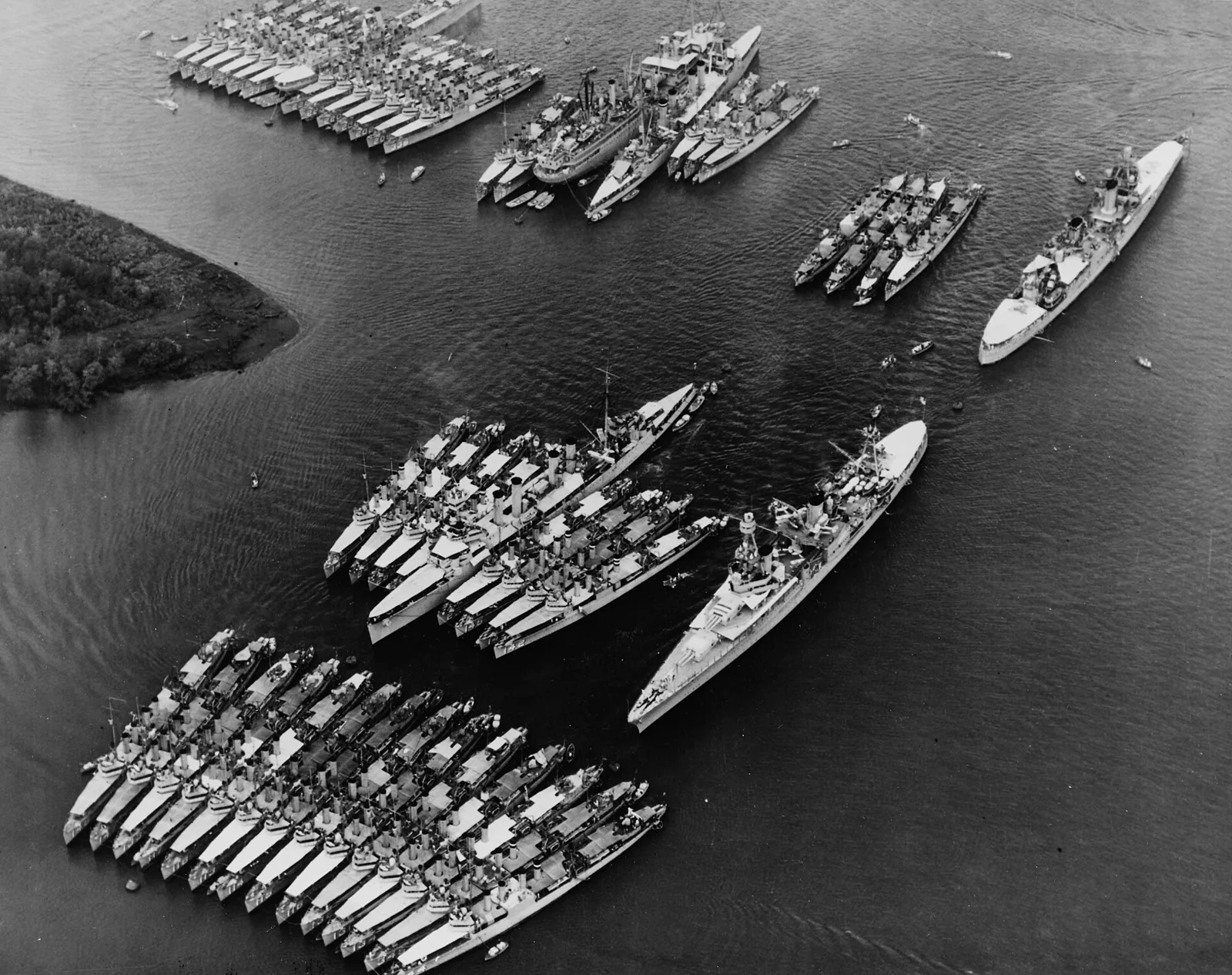
- Photograph US Navy cruisers and destroyers at Balboa, Panama on 23 April 1934 U.S. Navy — Official U.S. Navy photo 80-G-455906 from the U.S. Navy Naval History and Heritage Command — Public domain — Wikimedia Commons
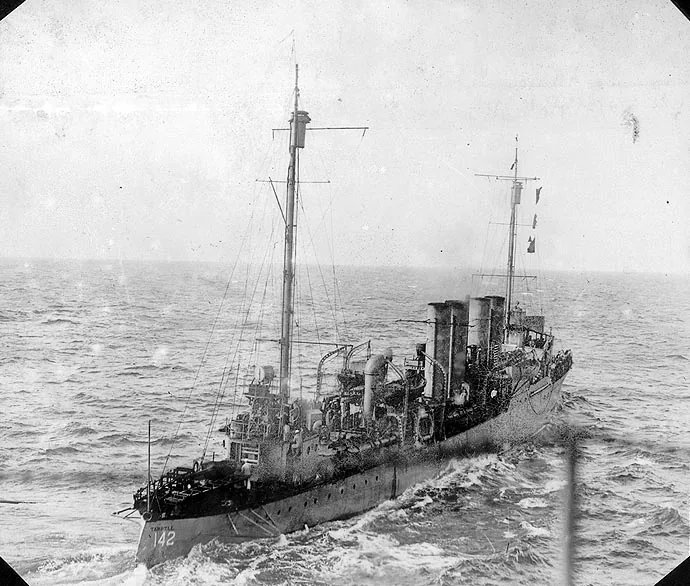
- Photograph USS Tarbell (DD-142) U.S. Navy — Official U.S. Navy photo NH 98919 from the U.S. Navy Naval History and Heritage Command — Public domain — Wikimedia Commons
- Photograph USS Wickes (DD-75) and USS Tarbell (DD-142) underway c1920 U.S. Navy — Official U.S. Navy photo NH 41906 from the U.S. Navy Naval History and Heritage Command — Public domain — Wikimedia Commons