United States Navy — Destroyer escort
USS Thornhill — service history
This is the full service history. For the vessel's particulars, photograph and specifications, see the entry.
In the words of the US Navy. The account below is reproduced verbatim from the Dictionary of American Naval Fighting Ships, compiled by the Naval History and Heritage Command — a work of the United States Government, in the public domain, and the only text on this site not written here.
Before commissioning
Leonard W. Thornhill, born on 17 August 1915 in Lamison, Ala., was appointed to the Naval Academy on 19 June 1934, graduated on 2 June 1938, and was commissioned an ensign. After serving at sea in Penn sylvania (BB-38) until September 1939 and in J. Fred Talbot (DD-156) until July 1940, he was transferred to Pensacola for flight training. Thornhill received his naval aviator's wings on 23 January 1941 and soon thereafter reported for duty at the Naval Air Station at Opa-Locka, Fla.
Following another assignment ashore at San Diego, Calif., Thornhill joined carrier-based Torpedo Squadron (VT) 2 on 13 August 1941. After the Japanese attack on Pearl Harbor, Thornhill served with his ship, Lexington (CV-2), during the first month of the war, patrolling the Johnston-Palmyra-Oahu triangle against possible enemy incursions. In February and March, he participated in the carrier's offensive patrols in the Coral Sea and in the attacks on Japanese installations at Salamaua and Lae located on the northern coast of New Guinea.
Early May found Lexington patrolling the Coral Sea after two weeks of upkeep in Pearl Harbor. Thornhill piloted one of the 12 TBD-1 torpedo bombers launched during mid-morning on 7 May to seek out and destroy Japanese forces converging on the Australian base at Port Moresby. At 1135, VT-2 encountered the light carrier Shoho and immediately launched a well coordinated attack in conjunction with Bombing Squadron (VB) 2. While VB-2 took some of the fighter pressure off the torpedo bombers, Thornhill and his comrades split formation and attacked the carrier from both directions astern. All 12 planes made their runs and drops successfully and without loss to themselves. The "Devastators" claimed nine hits from 12 drops, one of which was credited to Lt. (jg.) Thornhill. The coordinated attacks of VT-2 and VB-2 sent Shoho to the bottom, the first enemy carrier sunk by American forces in World War II.
The following day, during the second phase of the Battle of the Coral Sea, Thornhill went aloft with VT-2 at 0910 in search of the two remaining Japanese carriers, Shokaku and Zuikaku. After failing to encounter the enemy ships at their supposed location, Thornhill and his squadron mates initiated a "box search" to find their quarry. Sometime after 1100, they found their target, fleet carrier Shokaku, At 1142, VT-2 commenced its attack; and the carrier began a long, slow turn to the right which allowed each TBD-1 to make its "run without splitting across the stern." The attack ended just eight minutes later, and VT-2 began the flight home claiming five hits on Shokaku, all of which proved later to be wishful thinking. Only the dive bombers succeeded in damaging the enemy carrier.
During the return flight, VT-2 planes began to run low on fuel as a result of their drawn-out search earlier that morning. All planes cut back power in order to make the flight most economically. Even so, Lt. (jg.) Thornhill could not make it. His "Devastator" ran out of fuel some 20 miles short of home, and he had to ditch in the ocean. Though a destroyer went to their rescue, Thornhill and his crew perished at sea. For his contribution to the destruction of Shoho carried out with ". . . complete disregard for his own personal safety . . .," Lt. (jg.) Thornhill was awarded the Navy Cross posthumously.
Second World War 1939–1945
1943
Thornhill (DE-195) was laid down on 7 October 1943 at Newark, N.J., by the Federal Shipbuilding & Drydock Co.; launched on 30 December 1943; sponsored by Mrs. J. E. Thornhill, the mother of Lt. (jg.) Thornhill; and commissioned on 1 February 1944, Lt. John B. Shumway, USNR, in command.
1944
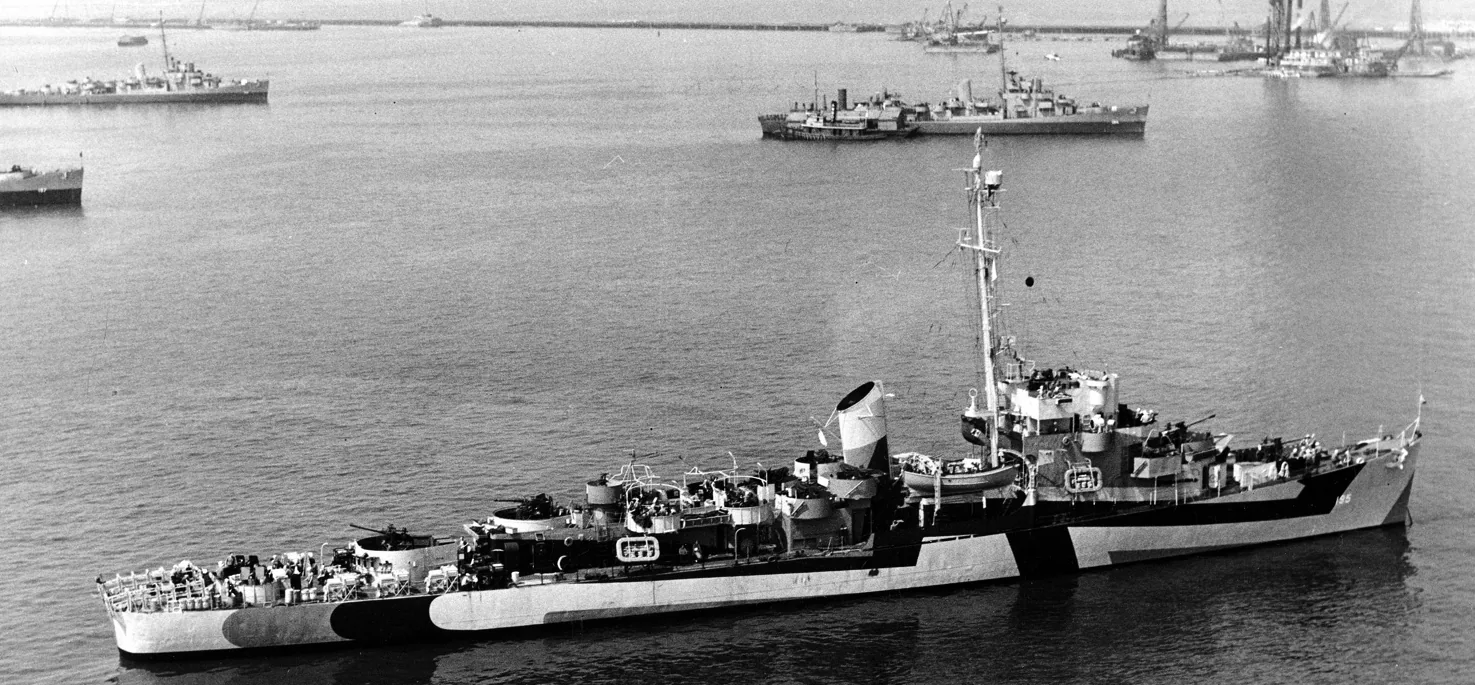
The destroyer escort got underway on 18 February, held shakedown training out of Bermuda, and returned to New York exactly one month later. Thornhill served as a training ship at Norfolk during April. In May, she returned to New York to escort a part of Convoy UGS-42 to Norfolk. The 108-ship convoy sortied from Hampton Roads on 13 May, bound for North Africa. Thorn hill arrived at Bizerte on 1 June and returned to New York on the 29th with a westbound convoy. Late in July, the destroyer escort screened another convoy to North Africa and returned to New York on 7 September 1944.
1945
During the next eight months, Thornhill made four more escort voyages to England and France. On 9 June 1945, she and the other ships of Escort Division (Cort-Div) 55 got underway for Guantanamo Bay and proceeded thence through the Panama Canal to the west coast of the United States. The division arrived at San Diego on 9 July. CortDiv 55 stood out to sea five days later and arrived at Pearl Harbor on the 19th to join the Destroyer Force, Pacific Fleet.
Thornhill and her division departed with SS Empress of Australia on 8 August, bound for the Marshalls, and reached Eniwetok the day after hostilities with Japan ceased. She remained in the Marshalls until 7 December when she and Wingfield (DE-194) headed back toward Hawaii. The two ships arrived at Pearl Harbor on 13 December 1945, and Thornhill served as a weather patrol ship there during January 1946. The destroyer escort sailed for home on 2 February and, after calling at San Diego, arrived at the Boston Navy Yard on 7 March. The next week she got underway for Green Cove Springs, Fla., to be inactivated. She was decommissioned on 17 June 1946 and assigned to the Atlantic Reserve Fleet.
Korean War period 1950–1953
1951
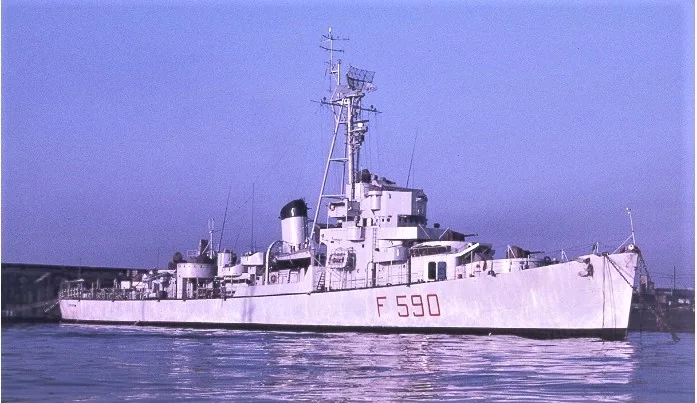
Thornhill was transferred to Italy under the Military Assistance Program on 10 January 1951 and was struck from the Navy list on 26 March that same year. She serves the Italian Navy as Aldebaran (F-590).
Other photographs
Held for this vessel, and not tied to any part of the account above.
References
Every work this entry draws on. There are no numbered markers in the text above: what we hold is the provenance of the page — this history, this article, these photographs.
- History Thornhill (DE-195) Dictionary of American Naval Fighting Ships, Naval History and Heritage Command. A work of the United States Government, in the public domain — the only text on this site reproduced verbatim.
- Facts USS Thornhill Structured facts only — dates, dimensions, armament and fate. No wording is taken from it. Harvested 1 August 2026.
- Photograph USS Thornhill (DE-195) at anchor off New York City (USA) on 10 July 1944 (80-G-235899) U.S. Navy — U.S. Navy photo 80-G-235899 from usndazzle.com — Public domain — Wikimedia Commons
- Photograph Nave Aldebaran Photo©Richard Mc Namara — it.Wikipedia — Public domain — Wikimedia Commons
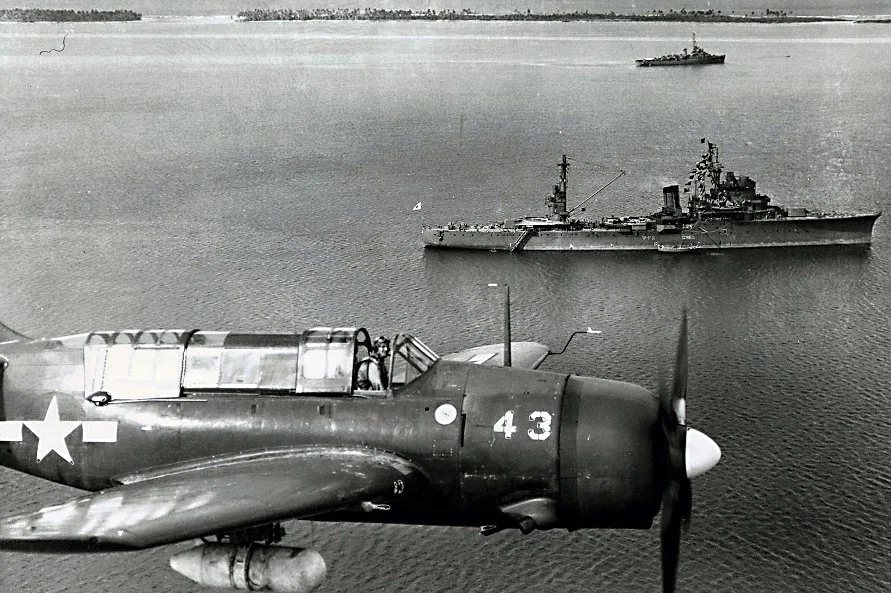
- Photograph Curtiss SB2C Helldiver flies over Jaluit atoll, in October 1945 (NNAM.1996.253.538) Unknown author — U.S. Navy National Naval Aviation Museum photo NNAM.1996.253.538 — Public domain — Wikimedia Commons
- Photograph USS Thornhill (DE-195) at anchor off New York City (USA), 10 July 1944 (80-G-235900) U.S. Navy — U.S. Navy photo 80-G-235900 from usndazzle.com — Public domain — Wikimedia Commons