USS Truxtun (APD-98)
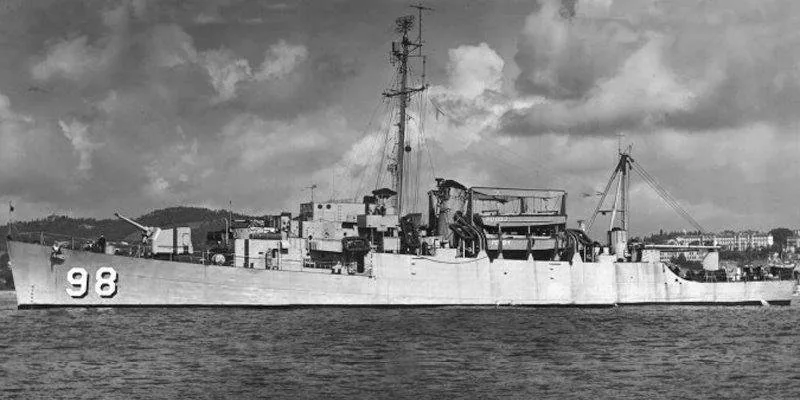
Service
- as USS Truxtun (DE-282)9 July 1945 — 15 January 196655 days of the war
- as ROCS Fu Shan (; DE-35)22 November 1965 — 1996
- Name
- USS Truxtun
- Pennant / hull number
- APD-98
- Namesake
- Thomas Truxtun
- Builder
- Charleston Navy Yard
- Laid down
- 13 December 1943
- Launched
- 9 March 1944
- Commissioned
- 9 July 1945
- Decommissioned
- 15 March 1946
- Struck
- 15 January 1966
- Fate
- Scrapped, in the late 1990s
- Status
- Scrapped
Specifications
- Displacement, standard
- 2,130 long tons (2,164 t)
- Length
- 93.27 m (306 ft)
- Beam
- 11.28 m (37 ft)
- Draught
- 3.66 m (12 ft)
- Speed
- 23 knots (42.6 km/h, 26.5 mph)
- Complement
- 204
- Main gun
- 127 mm (5 in)
Thomas Truxtun was born on 17 February 1755 near Hempstead, Long Island, New York. When his father died in 1765, young Truxtun came under the guardianship of John Troup of Jamaica, Long Island. Two years later, at the age of 12, he embarked upon a seafaring career, sailing with Captains Joseph Holmes and James Chambers in the London trade. At 16, he was pressed into service in the Royal Navy on board HMS Prudent. Truxtun's British commanding officer observed the lad's natural abilities and offered him aid in securing a midshipman's warrant. However, Truxtum declined, obtained his release through the good offices of influential friends, and returned to mercantile service. By the age of 20, he had risen to command of Andrew Caldwell in which he brought large quantities of gunpowder into Philadelphia in 1775. Later that year, his ship was seized by HMS Argo off St. Kitts in the West Indies, an act that caused some natural resentment in the young sea captain.
By the time Truxtun made his way back to Philadelphia, the colonies had reached the point of open rupture with the mother country. He signed on as a lieutenant in Congress, the first privateer to be fitted out for service against Great Britain. During the remainder of 1776, Truxtun participated in the capture of several prizes off the coast of Cuba. In 1777, he fitted out Continental Navy sloop Independence and sailed her to the Azores where he took three prizes. Upon his return, Truxtun fitted out Mars and made a highly successful cruise in the English Channel. Successively, he commanded Independence once more and then, in turn, Commerce and St. James.
In addition to privateering, Truxtun's ships also carried cargoes of military stores to the colonies. On one voyage in St. James, he landed a valuable cargo of gunpowder and military stores at Philadelphia. At a dinner to celebrate the feat, George Washington declared that Truxton's services had been worth those of a regiment. On another occasion, St. James, still under his command, carried Thomas Barclay, the American consul, to France.
Continue to the full service history About 962 words
From the Dictionary of American Naval Fighting Ships, compiled by the Naval History and Heritage Command (Truxtun IV (APD-98)). A work of the United States Government, in the public domain.
Armament and machinery
Armament and machinery
- Armament
- 1 × 5 in gun
- 6 × 40 mm guns
- 6 × 20 mm guns
- 2 × depth charge tracks
Sister ships
Sources
- Facts harvested from USS Truxtun (APD-98) on Wikipedia. Figures only — no wording is taken from it.
- Service history reproduced verbatim from Truxtun IV (APD-98) , Dictionary of American Naval Fighting Ships — public domain, a work of the United States Government.
- Photograph: U.S. Navy — U.S. Navy photo [1] from Navsource.org — Public domain — Wikimedia Commons