United States Navy — Destroyer
USS Vogelgesang (DD-862) — service history
This is the full service history. For the vessel's particulars, photograph and specifications, see the entry.
In the words of the US Navy. The account below is reproduced verbatim from the Dictionary of American Naval Fighting Ships, compiled by the Naval History and Heritage Command — a work of the United States Government, in the public domain, and the only text on this site not written here.
Before commissioning
Carl Theodore Vogelgesang , born on 11 January 1869 at North Branch, Calif., was appointed a naval cadet (the name at that time applied to young men studying at the Naval Academy) on 6 September 1886. On 6 June 1890, he graduated from the Academy and began active duty on board Alliance as a passed naval cadet. At the completion of his requisite two years of sea duty before final graduation, he was commissioned an ensign on 14 July 1892 to date from 1 July 1892. Successive tours of duty on board Adams and Mohican occupied his time until 1895 when he was ordered to Washington, D.C., for duty in the Bureau of Navigation. Detached from that post on 29 August 1896, Ens. Vogelgesang reported to the gunboat Bancroft on 3 September. That ship remained his home through the Spanish-American War . Vogelgesang served in her during convoy escort missions and on blockade duty off Havana and near the Isle of Pines. Tours of duty in Celtic and at the New York Navy Yard in conjunction with the fitting out of Kentucky (Battleship No. 6) and Wisconsin (Battleship No. 9) followed. On 6 June 1904, he returned to the Bureau of Navigation for a two-year tour of duty as navigator on board Louisiana (Battleship No. 19), during which he attained the rank of lieutenant commander on 1 July 1905. A fifteen-month assignment from June 1906 to September 1907 was followed by his first command, Mayflower.
That tour of duty ended in March 1908 when he transferred to Wisconsin as navigator. In May 1909, Lt. Comdr. Vogelgesang reported for duty ashore once more, this time to study at the Naval War College at Newport, R.I. On 2 May 1911, near the end of his assignment at the war college, Vogelgesang was promoted to full commander. On 2 May 1912, he transferred to Wyoming (Battleship No. 32) to fit her out. When she was commissioned, he assumed duty as her executive officer. In late January 1914, Cpmdr. Vogelgesang was ordered to Des Moines (Cruiser No. 15) which he commanded until 23 October. On 21 November 1914, he reported for duty at the Naval War College and remained there until the beginning of 1917, when he became Chief of Staff to the Commander in Chief, Asiatic Fleet. Just after assuming the duties of that office, he received his promotion to captain, to date from 29 August 1916. In January 1918, Capt. Vogelgesang relinquished his position as Chief of Staff to the Commander in Chief Asiastic Fleet, and reported to Rio de Janeiro, Brazil, as senior officer of the American naval commission.
On 9 January 1919, Capt. Vogelgesang took charge of the fitting out of Idaho (Battleship No. 42) at Camden, N.J., and assumed command of her when that battleship was placed in commission on 24 March 1919. He commanded Idaho until June 1920 when he became the Chief of Staff to the Commander in Chief, Atlantic Fleet. A year later, Capt. Vogelgesang became Commandant, 3d Naval District, at New York. That tour of duty lasted until November 1922 when he received orders to organize and lead the United States Naval Mission to Brazil. For the next two years, he and his staff joined their Brazilian counterparts in reorganizing the Brazilian Navy. During his two years in Brazil, he helped to strengthen the warm and enduring friendship between that nation and the United States. Early in that assignment, he was promoted to rear admiral, to date from 16 October 1922. Rear Admiral Vogelgesang completed his mission in South America in January 1925 and returned to the United States on 7 February. On 3 April, he broke his flag in New York (BB-34) and became Commander, Battleship Division 2 of the Scouting Fleet. In June 1926, he was detached from command of Battleship Division 2 and took command of the Light Cruiser Division, Scouting Fleet. That tour of duty was abbreviated when Rear Admiral Vogelgesang entered the Naval Hospital, Washington, D.C., for treatment of a kidney ailment. He died there on 16 February 1927.
Second World War 1939–1945
1944
Vogelgesang (DE-284), a Rudderow- class destroyer escort, was laid down by the Charleston Navy Yard sometime in 1943. However, before she was launched, her contract was cancelled on 10 June 1944.
Vogelgesang (DD-862), was laid down on 3 August 1944 at Staten Island, N.Y., by the Bethlehem Steel Co.; launched on 15 January 1945; sponsored by Miss Senaide Vogelgesang; and commissioned on 28 April 1945 at the New York Navy Yard, Comdr. O. W. Spahr in command.
Post-war 1946–1949
1947
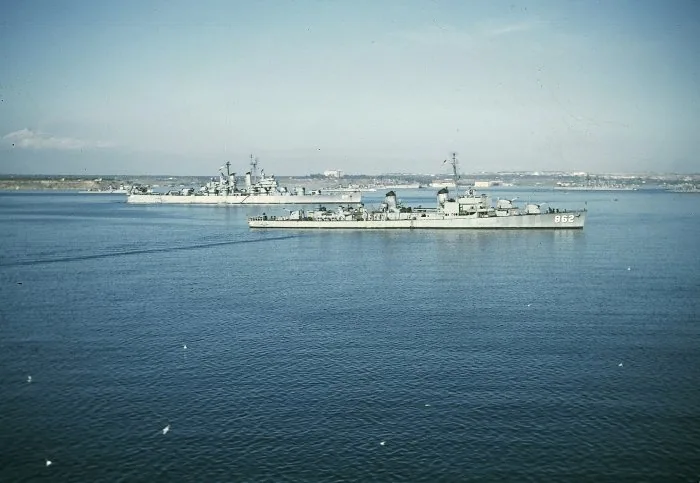
Vogelgesang conducted shakedown training out of Guantanamo Bay, Cuba, from mid-May to late June and returned to New York on the 24th for post-shakedown availability. In July, she moved to Newport, R.I., for gunnery exercises and, in August, began duty at Norfolk as a training platform for destroyer nucleus crews. In October, she interrupted her training schedule to take part in the Navy Day festivities at New York but resumed those duties in November. For the next two years, the destroyer operated out of Norfolk, along the east coast, and in the West Indies, conducting exercises both independently and in company with other units of the Atlantic Fleet. On 10 November 1947, she stood out of Norfolk on her first deployment to the Mediterranean Sea. She arrived at Gibraltar on 20 November and, after a little more than three months of exercises and port visits, departed the "middle sea" on 2 March 1948.
1949

The warship arrived back in Norfolk on 11 March and resumed a normal schedule of 2d Fleet operations. She ranged up and down the east coast until 4 January 1949 at which time she headed back to the Mediterranean. Vogelgesang completed her second deployment to the 6th Fleet on 14 May, departed Gibraltar that day, reentered Norfolk on the 23d, and commenced a two-month upkeep period.
Over the next eight years, Vogelgesang alternated five deployments to the Mediterranean with tours of duty along the east coast and in the West Indies. In addition, she also visited northern European ports during the summer of 1956 while on a midshipman training cruise. Her five Mediterranean tours consisted of normal training operations with units of the 6th Fleet and with elements of Allied navies as well as port visits at various points throughout the Mediterranean. In 1957, there came a change in Vogelgesang's routine of the previous eight years. She deployed to the Mediterranean once more in July; but, on this deployment, she added something new to her schedule. That new item was service in the Indian Ocean, for she added Aden and Massawa in Eritrea to her list of ports of call. In December, when she returned to the Mediterranean for another deployment with the 6th Fleet, she again transited the Suez Canal, repeated her former visits to middle eastern ports, and added Bahrein Island and Abadan, Iran, to her itinerary.
During the following nine years, Vogelgesang continue her schedule of alternating Mediterranean cruises and 2d Fleet operations. However, some special assignments highlighted her service. In 1961 and 1962, she provided support for the Project "Mercury" space shot.
Cold War 1954–1963
1962
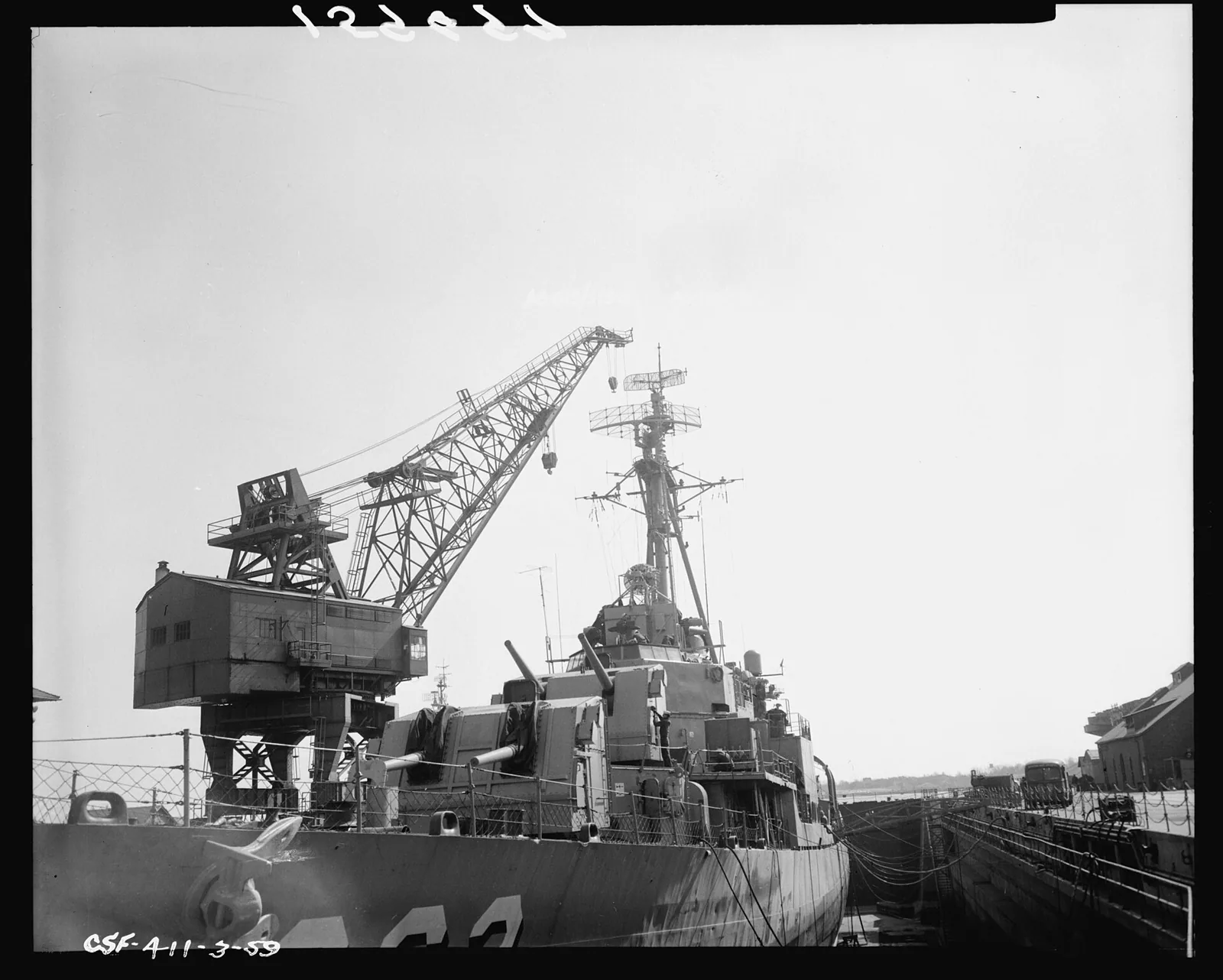
On 1 March 1962, she entered the Boston Naval Shipyard to begin a fleet rehabilitation and modernization (FRAM) overhaul. For the next 10 months, she underwent extensive structural changes as well as equipment installation to improve greatly her antisubmarine warfare capabilities. She completed her FRAM conversion on 31 January 1963 and resumed normal operations put of Norfolk. In 1964, she participated in two binational exercises with Canadian ships, CANUS SILEX in March and CANUS SLAMEX in September.
In October and November, she returned to European waters to participate in a large amphibious exercise, Operation "Steel Pike I," carried out on the Atlantic coast of Spain. In January of 1965, the warship served as part of the Project "Gemini" recovery force which picked up an unmanned experimental Gemini space capsule. In June, she deployed to the Mediterranean once again for a two-month tour of duty with the 6th Fleet. Vogelgesang resumed 2d Fleet operations early in September following another joint United States-Canadian exercise in August on her way back from Europe. On 3 December, she began her first regular overhaul since her FRAM conversion when she entered the Norfolk Naval Shipyard.
Vietnam War period 1964–1975
1966
Vogelgesang completed overhaul and sea trials on 22 March 1966 and resumed normal duty with the Atlantic Fleet. That assignment lasted until 1 June at which time she and the other ships of Destroyer Squadron (DesRon) 32 steamed out of Norfolk for a deployment to the western Pacific. Steaming by way of the Panama Canal, Pearl Harbor, and Guam, she and her colleagues reported for duty with the 7th Fleet at Subic Bay in the Philippines on 15 July. On the 19th, she headed for the Gulf of Tonkin in the screen of Constellation (CVA-64). The task group arrived in the gulf on 28 July, and Vogelgesang provided antisubmarine defense and plane guard services as the carrier's air group struck at targets in North Vietnam. On 15 August, the destroyer closed the shores of South Vietnam to provide gunfire support for troops operating ashore. On the night of 18 and 19 August, her 5-inch guns succeeded in breaking up a company-strength Viet Cong attack on a Popular Forces outpost near Dien Huong. Reports credited her main battery with killing 70 and wounding 40 of the attacking guerrillas. In addition to service in Vietnamese waters, the warship made visits to Hong Kong and Kaohsiung on Taiwan as well as periodic stops at Subic Bay for upkeep and replenishments. Vogelgesang concluded her only combat cruise during the Vietnam conflict on 10 November when she stood out of Subic Bay, bound, via the Indian Ocean, the Suez Canal, and the Mediterranean Sea, for Norfolk. She completed her round-the-world cruise at her home port on 17 December.
1967
After post-deployment standdown, Vogelgesang resumed her schedule alternating Mediterranean cruises with operations out of Norfolk. She spent the first 10 months of 1967 engaged in training operations along the east coast and in the West Indies. On 14 November 1967, the warship stood out of Norfolk for her first tour of duty with the 6th Fleet since 1965. On 24 November, she conducted turnover ceremonies at the Spanish island of Majorca and officially joined the 6th Fleet. For the next five months, the destroyer ranged the length and breadth of the Mediterranean, conducting training evolutions and making port visits. On 13 April 1968, she departed Malaga, Spain, to return to Norfolk.
After a 10-day transit, she reentered her home port on the 23d. She resumed normal 2d Fleet operations until 22 July at which time she departed Norfolk for a cruise to South American waters to participate in UNITAS IX, a series of multinational exercises with units of various Latin American navies. She concluded that assignment on 3 September when she reentered Norfolk.
1969
Normal operations and a series of tender availabilities in preparation for overhaul occupied her time from September of 1968 to June of 1969. On 2 June 1969, she departed Norfolk, en route to Boston. The warship entered the Boston Naval Shipyard and commenced regular overhaul on 5 June. She concluded sea trials successfully late in September and departed Boston on 3 October and arrived in Norfolk on the 5th. For the remainder of the year, the ship conducted post-repair exercises and refresher training in the Guantanamo Bay operating area. She returned to Norfolk on 14 December and remained in port for the rest of the year.
1970
Normal operations out of Norfolk occupied her until 30 April 1970 at which time she embarked upon another Mediterranean tour of duty. She changed operational control to the 6th Fleet on 10 May and conducted turnover at Majorca between the 12th and the 17th. For the first four months of the deployment, Vogelgesang conducted normal 6th Fleet operations: port visits and training evolutions. However, early in September, she joined a special contingency force assembled in the eastern Mediterranean in response to Syrian intervention in the Jordanian civil war on the side of militant, antigovernment, Arab guerrillas. She cruised that portion of the sea from 5 September to 6 October. Finally, however, the American show of force succeeded in getting the Syrian forces to withdraw from Jordan, and Vogelgesang resumed normal operations with the 6th Fleet. On 8 November, she departed Palma de Majorca to return home.
The warship reentered Norfolk on 17 November and remained there through the end of the year. The destroyer resumed normal 2d Fleet operations early in 1971 and remained so occupied for the next 11 months.
1971
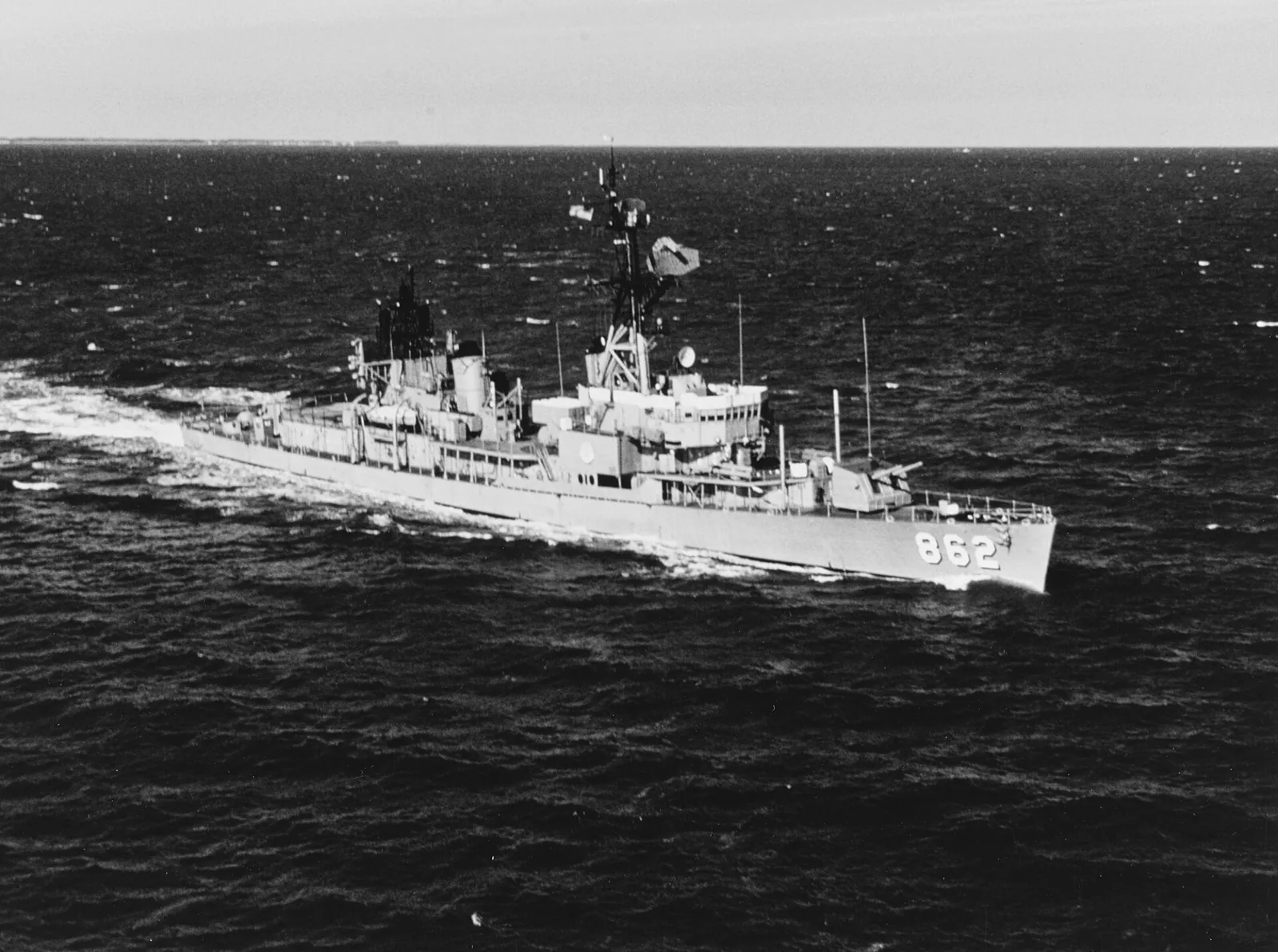
On 1 December 1971, she departed Norfolk for another tour of duty with the 6th Fleet in the Mediterranean. She arrived in port at Rota, Spain, on the 9th and conducted turnover ceremonies. For the following six months, Vogelgesang operated throughout the Mediterranean, engaged in the usual round of exercises and port visits. After turnover in Rota, the destroyer got underway on 23 June to return to Norfolk.
1973
On the 29th, she steamed into Hampton Roads and soon began a tender availability alongside Sierra (AD-18). She conducted operations out of Norfolk until 10 October at which time she began an extended repair period at the Norfolk Shipbuilding & Drydock Corp. The warship completed repairs on 26 January 1973 and finished sea trials by early February. She conducted normal operations for the remainder of the year, steaming as far south as the West Indies.
1974
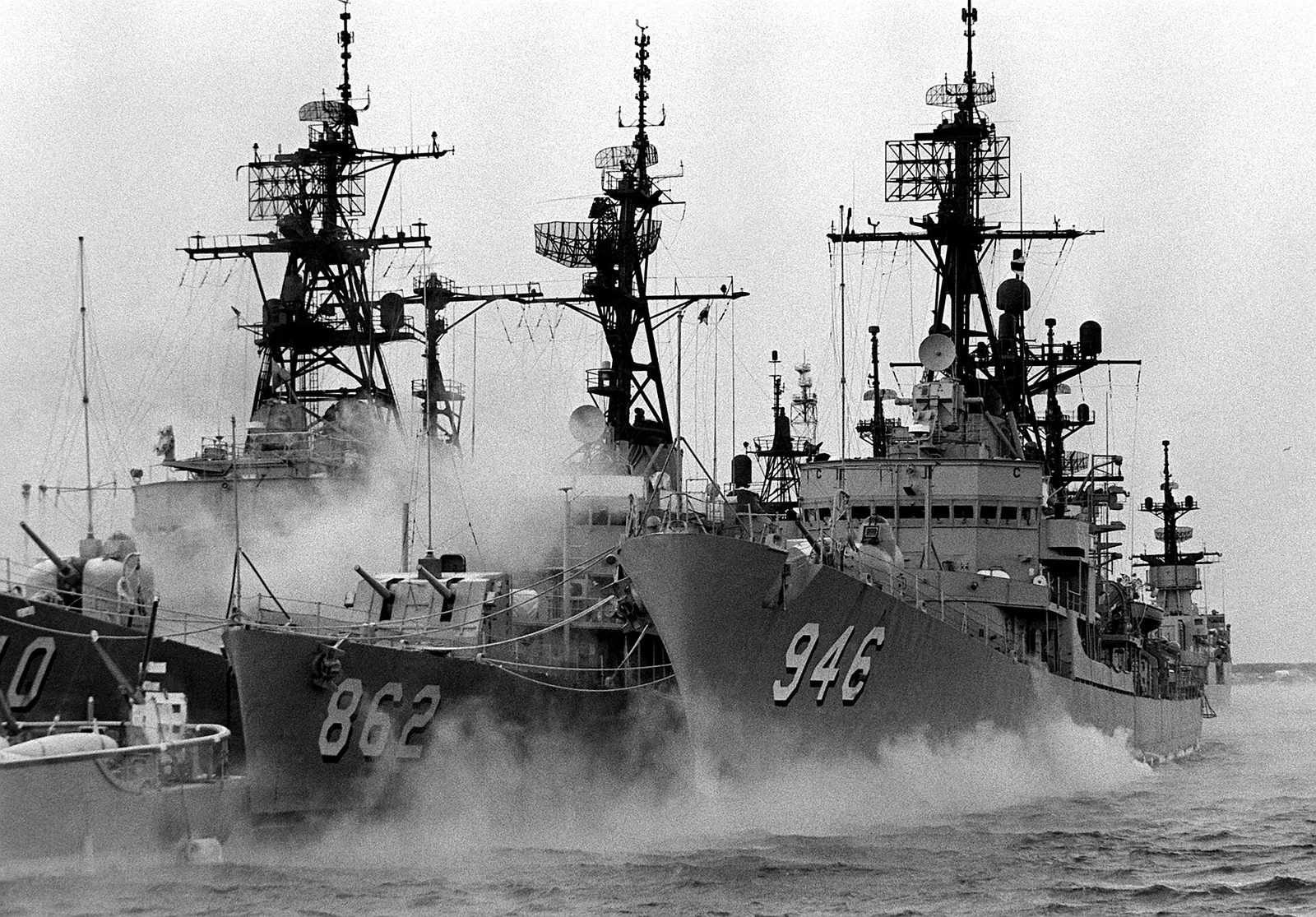
On 10 January 1974, Vogelgesang was transferred from DesRon 2 to DesRon 28 and reassigned to Naval Reserve training duty. On 1 March, her home port was changed from Norfolk to Newport, R.I. On 19 March, she headed out of Norfolk, bound for her new home port, where she arrived the following day. Since that time, Vogelgesang has operated at and out of Newport as a training platform for naval reservists, NROTC midshipmen, and OCS students. She alternated short periods at sea with weeks in port as a stationary training platform. Periodically, however, she has made extended training cruises down the east coast to the West Indies. As of the beginning of 1980, the destroyer continued to serve with the Naval Reserve training program, based at Newport, R.I.
Other photographs
Held for this vessel, and not tied to any part of the account above.




References
Every work this entry draws on. There are no numbered markers in the text above: what we hold is the provenance of the page — this history, this article, these photographs.
- History Vogelgesang (DD-862) Dictionary of American Naval Fighting Ships, Naval History and Heritage Command. A work of the United States Government, in the public domain — the only text on this site reproduced verbatim.
- Facts USS Vogelgesang (DD-862) Structured facts only — dates, dimensions, armament and fate. No wording is taken from it. Harvested 1 August 2026.
- Photograph USS Vogelgesang (DD-862) underway at sea in July 1954 U.S. Navy — Official U.S. Navy photo NH 107104 from the U.S. Navy Naval History and Heritage Command — Public domain — Wikimedia Commons
- Photograph USS Vogelgesang (DD-862) off New York on 27 April 1945 U.S. Navy — Official U.S. Navy Bureau of Ships photo 19-N-83314 available at Destroyerhistory.org — Public domain — Wikimedia Commons
- Photograph USS Vogelgesang (DD-862) underway in heavy seas, circa in the 1970s The original uploader was -ts- at English Wikipedia .; 2005-04-23 (original upload date) — U.S. Navy photo [1] from Navsource.org ; Originally from en.wikipedia ; description page is/was here — Public domain — Wikimedia Commons
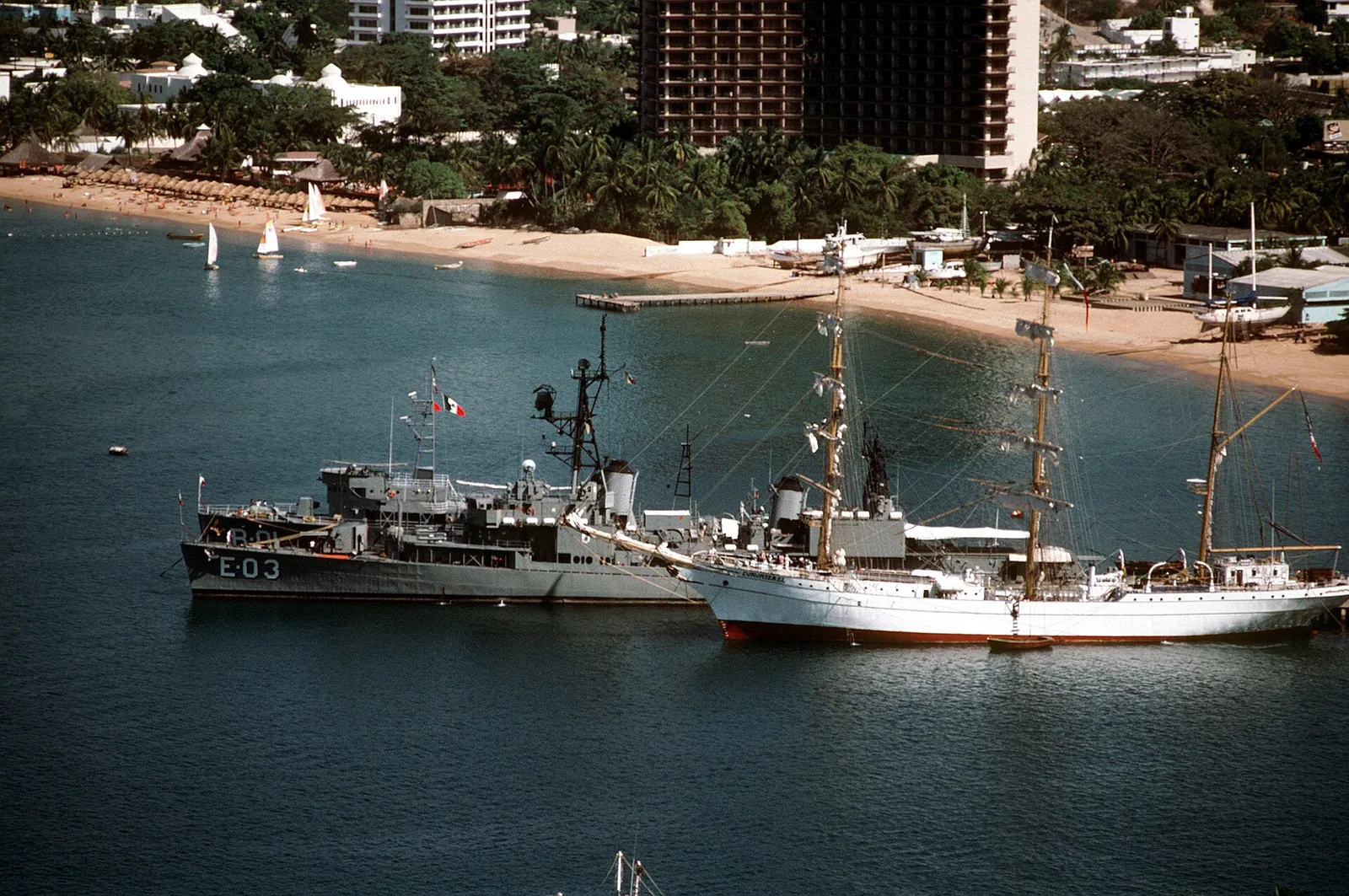
- Photograph Mexican Navy ships at Acapulco in 1995 Don S. Montgomery, USN (Ret.) — Public domain — Wikimedia Commons
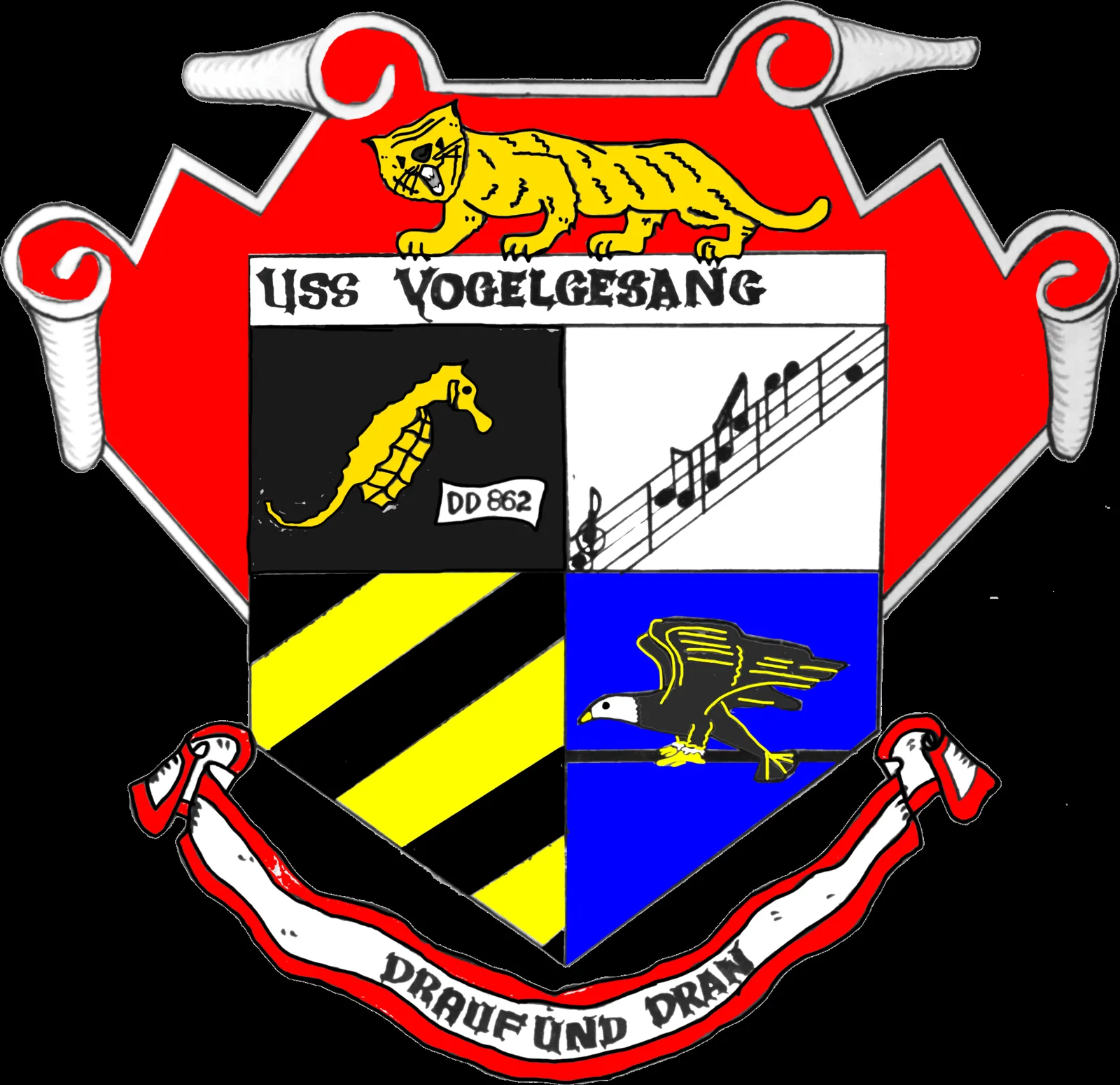
- Photograph Crest of USS Vogelgesang (DD-862) in 1961 Unknown author — U.S. Navy photo NH 65409-KN ; post-work Cobatfor — Public domain — Wikimedia Commons
- Photograph DD-862 Vogelgesang - DPLA - 7454b04e4b34ea17fe8dce92d6ae3559 Department of Defense. Department of the Navy. Bureau of Ships. 9/18/1947-5/1/1966 — This file was contributed to Wikimedia Commons by National Archives and Records Administration as part of a cooperation project. The donation was facilitated by the Digital Public Library of America , via its partner Digital Public Library of America . Record in source catalog DPLA identifier: 7454b04e4b34ea17fe8dce92d6ae3559 National Archives Identifier: 24745003 — Public domain — Wikimedia Commons
- Photograph USS Manley (DD-940), USS Vogelgesang (DD-862) and USS Edson (DD-946) at Naval Station Newport, Rhode Island (USA), circa in 1982 (6350856) U.S. Navy — Public domain — Wikimedia Commons
- Photograph USS Vogelgesang (DD-862) anchored at Augusta Bay, Sicily, circa in 1947 Charles J. Beggy, Jr., Electronics Technician Second Class, USN (ret.) — USS Midway website [1] — Public domain — Wikimedia Commons
- Photograph USS Vogelgesang (DD-862) and USS Steinaker (DD-863) before transfer to the Mexican Navy in November 1982 Clark, USN — Public domain — Wikimedia Commons
- Photograph USS Vogelgesang (DD-862) in 1949 U.S. Navy — U.S. Navy All Hands magazine October 1949 , p. 1 — Public domain — Wikimedia Commons
- Photograph USS Vogelgesang (DD-862) underway c1977 USN — U.S. Navy photo [1] from Navsource.org — Public domain — Wikimedia Commons
- Photograph USS Vogelgesang (DD-862) underway on 1 December 1971 U.S. Navy — Official U.S. Navy photo K-92093 from the U.S. Navy Naval History and Heritage Command — Public domain — Wikimedia Commons
- Photograph USS VOGELGESANG - War History - DPLA - 3e8a4dba8afb9e20fb4cc13699802338 Department of the Navy. Office of the Chief of Naval Operations. Intelligence Division. Office of Naval Records and Library. (1922 - 10/10/1945) — This file was contributed to Wikimedia Commons by National Archives and Records Administration as part of a cooperation project. The donation was facilitated by the Digital Public Library of America , via its partner Digital Public Library of America . Record in source catalog DPLA identifier: 3e8a4dba8afb9e20fb4cc13699802338 National Archives Identifier: 77693964 — Public domain — Wikimedia Commons
- Photograph USS Vogelgesang(DD-862) underway c1963 USN — U.S. Navy photo [1] from Navsource.org — Public domain — Wikimedia Commons