USS Baltimore (CA-68)
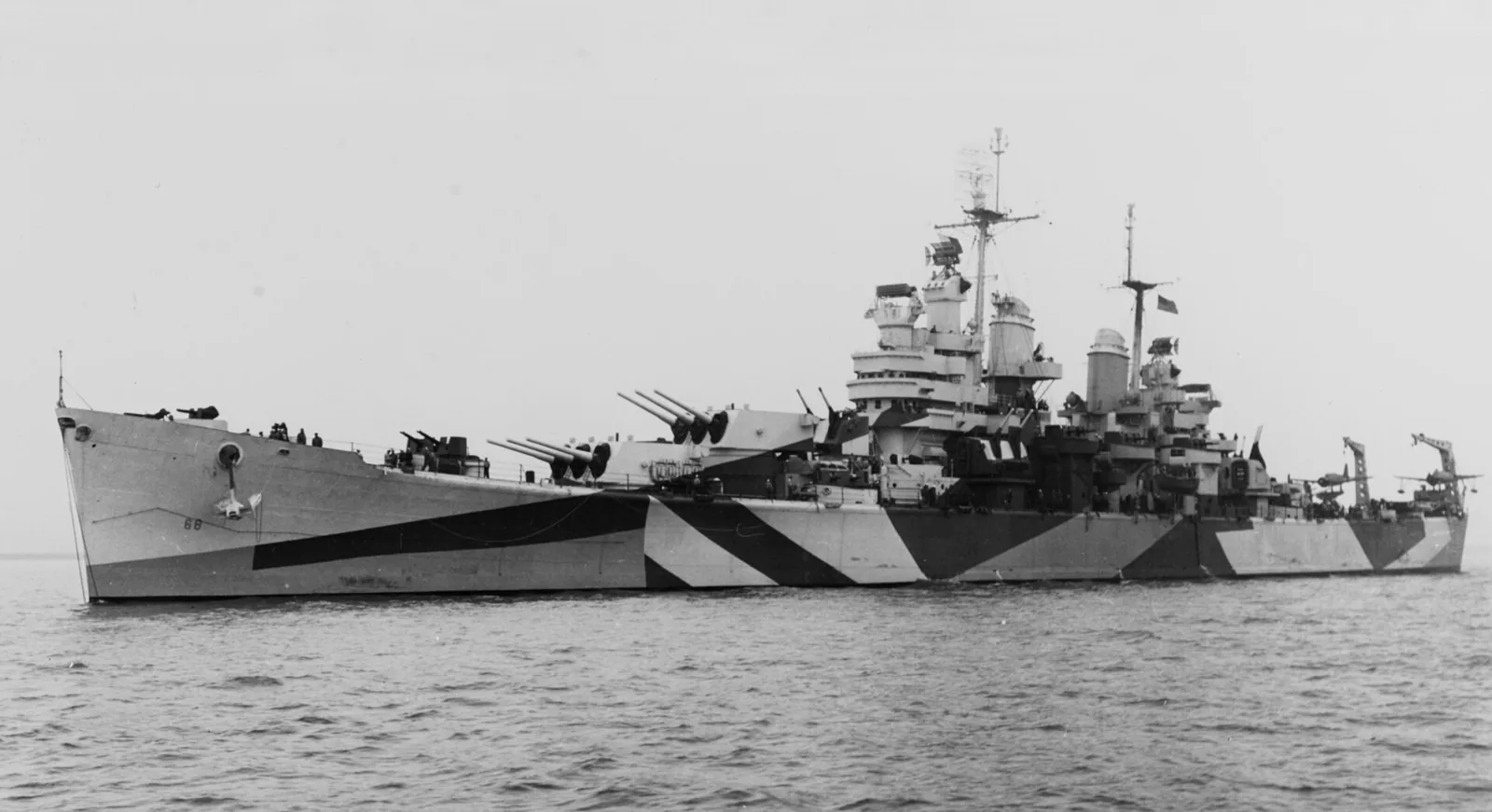
Service
- as Baltimore15 April 1943 — 31 May 1956871 days of the war
- Name
- USS Baltimore
- Pennant / hull number
- CA-68
- Namesake
- City of Baltimore, Maryland
- Builder
- Bethlehem Shipbuilding Corporation's Fore River Shipyard, Quincy, Massachusetts
- Laid down
- 26 May 1941
- Launched
- 28 July 1942
- Commissioned
- 15 April 1943
- Decommissioned
- 8 July 1946
- Recommissioned
- 28 November 1951
- Struck
- 15 February 1971
- Fate
- Sold 10 April 1972
Scrapped September 1972 (1972) - Status
- Scrapped
Specifications
- Displacement, standard
- 14,472 long tons (14,704 t)
- Displacement, full load
- 17,031 long tons (17,304 t)
- Length
- 205.13 m (673 ft) OA
- Beam
- 21.34 m (70 ft)
- Draught
- 6.1 m (20 ft)
- Speed
- 33 knots (61.1 km/h, 38 mph)
- Range
- 10,000 nmi (18,520 km)
- Complement
- 1,142
- Main gun
- 203 mm (8 in)
The fifth Baltimore (CA-68) the leader of a new class of post-Treaty heavy cruisers was laid down on 26 May 1941 at Quincy, Mass., by the Fore River plant of the Bethlehem Steel Corp.; launched on 28 July 1942; sponsored by Mrs. Howard W. Jackson, wife of the Mayor of Baltimore; and commissioned at the South Boston Annex of the Boston Navy Yard on 15 April 1943, Capt. William C. Calhoun in command.
After fitting out, Baltimore sailed for Hampton Roads on 17 June 1943 and proceeded up the Chesapeake to Annapolis. She reached that port on the 20th for a brief visit to the U.S. Naval Academy before returning to the Virginia capes area two days later for exercises. Following brief upkeep at Norfolk from 24 June to 1 July, the new cruiser cleared Hampton Roads on the latter day and headed toward Trinidad, in the British West Indies, for shakedown. She went through her paces intensive training in gunnery out of Port of Spain, Trinidad. Following her return to Hampton Roads on 24 July, she got underway again on the 28th and arrived at Boston that same day for post shakedown availability and repairs to her leaking main battery hydraulic piping. After this work was completed early in September, she proceeded to Norfolk.
On 21 September 1943, the ship sailed for the west coast in company with the destroyer Sigourney (DD-643). Transiting the Panama Canal on the 25th, the two combatants reached San Diego on 4 October. Baltimore then carried out further gunnery exercises and training off the west coast between 9 and 13 October. After standing out of San Diego Bay on the 16th of that month, she tarried briefly at San Francisco before proceeding independently to Pearl Harbor, Territory of Hawaii, where she arrived on the 29th.
Continue to the full service history About 3,300 words
From the Dictionary of American Naval Fighting Ships, compiled by the Naval History and Heritage Command (Baltimore V (CA-68)). A work of the United States Government, in the public domain.
Armament and machinery
Armament and machinery
- Propulsion
- 4 × General Electric geared turbines
- 4 × screws
- Power
- 4 × 615 psi Steam boilers
- 120000 shp
- Armament
- 3 × triple 8"(203mm)/55 caliber guns
- 6 × dual 5"(127mm)/38 caliber anti-aircraft guns
- 12 × quad 40 mm Bofors anti-aircraft guns
- 24 × single 20 mm Oerlikon anti-aircraft cannons
- Armour
- Belt: 4 - 6 in
- Deck: 2.5 in
- Barbettes: 6 - 6.3 in
- Turrets: 1.5 - 8 in
- Aircraft
- 4 × floatplanes
Sister ships
Sources
- Facts harvested from USS Baltimore (CA-68) on Wikipedia. Figures only — no wording is taken from it.
- Service history reproduced verbatim from Baltimore V (CA-68) , Dictionary of American Naval Fighting Ships — public domain, a work of the United States Government.
- Photograph: Unknown author — U.S. Navy photo NH 91462 — Public domain — Wikimedia Commons