USS Presley
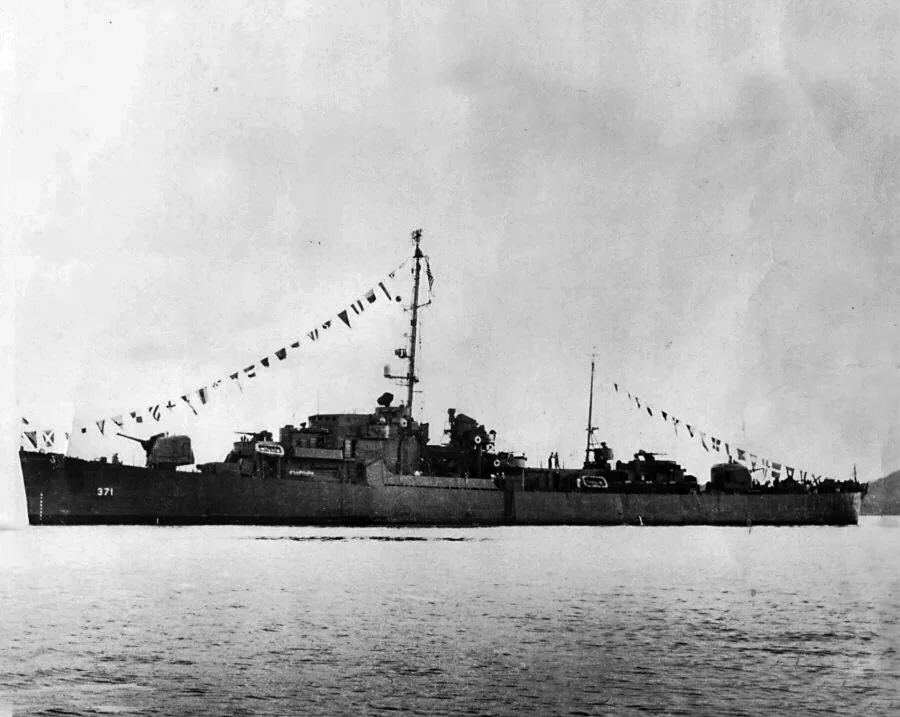
Service
- as Presley7 November 1944 — 20 June 1946299 days of the war
- Name
- USS Presley
- Pennant / hull number
- DE-371
- Namesake
- Sam Davis Presley
- Builder
- Consolidated Steel Corporation, Orange, Texas
- Laid down
- 6 June 1944
- Launched
- 19 August 1944
- Commissioned
- 7 November 1944
- Decommissioned
- 20 June 1946
- Struck
- 30 June 1968
- Fate
- Sold for scrapping 2 April 1970 (1970)
- Status
- Scrapped
Specifications
- Displacement, standard
- 1,350 long tons (1,372 t)
- Length
- 93.27 m (306 ft)
- Beam
- 10.97 m (36 ft)
- Draught
- 2.74 m (9 ft)
- Speed
- 24 knots (44.4 km/h, 27.6 mph)
- Range
- 6,000 nmi (11,112 km)
- Complement
- 215
- Main gun
- 127 mm (5 in)
Sam Davis Presley, born at Carthage, Miss., 17 December 1918, enlisted in the Navy 7 November 1939. On 30 September 1942 he became Aviation Machinist's Mate first class. He received the Navy Cross for extraordinary heroism during the Battle of the Santa Cruz Islands, 26 October 1942. As his ship Enterprise, came under sustained enemy air attack, Aviation Machinist's Mate First Class Presley voluntarily abandoned the shelter of his normal battle station. Climbing into a plane parked on the flight deck, he manned the flexible guns in the rear cockpit and commenced an effective fire against the attacking aircraft. As the battle continued, a bomb explosion blew the plane overboard. AMI Presley was listed as "missing in action," and presumed dead 27 October 1943.
Presley (DE-371) was laid down by the Consolidated Steel Corp., Ltd., Orange, Tex., 6 June 1944; launched 19 August 1944; sponsored by Mrs. Willie Lynn Presley; and commissioned 7 November 1944, Lt. Comdr. Richard S. Paret, USNR, in command.
After shakedown off Bermuda, Presley transited the Panama Canal 24 January 1945 and proceeded to Pearl Harbor for further training. She arrived at Noumea 22 March, and departed 3 May to escort a group of transports to Leyte Gulf. She subsequently touched at Manus, Saipan, and Ulithi before making two trips to Okinawa. The end of the war found her anchored in Ulithi Harbor.
On 19 September Presley proceeded to Guam for duty, making two trips to Truk where she served as harbor patrol and station ship pending the occupation of that enemy post by U.S. forces. On 5 November the ship was ordered to the United States to be placed in an inactive status. Presley decommissioned 20 June 1946, and joined the Pacific Reserve Fleet berthed at San Diego. She was struck from the Naval Vessel Register 30 June 1968.
From the Dictionary of American Naval Fighting Ships, compiled by the Naval History and Heritage Command (Presley (DE-371)). A work of the United States Government, in the public domain.
Armament and machinery
Armament and machinery
- Propulsion
- 2 boilers, 2 geared turbine engines, 12000 shp; 2 propellers
- Armament
- 2 × single 5 in (127 mm) guns
- 2 × twin 40 mm (1.6 in) AA guns
- 10 × single 20 mm (0.79 in) AA guns
- 1 × triple 21 in (533 mm) torpedo tubes
- 8 × depth charge throwers
- 1 × Hedgehog ASW mortar
- 2 × depth charge racks
Sister ships
- USS Abercrombie
- USS Albert T. Harris
- USS Bivin
- USS Cecil J. Doyle
- USS Charles E. Brannon
- USS Chester T. O’Brien
- USS Conklin
- USS Corbesier (DE-438)
- USS Cross
- USS Dennis
- USS Douglas A. Munro
- USS Doyle C. Barnes
- USS Dufilho
- USS Edmonds
- USS Edward H. Allen
- USS Edwin A. Howard
- USS Eversole (DE-404)
- USS Formoe
- USS French
- USS Gentry
- USS George E. Davis
- USS Gilligan
- USS Goss
- USS Grady
Sources
- Facts harvested from USS Presley on Wikipedia. Figures only — no wording is taken from it.
- Service history reproduced verbatim from Presley (DE-371) , Dictionary of American Naval Fighting Ships — public domain, a work of the United States Government.
- Photograph: U.S. Navy — U.S. Navy photo [1] from Navsource.org — Public domain — Wikimedia Commons