USS Samuel B. Roberts (DE-413)
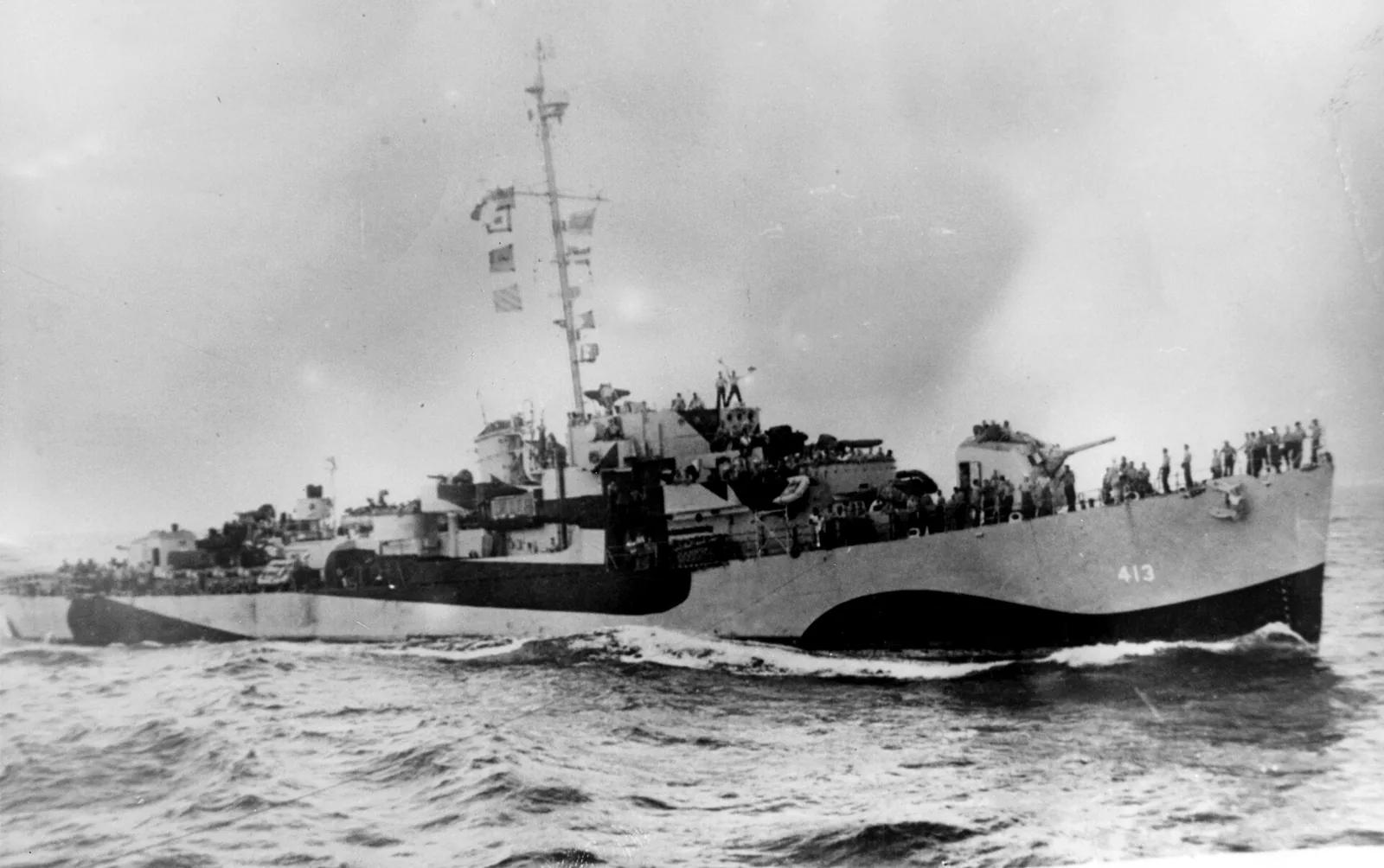
Service
- as USS Samuel B. Roberts28 April 1944 — 25 October 1944180 days of the war
- Name
- USS Samuel B. Roberts
- Pennant / hull number
- DE-413
- Namesake
- Samuel Booker Roberts Jr.
- Builder
- Brown Shipbuilding, Houston, Texas
- Laid down
- 6 December 1943
- Launched
- 20 January 1944
- Commissioned
- 28 April 1944
- Fate
- Sunk during the Battle off Samar, 25 October 1944
Shipwreck found, 22 June 2022 (1944) - Status
- Wreck
Specifications
- Displacement, standard
- 1,350 long tons (1,372 t)
- Length
- 93.27 m (306 ft)
- Beam
- 10.97 m (36 ft)
- Draught
- 2.74 m (9 ft)
- Speed
- 28.7 knots (53.2 km/h, 33 mph)
- Range
- 6,000 nmi (11,112 km)
- Complement
- 215
- Main gun
- 127 mm (5 in)
Samuel Booker Roberts, Jr. -- born in San Francisco, Calif., on 12 May 1921 to Samuel B. and Ann [Wexler] Roberts -- enlisted in the U.S. Naval Reserve on 13 April 1939 at Portland, Ore., and underwent training from 19 August to 1 September 1939. Recalled to active duty as a seaman second class, Roberts reported on board the battleship California (BB-44) on 12 July 1940. After that tour of duty, he returned to Seattle, Wash., as a passenger in Maryland (BB-46) on 12 October, and was released from active duty.
Recalled on 2 December 1940, Roberts received assignment to the transport Heywood (AP-12), formerly the Panama-Pacific liner City of Baltimore , which had been acquired in late October and was undergoing conversion at Portland. Heywood , her crew composed of naval reservists – like Roberts – from Portland, and Chicago, Ill., was commissioned on 19 February 1941. Then, after conducting shakedown training off San Diego, Calif., and in Hawaiian waters, the transport embarked elements of the Sixth Marine Regiment, and departed San Diego on 31 May; she transited the Panama Canal on 5 June, en route to Charleston, S.C., which port she reached ten days later. Ultimately, Heywood sailed for Iceland, reaching Reykjavik on 7 July to disembark elements of the first U.S. Marines to be landed on Icelandic soil.
Within three months, Heywood made a second voyage to Iceland, and before the year [1941] was out, conducted three passenger-carrying trips to Bermuda, Puerto Rico, and Trinidad. During that time, Roberts advanced in rate to seaman first class on 1 September. On the day the Japanese attacked Pearl Harbor, 7 December 1941, Roberts’ ship lay at Hampton Roads; soon thereafter, the transport took part in exercises in the waters of Chesapeake Bay, and later made her third voyage to Iceland. Ultimately departing the east coast of the U.S. on 10 April 1942, Heywood set course for the Pacific. Transiting the Panama Canal on 18-19 April, she reached Pago Pago, Samoa, on 10 May. Three days later, Roberts was transferred to await the next available transportation to join his next ship. Embarking in the cargo ship Fomalhaut (AK-22) on 21 June, Roberts reached Wellington, New Zealand, on 1 July.
Continue to the full service history About 5,573 words
From the Dictionary of American Naval Fighting Ships, compiled by the Naval History and Heritage Command (Samuel B. Roberts I (DE-413)). A work of the United States Government, in the public domain.
Armament and machinery
Armament and machinery
- Propulsion
- 2 × geared steam turbines
- 2 × boilers
- 2 × shafts
- Power
- 12000 shp
- Armament
- 2 × single 5 in (127 mm) guns
- 2 × twin 40 mm (1.6 in) AA guns
- 10 × single 20 mm (0.79 in) AA guns
- 1 × triple 21 in (533 mm) torpedo tubes
- 8 × depth charge throwers
- 1 × Hedgehog ASW mortar
- 2 × depth charge racks
Sister ships
- USS Abercrombie
- USS Albert T. Harris
- USS Bivin
- USS Cecil J. Doyle
- USS Charles E. Brannon
- USS Chester T. O’Brien
- USS Conklin
- USS Corbesier (DE-438)
- USS Cross
- USS Dennis
- USS Douglas A. Munro
- USS Doyle C. Barnes
- USS Dufilho
- USS Edmonds
- USS Edward H. Allen
- USS Edwin A. Howard
- USS Eversole (DE-404)
- USS Formoe
- USS French
- USS Gentry
- USS George E. Davis
- USS Gilligan
- USS Goss
- USS Grady
Sources
- Facts harvested from USS Samuel B. Roberts (DE-413) on Wikipedia. Figures only — no wording is taken from it.
- Service history reproduced verbatim from Samuel B. Roberts I (DE-413) , Dictionary of American Naval Fighting Ships — public domain, a work of the United States Government.
- Photograph: Unknown author — U.S. Navy photo NH 96011 — Public domain — Wikimedia Commons