USS Smith (DD-378)
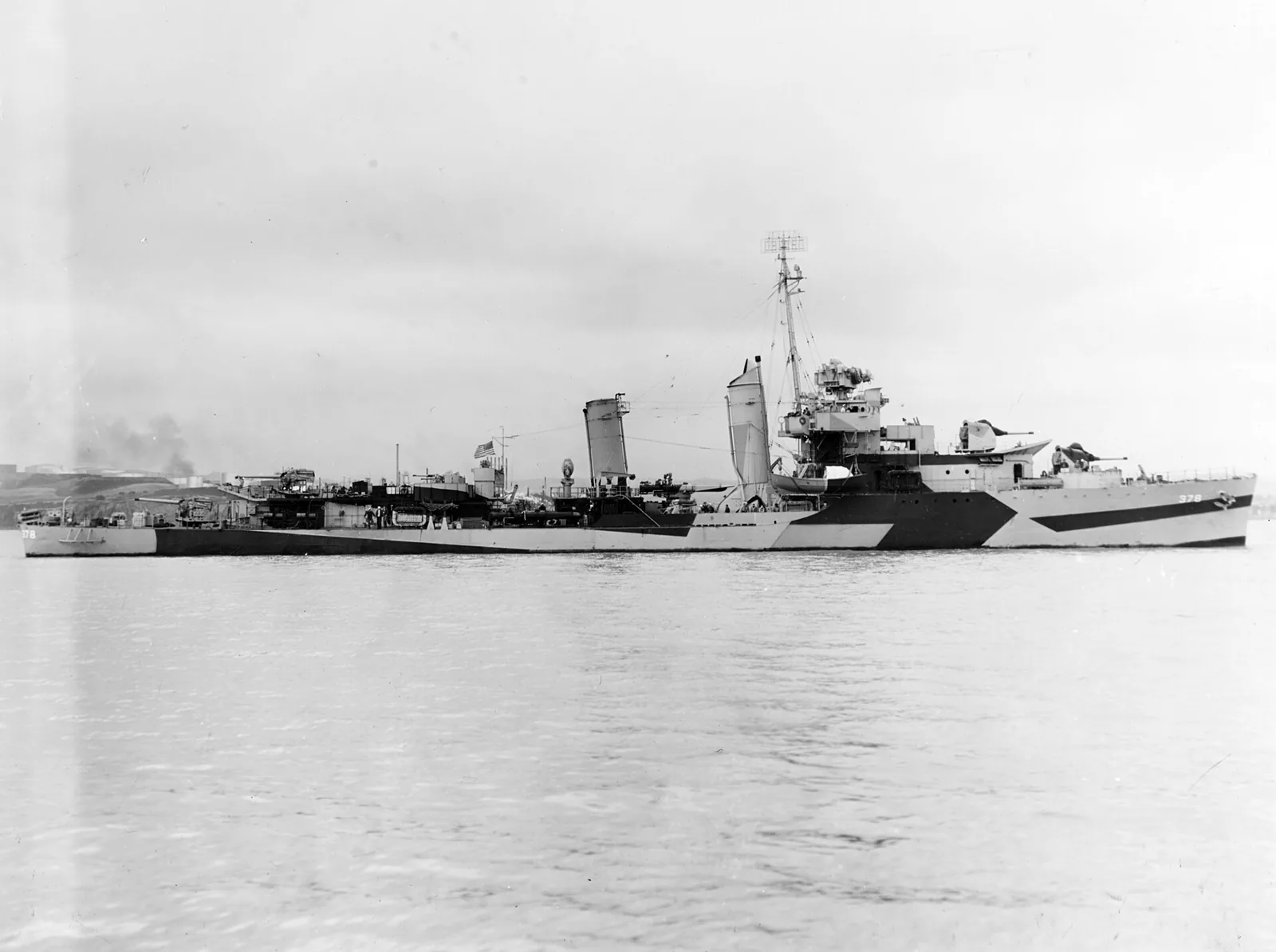
Service
- as Smith19 September 1936 — 28 June 19462,193 days of the war
- Name
- USS Smith
- Pennant / hull number
- DD-378
- Namesake
- Joseph B. Smith
- Builder
- Mare Island Naval Shipyard
- Laid down
- 27 October 1934
- Launched
- 20 February 1936
- Commissioned
- 19 September 1936
- Decommissioned
- 28 June 1946
- Struck
- 25 February 1947
- Fate
- Sold for scrapping, August 1947 (1947)
- Status
- Scrapped
Specifications
- Displacement, standard
- 1,500 long tons (1,524 t)
- Length
- 103.94 m (341 ft)
- Beam
- 10.67 m (35 ft)
- Draught
- 2.74 m (9 ft)
- Speed
- 37 knots (68.5 km/h, 42.6 mph)
- Complement
- 158
- Main gun
- 127 mm (5 in)
Joseph B. Smith was born in Belfast, Maine, in 1826 and was appointed midshipman in the United States Navy on 19 October 1841. He cruised on various stations from 1841 to 1860, when he was ordered to frigate, Congress. He was in command of Congress on 8 March 1861 when she was attacked and destroyed by the Confederate ironclad, Virginia, and lost his life in the action. When his father, Commodore Joseph Smith, heard of the surrender of Congress, he said, "Then Joe is dead," feeling that she never would have surrendered while his son lived.
The second Smith (DD-378) was laid down on 27 October 1934 by Mare Island Navy Yard, Mare Island, Calif.; launched on 20 February 1936; sponsored by Mrs. Yancey S. Williams; and commissioned on 19 September 1936, Comdr. H. L. Grosskopf in command.
At the outbreak of the war, Smith was in San Francisco attached to Destroyer Squadron (DesRon) 5 and from then until April 1942, she performed escort duty from the west coast to Pearl Harbor. On 7 April, Smith was assigned to Task Force (TF) 1, composed of Battleship Division 3, which held extensive training exercises along the west coast until it departed for Pearl Harbor on 1 June. Upon her arrival, Smith was assigned to TF 17 commanded by Vice Admiral MarcMitscher. She engaged in war patrols and training exercises for a month and then escorted a convoy back to San Francisco. After overhaul and subsequent sea trials in the Bay Area, she returned to Pearl Harbor in mid-August and began a period of training and upkeep. On 15 October, she was assigned to TF 16 composed of Enterprise (CV-6) and South Dakota (BB-57). TF 16 departed Pearl Harbor on war patrol, on 16 October, and was joined the following week by Portland (CA-33) and San Juan (CL-54) with their destroyer screen.
Continue to the full service history About 2,209 words
From the Dictionary of American Naval Fighting Ships, compiled by the Naval History and Heritage Command (Smith II (DD-378)). A work of the United States Government, in the public domain.
Armament and machinery
Armament and machinery
- Armament
- As built:
- 1 × Gun Director above bridge
- 5 × 5 in/38 cal. DP (5x1)
- 12 × 21 inch (533 mm) torpedo tubes (3x4)
- 4 × .50 cal (12.7 mm) AA machine guns (4x1)
- 2 × depth charge stern racks
- c1944:
- 1 × Mk 33 Gun Fire Control System
- 4 × 5 in (127 mm)/38 cal. DP (4x1)
- 12 × 21 in (533 mm) torpedo tubes (3x4)
- 2 × Mk 51 Gun Directors
- 4 × Bofors 40 mm AA (2x2)
- 5 × Oerlikon 20 mm AA (5x1)
- 2 × depth charge roll-off stern racks
- 4 × K-gun depth charge projectors
Sister ships
- USS Case (DD-370)
- USS Cassin (DD-372)
- USS Conyngham (DD-371)
- USS Cummings (DD-365)
- USS Cushing (DD-376)
- USS Downes (DD-375)
- USS Drayton (DD-366)
- USS Dunlap
- USS Fanning (DD-385)
- USS Flusser (DD-368)
- USS Lamson (DD-367)
- USS Mahan (DD-364)
- USS Perkins (DD-377)
- USS Preston (DD-379)
- USS Reid (DD-369)
- USS Shaw (DD-373)
- USS Tucker (DD-374)
Sources
- Facts harvested from USS Smith (DD-378) on Wikipedia. Figures only — no wording is taken from it.
- Service history reproduced verbatim from Smith II (DD-378) , Dictionary of American Naval Fighting Ships — public domain, a work of the United States Government.
- Photograph: Unknown author — U.S. Navy Bureau of Ships photo 19-N-67558 — Public domain — Wikimedia Commons