USS Williams (DE-372)
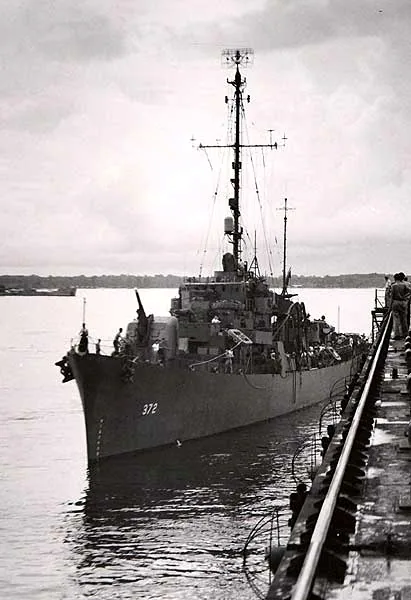
Service
- as Williams11 November 1944 — 4 June 1946295 days of the war
- Name
- USS Williams
- Pennant / hull number
- DE-372
- Namesake
- George Washington Williams
- Builder
- Consolidated Steel Corporation
- Laid down
- 5 June 1944
- Launched
- 22 August 1944
- Commissioned
- 11 November 1944
- Decommissioned
- 4 June 1946
- Struck
- 1 July 1967
- Fate
- Sunk as target off California 29 June 1968 (1968)
- Status
- Wreck
Specifications
- Displacement, standard
- 1,350 long tons (1,372 t)
- Length
- 93.27 m (306 ft)
- Beam
- 10.97 m (36 ft)
- Draught
- 2.74 m (9 ft)
- Speed
- 24 knots (44.4 km/h, 27.6 mph)
- Range
- 6,000 nmi (11,112 km)
- Complement
- 215
- Main gun
- 127 mm (5 in)
John Poster Williams, born on 12 October 1743 at Boston, Mass., was appointed a captain in the Navy of Massachusetts and received command of the brig Hazard late in 1777. In the following year, he took her to sea in a fruitless search for British West Indiamen; but he and his ship eventually achieved success in 1779. While cruising in the West Indies, Hazard fell in with the privateer brigantine Active on 16 March. At the end of a "smart action" of 35-minutes' duration, "yard arm to yard arm," Active struck her colors and became Hazard's prize, after having suffered 13 killed and 20 wounded out of her 95-man crew. Hazard sent the captured brigantine back to Massachusetts under a prize crew and subsequently returned home in April, after taking several other prizes.
In May, Hazard returned to sea, this time in company with the brig Tyrannicide. At 0830 on 15 June, the two ships fell in with two British ships and, after a short, sharp engagement, forced both enemy vessels to strike their colors. Later that summer, Hazard, like the rest of the Massachusetts Navy, took part in the ill-fated Penobscot expedition, an operation which eventually cost the state's navy all of its commissioned vessels.
Williams received command of the new 26-gun frigate Protector in the spring of 1780 and took her to sea in June. In accordance with instructions from the Board of War, the new warship cruised in the vicinity of the Newfoundland Banks, on the lookout for British merchantmen. Her vigilance was rewarded early in June.
Continue to the full service history About 1,536 words
From the Dictionary of American Naval Fighting Ships, compiled by the Naval History and Heritage Command (Williams III (DE-372)). A work of the United States Government, in the public domain.
Armament and machinery
Armament and machinery
- Propulsion
- 2 boilers, 2 geared turbine engines, 12000 shp; 2 propellers
- Armament
- 2 × single 5 in (127 mm) guns
- 2 × twin 40 mm (1.6 in) AA guns
- 10 × single 20 mm (0.79 in) AA guns
- 1 × triple 21 in (533 mm) torpedo tubes
- 8 × depth charge throwers
- 1 × Hedgehog ASW mortar
- 2 × depth charge racks
Sister ships
- USS Abercrombie
- USS Albert T. Harris
- USS Bivin
- USS Cecil J. Doyle
- USS Charles E. Brannon
- USS Chester T. O’Brien
- USS Conklin
- USS Corbesier (DE-438)
- USS Cross
- USS Dennis
- USS Douglas A. Munro
- USS Doyle C. Barnes
- USS Dufilho
- USS Edmonds
- USS Edward H. Allen
- USS Edwin A. Howard
- USS Eversole (DE-404)
- USS Formoe
- USS French
- USS Gentry
- USS George E. Davis
- USS Gilligan
- USS Goss
- USS Grady
Sources
- Facts harvested from USS Williams (DE-372) on Wikipedia. Figures only — no wording is taken from it.
- Service history reproduced verbatim from Williams III (DE-372) , Dictionary of American Naval Fighting Ships — public domain, a work of the United States Government.
- Photograph: U.S. Navy — U.S. Navy photo [1] from Navsource.org — Public domain — Wikimedia Commons