HMS Bayntun
Service
- as Bayntun? — 20 January 19431,237 days of the war
- as Bayntun20 January 1943 — 14 June 1945876 days of the war
- as Bayntun22 August 1945 — 19 October 194511 days of the war
- Name
- HMS Bayntun
- Pennant / hull number
- K310
- Namesake
- Henry William Bayntun
- Builder
- Boston Navy Yard
- Laid down
- 5 April 1942
- Launched
- 27 June 1942
- Commissioned
- 20 January 1943
- Decommissioned
- 14 June 1945
- Struck
- 1 November 1945
- Fate
- Sold for scrapping, 17 June 1947 (1947)
- Status
- Scrapped
Specifications
- Displacement, full load
- 1,430 long tons (1,453 t)
- Length
- 88.09 m (289 ft) OA
- Beam
- 10.67 m (35 ft)
- Draught
- 3.05 m (10 ft)
- Speed
- 19 knots (35.2 km/h, 21.9 mph)
- Range
- 4,150 nmi (7,686 km)
- Complement
- 175
- Main gun
- 76 mm (3 in)
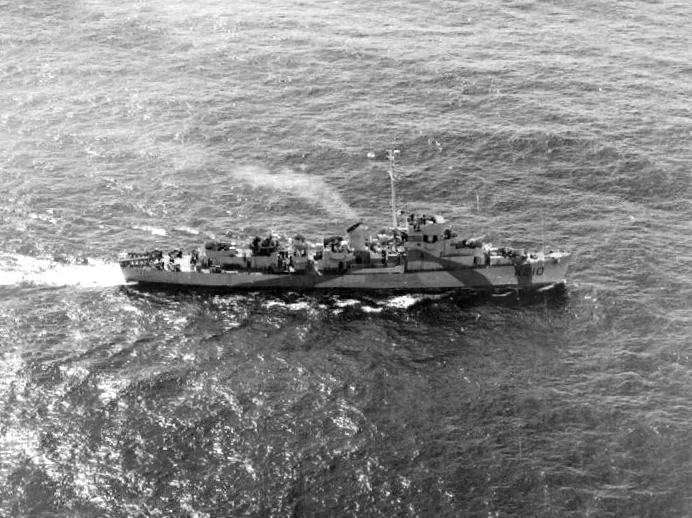
HMS Bayntun was a frigate of the Captain-class frigate Royal Navy in service with the United States Navy. She carried the pennant number K310. She was named for Henry William Bayntun. Boston Navy Yard laid her keel on 5 April 1942. Launched on 27 June 1942, she entered service on 20 January 1943.
46 ships of the class were built.
Displacement was 1,430 long tons. She measured 88.1 m (289 ft) long with a beam of 10.7 m (35 ft). Her designed speed was 19 knots, and she carried a complement of 175.
Her main battery was three 76 mm (3 in) guns. Her machinery developed 6,000 shp.
She served with the United States Navy as Bayntun until 20 January 1943. She then passed to the Royal Navy, serving as Bayntun from 20 January 1943. She then passed to the United States Navy, serving as Bayntun from 22 August 1945. She was in commission for 2,124 days of the Second World War. She was decommissioned on 14 June 1945. She was struck from the register on 1 November 1945.
She was broken up for scrap on 17 June 1947.
Written from the harvested record. Every figure above is sourced; the wording is this site's own.
Armament and machinery
Armament and machinery
- Propulsion
- 2 × electric drive
- 2 × screws
- Power
- 4 × GM Model 16-278A diesel engines
- 6000 shp
- Armament
- 3 × 3 in/50 caliber MK.22 guns
- 2 × 40 mm Bofors guns
- 6 × 20 mm Oerlikon cannons
- 1 × Hedgehog anti-submarine mortar
- 4 × Mk6 depth charge projectors
- 2 × Mk9 depth charge tracks
Sister ships
- HMS Affleck
- HMS Aylmer
- HMS Balfour
- HMS Bentley
- HMS Berry
- HMS Blackwood (K313)
- HMS Braithwaite
- HMS Bullen
- HMS Burges (K347)
- HMS Byard
- HMS Capel (K470)
- HMS Cooke
- HMS Cotton
- HMS Cranstoun
- HMS Cubitt
- HMS Curzon (K513)
- HMS Dacres
- HMS Deane
- HMS Domett
- HMS Drury
- HMS Essington (K353)
- HMS Foley (K474)
- HMS Gardiner
- HMS Garlies
Sources
- Facts harvested from HMS Bayntun on Wikipedia. Figures only — no wording is taken from it.
- Photograph: Royal Navy official photographer — http://media.iwm.org.uk/iwm/mediaLib//7/media-7263/large.jpg This photograph FL 1627 comes from the collections of the Imperial War Museums — Public domain — Wikimedia Commons