HMS London (69)
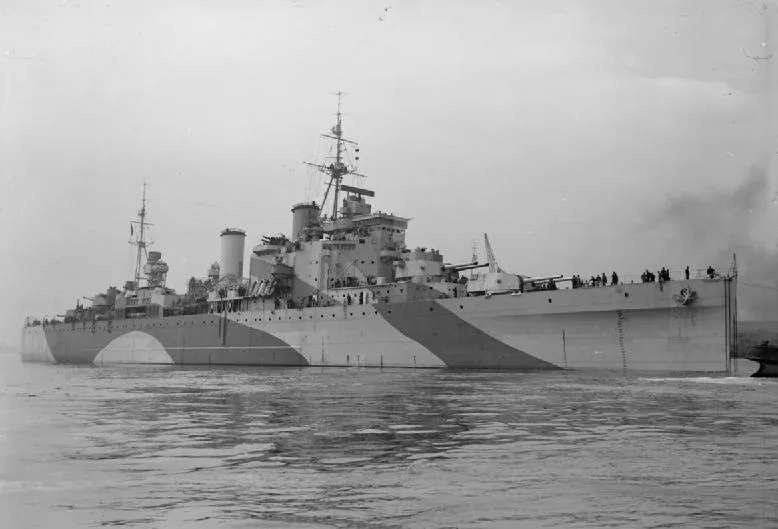
Service
- as HMS London31 January 1929 — 3 January 19502,193 days of the war
- Name
- HMS London
- Pennant / hull number
- 69
- Namesake
- London
- Builder
- Portsmouth Dockyard
- Laid down
- 23 February 1926
- Launched
- 14 September 1927
- Commissioned
- 31 January 1929
- Fate
- Sold for scrapping, 3 January 1950. Broken up from 22 January 1950 by T. W. Ward of Barrow (1950)
- Status
- Scrapped
Specifications
- Displacement, standard
- 9,750 long tons (9,906 t)
- Displacement, full load
- 13,315 long tons (13,529 t)
- Length
- 192.94 m (633 ft)
- Beam
- 20.12 m (66 ft)
- Draught
- 6.4 m (21 ft)
- Speed
- 32 knots (59.3 km/h, 36.8 mph)
- Range
- 9,120 nmi (16,890 km)
- Complement
- 784
- Main gun
- 203 mm (8 in)
HMS London was a County-class cruiser heavy cruiser of the Royal Navy. She carried the pennant number 69. The ship was named after London. Her keel was laid at Portsmouth Dockyard on 23 February 1926. She entered service on 31 January 1929, having been launched on 14 September 1927.
Her class ran to 13 ships. The class followed the Hawkins-class cruiser and was succeeded by the York-class cruiser.
Displacement was 9,750 long tons standard and 13,315 long tons at full load. She measured 192.9 m (633 ft) long with a beam of 20.1 m (66 ft). Her designed speed was 32 knots, and she carried a complement of 784. Her main battery was of 203 mm (8.0 in) calibre.
She was in commission for 2,193 days of the Second World War.
She was broken up for scrap on 3 January 1950.
Written from the harvested record. Every figure above is sourced; the wording is this site's own.
Armament and machinery
Armament and machinery
- Propulsion
- Eight Admiralty 3-drum boilers
- Four shaft Parsons geared turbines
- 80,000 shp (60 MN)
- Armament
- 8 × BL 8-inch (203 mm L/50) Mk.VIII in twin mounts Mk.I*
- 4–8 × QF 4-inch (102 mm L/45) Mk.V in single mounts HA Mk.III
- 4 × QF 2 pdr (40 mm L/39) Mk.II in single mounts HA Mk.I
- 8 × QF 0.5-inch (12.7 mm L/50) Mk.III in quad mounts Mk.I
- 8 × 21 inch (533 mm) torpedoes in quad mounts
- Aircraft
- One Supermarine Walrus, one catapult
Sister ships
Sources
- Facts harvested from HMS London (69) on Wikipedia. Figures only — no wording is taken from it.
- Photograph: Royal Navy official photographer — This photograph FL 2968 comes from the collections of the Imperial War Museums (collection no. 8308-29) — Public domain — Wikimedia Commons