United States Navy — Light cruiser
USS Astoria (CL-90) — service history
This is the full service history. For the vessel's particulars, photograph and specifications, see the entry.
In the words of the US Navy. The account below is reproduced verbatim from the Dictionary of American Naval Fighting Ships, compiled by the Naval History and Heritage Command — a work of the United States Government, in the public domain, and the only text on this site not written here.
Before commissioning
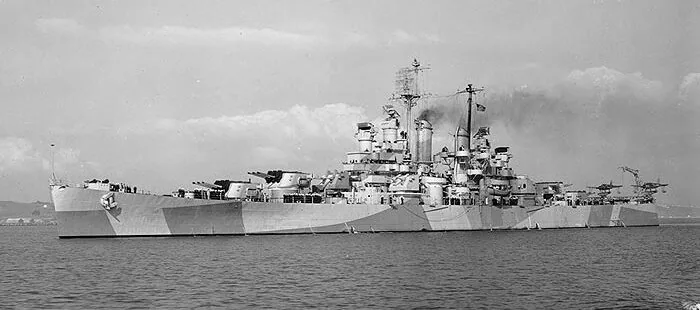
A city and port of entry in northwestern Oregon located on the southern bank at the mouth of the Columbia River. It is the seat of government for Clatsop County.
Second World War 1939–1945
1941
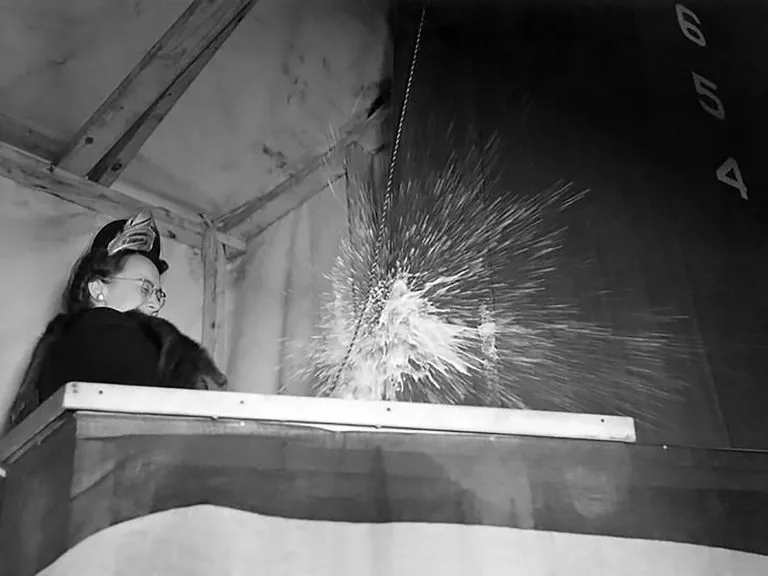
The third Astoria (CL-90) was laid down on 6 September 1941 at Philadelphia, Pa., by the William Cramp & Sons Shipbuilding Co.; launched on 6 March 1943; sponsored by Mrs. Robert Lucas, the wife of the editor of the Astorian Budget; and commissioned at the Philadelphia Navy Yard on 17 May 1944, Capt. George C. Dyer in command.
The light cruiser conducted shakedown training in the vicinity of Bermuda between 6 June and 23 July and returned to Philadelphia on the latter day for post-shakedown overhaul. She departed Philadelphia on 19 September, bound for the Pacific. Steaming via the Panama Canal, Astoria arrived in San Diego on 3 October. Later in the month, she moved to the Mare Island Navy Yard and got underway for Hawaii on the 25th. She arrived at Oahu on the 31st and remained at Pearl Harbor until 16 November. On that day, she got underway for Ulithi Atoll in the Western Carolines. She made a stop at Eniwetok in the Marshalls before entering the lagoon at Ulithi on 25 November. There, the warship reported for duty with Task Group (TG) 38.2 of the Fast Carrier Task Force.
1944 Mindoro

Astoria sortied with Task Force (TF) 38 on 11 December 1944 for her first war cruise. Her mission was to serve in the antiaircraft screen of the carriers while their planes supported the landings of Mindoro. The flattops launched air strikes between 14 and 16 December. Weather began turning bad on the 17th and, that night and the next day, Astoria steamed with TF 38 through the infamous typhoon that sank destroyers Spence (DD-512), Hull (DD-350),and Monaghan (DD-354). However, the cruiser weathered the storm fairly well. After two days of searches for the survivors of the three lost destroyers, TF 38 headed back to Ulithi for a Christmas rest.
1945
She departed Ulithi again on the 30th, when TF 38 got underway to provide air support for the Luzon landings scheduled for 9 January 1945. The carriers' direct support for that operation lasted from 6 to 9 January. On the night of the 9th, Admiral Halsey led TF 38, including Astoria, into the South China Sea to begin raiding Japan's inner defenses. For the next two weeks, the carriers pounded military targets in Japanese-held southern China and French Indochina pausing periodically to harass Formosa. While Astoria steamed in the screen, the carrier air groups bombed shipping and shore installations in the vicinity of Camranh Bay, Hong Kong, Canton, Formosa, and Hainan Island, before the task force returned to Ulithi on 25 January.
Early in February, the cruiser again sortied with the carriers, now redesignated TF 58 with Admiral Spruance's assumption of command, to launch the first strikes against the Japanese home islands since the Halsey-Doolittle raid of 1942. The force arrived off Honshu on 16 February and began two days of air raids on the Tokyo Area. On the 18th, TF 58 headed south, took a passing punch at Chi Chi Jima in the Bonins, and arrived off Iwo Jima by mid-afternoon the next day. While the carrier aircraft provided air support for the landings, Astoria moved in close to shore on the 21st to begin a 26-hour period of gunfire support for the troops ashore. She then steamed north to support the carriers in further strikes against Tokyo before returning to Ulithi by 3 March.
On 14 March, she returned to sea with TF 58 to begin support of the impending campaign to capture Okinawa in the Ryukyu Islands. During that operation, Astoria remained at sea with the fast carriers for 80 days while their planes struck at shipping, airfields, and other installations on and around Kyushu, Shikoku, and Honshu as well as on Okinawa and the surrounding islands. The cruiser supplied antiaircraft defense for the carriers of her task group and claimed to have splashed 11 enemy planes and to have assisted in downing numerous others. She concluded her long cruise in support of the conquest of Okinawa when she arrived at Leyte in the Philippines on 1 June.
There, she remained for a month of repairs with some opportunity for her crewmen to enjoy rest and relaxation. On 1 July, she returned to sea for her final combat of the war. She screened the carriers once more as they launched their planes at the Japanese home islands. During that time, she and Cruiser Division (CruDiv) 17 conducted two unsuccessful antishipping sweeps along the coast of Honshu. The first came on the night of 17 and 18 July while the second occurred on the night of 24 and 25 July. The carriers continued strikes on Japan throughout July and during the first two weeks of August.
After the Japanese agreed to capitulate and hostilities ceased on 15 August, she continued to patrol off Honshu with TF 38. She remained on that assignment until 3 September when she received orders to return to the United States. The warship arrived in San Pedro, Calif., on 15 September and remained there until 24 November. On the latter day, she got underway for Hawaii. Astoria arrived in Pearl Harbor on the 30th and conducted type training for several days. She headed back to San Pedro on 10 December and arrived there on the 15th.
Post-war 1946–1949
1946
For the next 10 months, she ranged up and down the Pacific coast of North America from San Diego in the south to Vancouver, British Columbia, in the north. On 15 October 1946, Astoria departed San Pedro on her way to the Central Pacific. Steaming via Pearl Harbor, she arrived at Guam in the Mariana Islands on 2 November. She operated in the Marianas, frequently visiting both Guam and Saipan, until mid-February 1947. On the 19th, she departed Guam. Sailing by way of Kwajalein in the Mar-shalls and Pearl Harbor, the cruiser entered port at San Diego on 24 March. There, she resumed duty along the Pacific coast until October of 1948.
1949
On 1 October, the ship headed for the Far East. She made a three-day stop at Pearl Harbor before continuing on to Tsingtao, China, where she arrived on the 29th. For almost four months, she cruised Asian waters, visiting such ports as Inchon and Pusan in Korea, Sasebo and Yokosuka in Japan, and Shanghai and Tsingtao in China. On 16 February 1949, Astoria departed Yokosuka to return to the United States. After the customary stop at Pearl Harbor, the warship arrived in San Francisco on 8 March. On 1 July 1949, Astoria was placed out of commission and was berthed with the San Francisco Group, Pacific Reserve Fleet. There, she stayed until 20 May 1958 when she was transferred to the San Diego Group. The light cruiser remained in reserve for another 11 years. On 1 November 1969, her name was struck from the Navy list. She was sold on 12 January 1971 to the Nicolai Joffe Corp., of Beverly Hills, Calif., for scrapping.
Other photographs
Held for this vessel, and not tied to any part of the account above.

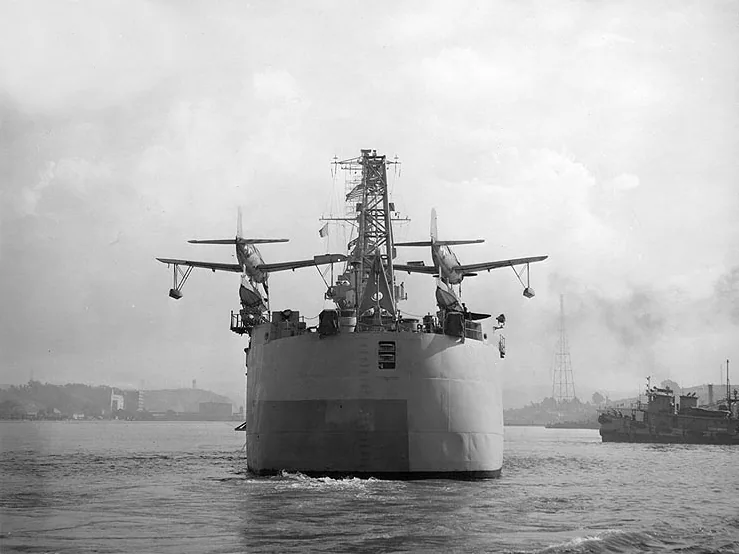
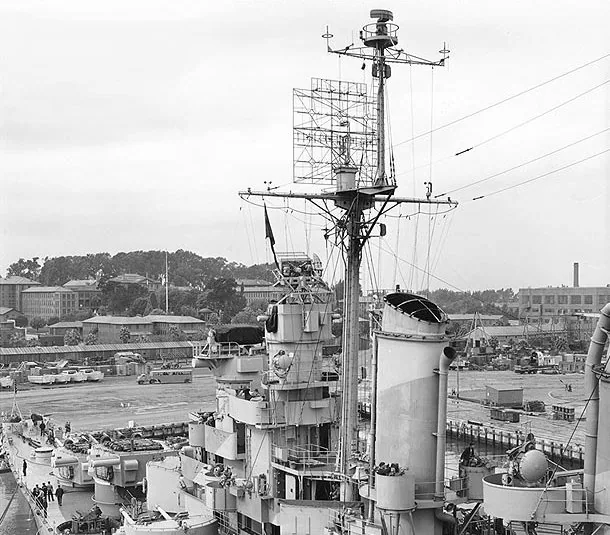
References
Every work this entry draws on. There are no numbered markers in the text above: what we hold is the provenance of the page — this history, this article, these photographs.
- History Astoria III (CL-90) Dictionary of American Naval Fighting Ships, Naval History and Heritage Command. A work of the United States Government, in the public domain — the only text on this site reproduced verbatim.
- Facts USS Astoria (CL-90) Structured facts only — dates, dimensions, armament and fate. No wording is taken from it. Harvested 1 August 2026.
- Photograph USS Astoria (CL-90) underway at sea, circa in 1947 (NH 98423) Unknown author — U.S. Navy photo NH 98423 — Public domain — Wikimedia Commons
- Photograph USS Astoria (CL-90) off the Mare Island Naval Shipyard on 21 October 1944 (NH 98414) Unknown author — U.S. Navy photo NH 98414 — Public domain — Wikimedia Commons
- Photograph 30PeggyLucasbreakschampagnebottle-768w US Navy — https://social.dogtime.com/s/rare-photos-us-navy-ww2?as=6dap23852556535820636&utm_source=fb&utm_medium=z020794&utm_content=23852556509500636&utm_campaign=6dap23852556535820636&bdk=0 — Public domain — Wikimedia Commons
- Photograph USS Astoria (CL-90) underway at sea on 22 July 1944 U.S. Navy — Official U.S. Navy photo NH 98413 from the U.S. Navy Naval History and Heritage Command — Public domain — Wikimedia Commons
- Photograph Stern view of USS Astoria (CL-90) in October 1944 U.S. Navy — Official U.S. Navy photo NH 98418 from the U.S. Navy Naval History and Heritage Command — Public domain — Wikimedia Commons
- Photograph USS Astoria (CL-90) forward superstructure, 21 October 1944 US Navy Employee — Naval Historical Center — Public domain — Wikimedia Commons
- Photograph USS Astoria (CL-90) off the Mare Island Naval Shipyard on 21 October 1944 (NH 98414) (cropped) Unknown author — U.S. Navy photo NH 98414 — Public domain — Wikimedia Commons