USS Augusta (CA-31)
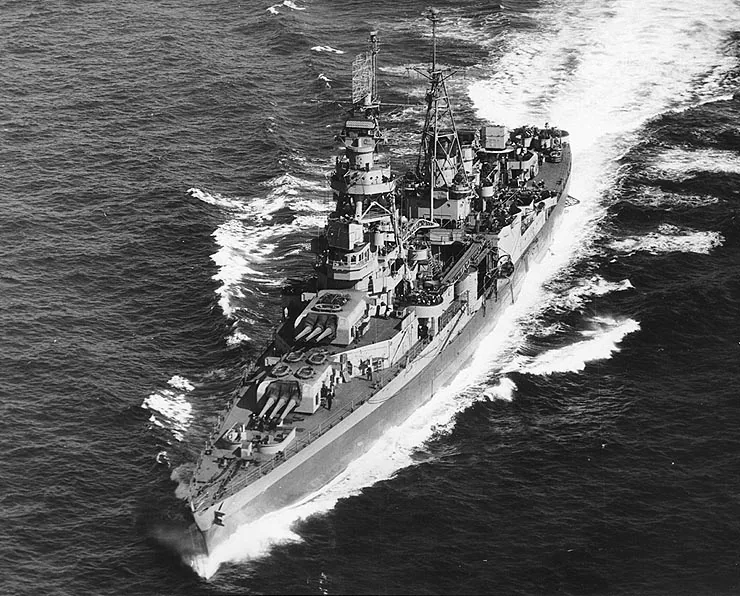
Service
- as Augusta30 January 1931 — 16 July 19462,193 days of the war
- Name
- USS Augusta
- Pennant / hull number
- CA-31
- Namesake
- City of Augusta, Georgia
- Builder
- Newport News Shipbuilding, Newport News, Virginia
- Ordered
- 18 December 1924
- Laid down
- 2 July 1928
- Launched
- 1 February 1930
- Commissioned
- 30 January 1931
- Decommissioned
- 16 July 1946
- Struck
- 1 March 1959
- Fate
- Sold for scrap, 9 November 1959 (1959)
- Status
- Scrapped
Specifications — As built
- Displacement, standard
- 9,050 long tons (9,195 t)
- Length
- 182.88 m (600 ft) OA
- Beam
- 20.12 m (66 ft)
- Draught
- 4.88 m (16 ft)
- Speed
- 32.7 knots (60.6 km/h, 37.6 mph)
- Range
- 10,000 nmi (18,520 km)
- Complement
- 795
- Main gun
- 203 mm (8 in)
The first, third, and fourth Augustas were named for the city in Georgia while the fifth was named for the capital of Maine.
The fourth Augusta (CL-31) was laid down on 2 July 1928 at Newport News, Va., by Newport News Shipbuilding and Dry Dock Co.; launched on 1 February 1930; sponsored by Miss Evelyn McDaniel of Augusta, Ga.; and commissioned at the Norfolk Navy Yard, Portsmouth, Va., on 30 January 1931, Capt. James O. Richardson in command.
Damage to one of her turbines curtailed the ship's original shakedown cruise, but Augusta conducted abbreviated initial training during a cruise to Colon, Panama, and back, before she was assigned duty as flagship for Commander, Scouting Force, Vice Admiral Arthur L. Willard, on 21 May 1931. During the summer of 1931, she operated with the other warships of Scouting Force carrying out tactical exercises off the New England coast. In August 1931, she was reclassified a heavy cruiser, CA-31. In September, Augusta moved south to Chesapeake Bay, where she joined her colleagues in their normal fall gunnery drills. That employment lasted until mid-November when the cruisers disbanded and retired to their respective home yards. Augusta entered the Norfolk Navy Yard at that time.
Continue to the full service history About 8,410 words
From the Dictionary of American Naval Fighting Ships, compiled by the Naval History and Heritage Command (Augusta IV (CL-31)). A work of the United States Government, in the public domain.
Armament and machinery
This vessel is recorded in 2 configurations. Wartime refits changed armament and complement substantially, so each is kept separately rather than averaged into one set of figures. The figures above are as built.
As built
- Propulsion
- 4 × Parsons reduction steam turbines, Curtis cruising gears
- 4 × screws
- Power
- 8 × White-Forster boilers
- 107000 shp
- Armament
- 9 × 8 in/55 caliber guns (3x3)
- 4 × 5 in/25 caliber anti-aircraft guns
- 2 × 3-pounder 47 mm saluting guns
- 6 × 21 in torpedo tubes
- Armour
- Belt: 3 - 3+3/4 in
- Deck: 1-2 in
- Barbettes: 1+1/2 in
- Turrets: 3/4 - 2+1/2 in
- Conning Tower: 1+1/4 in
- Aircraft
- 4 × Curtiss SOC Seagull scout-observation floatplanes
1945
- Main gun
- 203 mm (8 in)
- Armament
- 9 × 8 in/55 caliber guns (3x3)
- 8 × 5 in/25 caliber anti-aircraft guns
- 2 × 3-pounder 47 mm saluting guns
- 6 × quad 40 mm Bofors guns
- 20 × 20 mm Oerlikon cannons
Sister ships
Sources
- Facts harvested from USS Augusta (CA-31) on Wikipedia. Figures only — no wording is taken from it.
- Service history reproduced verbatim from Augusta IV (CL-31) , Dictionary of American Naval Fighting Ships — public domain, a work of the United States Government.
- Photograph: U.S. Navy, photographed from a Utility Squadron 15 (VJ-15) aircraft. — U.S. Navy photo NH 97932 — Public domain — Wikimedia Commons