USS Houston (CA-30)
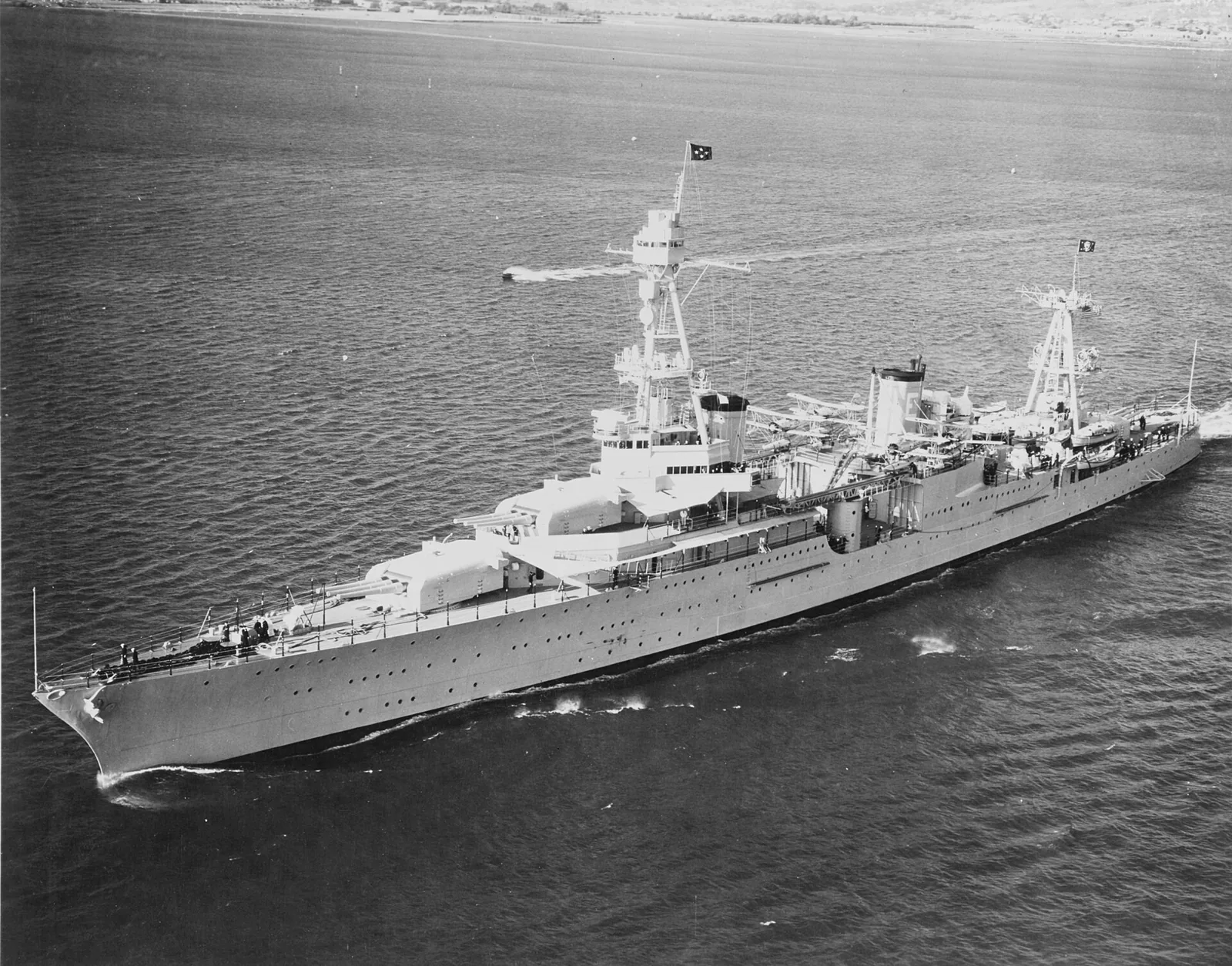
Service
- as Houston17 June 1930 — 1 March 1942912 days of the war
- Name
- USS Houston
- Pennant / hull number
- CA-30
- Namesake
- City of Houston, Texas
- Builder
- Newport News Shipbuilding, Newport News, Virginia
- Ordered
- 18 December 1924
- Laid down
- 1 May 1928
- Launched
- 7 September 1929
- Commissioned
- 17 June 1930
- Fate
- Sunk in the Battle of Sunda Strait, 1 March 1942 (1942)
- Status
- Wreck
Specifications — As built
- Displacement, standard
- 9,050 long tons (9,195 t)
- Length
- 182.88 m (600 ft) OA
- Beam
- 20.12 m (66 ft)
- Draught
- 4.88 m (16 ft)
- Speed
- 32.7 knots (60.6 km/h, 37.6 mph)
- Range
- 10,000 nmi (18,520 km)
- Complement
- 785
- Main gun
- 203 mm (8 in)
The second Houston (CL-30) was laid down on 1 May 1928 at Newport News, Va., by the Newport News Shipbuilding & Dry Dock Co.; launched on 7 September 1929; sponsored by Miss Elizabeth Holcombe, daughter of the mayor of Houston, Texas; and commissioned at the Norfolk Navy Yard, Portsmouth, Va., on 17 June 1930, Capt. Jesse B. Gay commanding.
After fitting out, Houston visited New York City; Gardiner’s Bay, Long Island, N.Y.; then Newport, R.I., before clearing the last-named place on 30 August 1930 for northern Europe. During her shakedown cruise the new warship paid port calls at Southampton, England (8-17 September); Rotterdam, the Netherlands (18-27 September); and Le Havre, France (28 September-6 October) before she set a course to return to the U.S. She paused briefly at Key West, Fla. (18-20 October) after which she proceeded to the city for which she was named. Following her visit to Houston (23-29 October), the cruiser paused again at Key West (1-2 November) then pushed on for Hampton Roads, standing in on 5 November, assigned to Cruiser Squadron 5, Scouting Fleet.
Following a post-shakedown availability, Houston departed the New York Navy Yard on 10 January 1931 and proceeded to the Philippine Islands, steaming via Hampton Roads, Va., the Panama Canal, and Honolulu, Territory of Hawaii, standing in to Manila, Philippine Islands, on 22 February 1931. Two days later, on 24 February 1931, Adm. Charles B. McVay, Jr., Commander in Chief, Asiatic Fleet (CinCAF) hauled down his flag on board the heavy cruiser Pittsburgh (CA-4) and transferred it to Houston , which had arrived on the station after her long voyage “ready in all respects for any duty” and required “no time for [an] engineering overhaul.”
Continue to the full service history About 7,846 words
From the Dictionary of American Naval Fighting Ships, compiled by the Naval History and Heritage Command (Houston II (CA-30)). A work of the United States Government, in the public domain.
Armament and machinery
This vessel is recorded in 2 configurations. Wartime refits changed armament and complement substantially, so each is kept separately rather than averaged into one set of figures. The figures above are as built.
As built
- Propulsion
- 4 × Parsons reduction steam turbines, Curtis cruising gears
- 4 × screws
- Power
- 8 × White-Forster boilers
- 107000 shp
- Armament
- 9 × 8 in/55 caliber guns (3×3)
- 4 × 5 in/25 caliber anti-aircraft guns
- 16 × 1.1 inch (28 mm)/75 caliber anti-aircraft guns in four quad mounts
- 2 × 3-pounder 47 mm saluting guns
- 6 × 21 in torpedo tubes. Torpedo battery removed by the mid-Thirties.
- Armour
- Belt: 3 - 3+3/4 in
- Deck: 1-2 in
- Barbettes: 1+1/2 in
- Turrets: 3/4 - 2+1/2 in
- Conning Tower: At least 3 inches.
- Aircraft
- 4 × SOC Seagull scout-observation floatplanes
1942
- Main gun
- 203 mm (8 in)
- Armament
- 9 × 8 in/55 caliber guns (3x3)
- 8 × 5 in/25 caliber anti-aircraft guns
- 2 × 3-pounder 47 mm saluting guns
- 16 × 1.1 in/75 anti-aircraft guns in four quad mounts.
- 8 × .50 in machine guns
Sister ships
Sources
- Facts harvested from USS Houston (CA-30) on Wikipedia. Figures only — no wording is taken from it.
- Service history reproduced verbatim from Houston II (CA-30) , Dictionary of American Naval Fighting Ships — public domain, a work of the United States Government.
- Photograph: U.S. Navy — Official U.S. Navy photo NH 53582 from the U.S. Navy Naval History and Heritage Command — Public domain — Wikimedia Commons