United States Navy — Destroyer
USS Burns (DD-588) — service history
This is the full service history. For the vessel's particulars, photograph and specifications, see the entry.
In the words of the US Navy. The account below is reproduced verbatim from the Dictionary of American Naval Fighting Ships, compiled by the Naval History and Heritage Command — a work of the United States Government, in the public domain, and the only text on this site not written here.
Second World War 1939–1945
1942
The second Burns (DD-588) was laid down on 9 May 1942, at Charleston, S.C., by the Charleston Navy Yard; launched on 8 August 1942 and sponsored by Mrs. Harry L. Smith, great-granddaughter of Capt. Burns; and commissioned on 3 April 1943, Cmdr. Donald T. Eller in command.
1943 Philippine Sea
After a six-week shakedown off Guantánamo Bay, Cuba, through April 1943, Burns steamed westward through the Panama Canal for action against the enemy. Arriving at Pearl Harbor on 17 September 1943, she underwent a few weeks of training, until getting underway to participate in several Pacific War operations. After a few preliminary operations in the Gilbert Islands and Bismarck Archipelago, she received a duty assignment attaching her to the fast carrier task force 38/58. Active as an anti-submarine escort, picket ship, fighter-director ship, and aircraft rescue vessel, Burns began her combat career during a raid on Wake Island (5–6 October).
Burns continued to contribute to several actions throughout 1943, including the raids on Palau, Yap, Ulithi, and Woleai (30 March–1 April), and a month later at Truk, Satawan, and Ponape [Pohnpei] (29 April–1 May). She also provided anti-submarine patrol duties during the Hollandia, Western New Guinea, operation (21–24 April). The ensuing campaign in the Marianas Islands (15 June–6 April) included the first, second, third, and fourth Bonin raids, the Battle of the Philippine Sea , capture and occupation of Saipan and Guam , and the Palau, Yap, and Ulithi raids.
Providing support for incursion into the Gilbert Islands (20 November–8 December 1943), Burns received orders to steam to the Marshall Islands to help invading allied forces protect Kwajalein and Majuro Atolls (29 January–8 February 1944). On 30 January 1944, off Ujae Atoll, Burns encountered four enemy convoy vessels steaming under the cover of darkness off Kwajalein. In the 34-minute long battle, she attacked the convoy, guns firing as fast as they could be loaded, and within an hour hit and sank two of the enemy ships. Japanese transport Akibasan Maru and guardboat Nichiei Maru burned fiercely before going under. The following morning, Burns rejoined her group with a broom flying proudly from her masthead indicating a “clean sweep.”
1944 Operation Hailstone
During the first U.S. carrier raid, codenamed Operation Hailstone , off Truk in the Caroline Islands (16–17 February 1944), Burns sank 180-foot Japanese submarine chaser Ch 24 on patrol. After lowering one of her boats to rescue about a half-dozen reluctant prisoners from the water, she joined a special strike unit and engaged in a one-sided gun and torpedo battle with enemy warships attempting to escape from Truk. She also earned an assist in the sinking of Japanese light cruiser Katori and trawler No. 15 Shonan Maru, before receiving orders to track down and terminate Japanese submarine chaser No. 24 , which she accomplished at 1655. Six enemy prisoners were rescued from the sea. Cmdr. Eller earned the Navy Cross for his actions during the battle, while the gunnery officer, Lt. James P. Jamison, received the Silver Star .
After operations in the Western Caroline Islands, which included the capture of the Southern Palau Islands, the assault on the Philippine Islands began (6 September–14 October 1944). Burns supported Third Fleet operations engaged with the Imperial Japanese Navy at Okinawa , Luzon, and Formosa [Taiwan] (10 October–14 November). Cmdr. Jacob T. Bullen, the destroyer’s commanding officer, received the Silver Star for his efforts helping screen crippled heavy cruiser Canberra (CA-70) away from Formosa on 13 October. Four crewmembers received Purple Heart awards for injuries sustained during an enemy air attack on the same day.
1945 Lingayen Gulf
Burns was present during the landings at Lingayen Gulf (4–18 January 1945) in the Philippines. On 4 January 1945, while en route to Lingayen Gulf to support the invasion of Luzon with the Seventh Fleet, Burns lowered rescue boats to pick up survivors of escort aircraft carrier Ommaney Bay (CVE-79), hit by a kamikaze suicide aircraft. After moving in closer to the ship itself to rescue stragglers, a sizeable explosion rocked the carrier, showering the nearby destroyers with flying shrapnel and flaming debris, but causing no casualties on board Burns. Having rescued over 160 survivors, the destroyer sent a single torpedo into the burning carrier, sending her to the bottom.
After the success of the landings at Lingayen, during which time Burns survived several more kamikaze attacks (and added an enemy plane to her kill total), she received long-awaited orders to return to the United States for a badly needed overhaul. After 19 months in the Pacific War, the crew would receive six weeks of well-earned leave and duty back at home.
By the middle of May 1945, Burns was back in the Pacific. Receiving an assignment to Seventh Fleet, she participated in the bombardment and occupation of Borneo at Brunei Bay and at Balikpapan. When the news of Japan’s surrender came on 15 August, Burns was performing special escort duty east of the Philippines. While other U.S. warships steamed into Tōkyō Bay in September, Burns made way for the Yellow Sea to support Allied forces in occupying Korea and China. She received a “well done” for her work in sighting and destroying (by gunfire) 28 drifting sea mines while the task force patrolled the Yellow Sea.
Moving toward Tsingtao [Qingdao], China, the destroyer acted in a protective and diplomatic capacity as a liaison vessel with the few American occupation teams already shore who supervised the evacuation of civilian refugees. Paving the way for the Sixth Marine Division, expected in the following weeks, Burns also took control of six prize Japanese-held merchant ships.
With occupation duties turned over to the marines, Burns began routine duties with the North China Fleet. However, as the months of October–November 1945 passed, the long days at sea were occasionally broken up with port visits to Tsingtao and Shanghai, China, and Jinsen [Inchon], Korea. Finally, in December 1945, Burns received orders to return to the West Coast of the United States, arriving in San Francisco, Calif., on 8 January 1946.
Other photographs
Held for this vessel, and not tied to any part of the account above.
References
Every work this entry draws on. There are no numbered markers in the text above: what we hold is the provenance of the page — this history, this article, these photographs.
- History Burns II (DD-588) Dictionary of American Naval Fighting Ships, Naval History and Heritage Command. A work of the United States Government, in the public domain — the only text on this site reproduced verbatim.
- Facts USS Burns (DD-588) Structured facts only — dates, dimensions, armament and fate. No wording is taken from it. Harvested 1 August 2026.
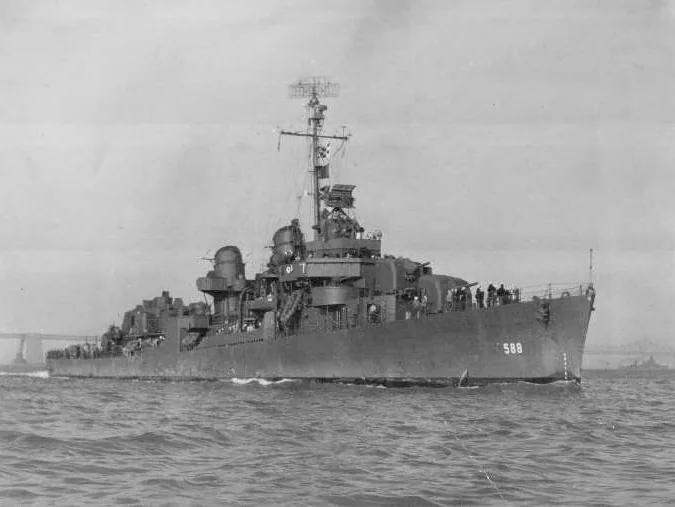
- Photograph USS Burns (DD-588) at sea c1945 USN — Official U.S. Navy Bureau of Ships photo 19-N-81928 available at Destroyerhistory.org — Public domain — Wikimedia Commons
- Photograph USS Burns (DD-588) off San Francisco in January 1946 U.S. Navy — U.S. Navy photo [1] from Navsource.org — Public domain — Wikimedia Commons