USS Enterprise (CV-6)
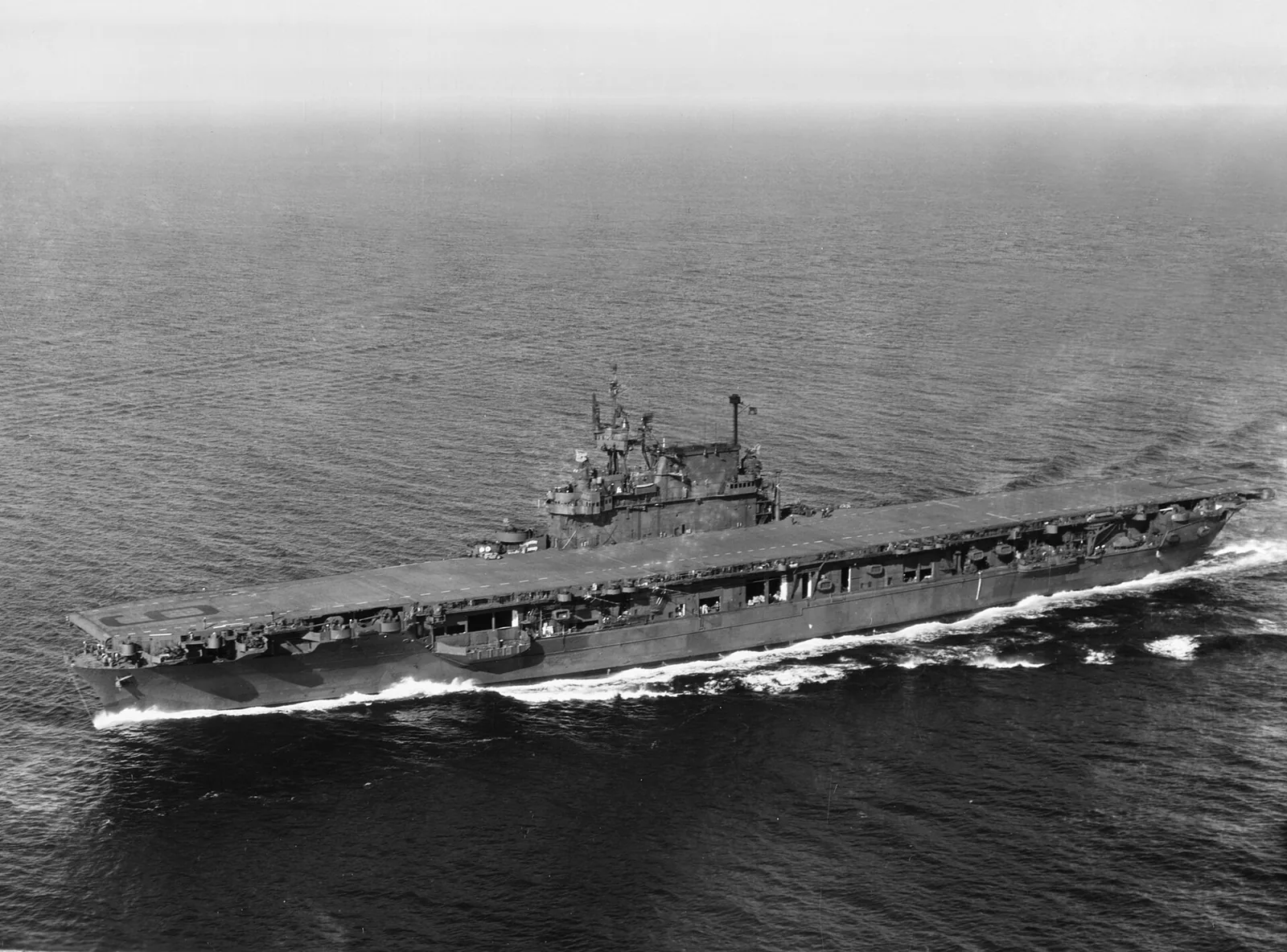
Service
- as USS Enterprise12 May 1938 — 17 February 19472,193 days of the war
- Name
- USS Enterprise
- Pennant / hull number
- CV-6
- Builder
- Newport News Shipbuilding
- Ordered
- 1933
- Laid down
- 16 July 1934
- Launched
- 3 October 1936
- Commissioned
- 12 May 1938
- Decommissioned
- 17 February 1947
- Struck
- 2 October 1956
- Fate
- Scrapped 1958–1960 (1958)
- Status
- Scrapped
Specifications
- Displacement, standard
- 19,800 long tons (20,118 t)
- Displacement, full load
- 25,500 long tons (25,909 t)
- Length
- 246.58 m (809 ft) OA
- Beam
- 25.3 m (83 ft)
- Draught
- 7.62 m (25 ft)
- Speed
- 32.5 knots (60.2 km/h, 37.4 mph)
- Range
- 12,500 nmi (23,150 km)
- Complement
- 2,217
- Main gun
- 127 mm (5 in)
The seventh Enterprise (CV-6) was authorized by an Act of Congress on 16 June 1933; laid down on 16 July 1934, at Newport News, Va., by Newport News Shipbuilding & Dry Dock Co.; launched on 3 October 1936; sponsored by Mrs. Lulie H. Swanson, wife of Secretary of the Navy Claude A. Swanson; and commissioned on 12 May 1938 at Naval Operating Base (NOB) Norfolk, Va., Capt. Newton H. White in command.
Under the terms of the National Industrial Recovery Act of 1933, on 16 June 1933, President Franklin D. Roosevelt allotted $238 million to the Navy for the construction of new ships including two aircraft carriers, and in less than two months contracts were awarded for Carrier Nos. 5 and 6. Rear Adm. Ernest J. King, Chief of the Bureau of Aeronautics (BuAer), recommended the name Enterprise for Carrier No. 6 to Secretary of the Navy Swanson, on 11 August 1933:
“This is one of the most famous names of the Navy through its association in the French, Revolutionary and Tripolitan wars. It dates back to the Revolutionary War, when it was borne by one of [Benedict] Arnold’s vessels on Lake Champlain and later by a packet in the continental service on the Atlantic.”
Continue to the full service history About 35,032 words
From the Dictionary of American Naval Fighting Ships, compiled by the Naval History and Heritage Command (Enterprise VII (CV-6)). A work of the United States Government, in the public domain.
Armament and machinery
Armament and machinery
- Propulsion
- 4 × shafts; 4 × Parsons geared steam turbines
- Power
- 120000 shp
- 9 × Babcock & Wilcox boilers
- Armament
- 8 × single 5 in/38 cal guns
- 4 × quad 1.1 in/75 cal guns
- 24 × .50 caliber machine guns
- From April 1942:
- 8 × 5 in/38 cal
- 4 × quad 1.1 in/75 cal
- 30 × 20 mm Oerlikon cannons
- From mid-June 1942 to mid-September 1942:
- 8 × 5 in/38 cal
- 5 × quad 1.1 in/75 cal
- 32 × 20 mm Oerlikons
- From mid-September 1942:
- 8 × 5 in/38 cal
- 4 × quad 40 mm Bofors guns
- 1 × quad 1.1 in/75 cal
- 44 × 20 mm Oerlikons (46 from 11/42)
- From October 1943:
- 8 × 5 in/38 cal
- 40 × 40 mm Bofors (8×2, 6×4)
- 50 × 20 mm Oerlikon
- From September 1945:
- 8 × 5 in/38 cal
- 54 × 40 mm Bofors (5×2, 11×4)
- 32 × 20 mm Oerlikons (16×2)
- Armour
- 2.5–4 in belt
- 60 lb protective decks
- 4 in bulkheads
- 4 in side and 2 in top round conning tower
- 4 in side over steering gear
- Aircraft
- 96 aircraft maximum, 80-90 average on board
Sister ships
Sources
- Facts harvested from USS Enterprise (CV-6) on Wikipedia. Figures only — no wording is taken from it.
- Service history reproduced verbatim from Enterprise VII (CV-6) , Dictionary of American Naval Fighting Ships — public domain, a work of the United States Government.
- Photograph: Unknown author — U.S. Navy Bureau of Ships photo 19-N-89185 — Public domain — Wikimedia Commons