USS Hornet (CV-8)
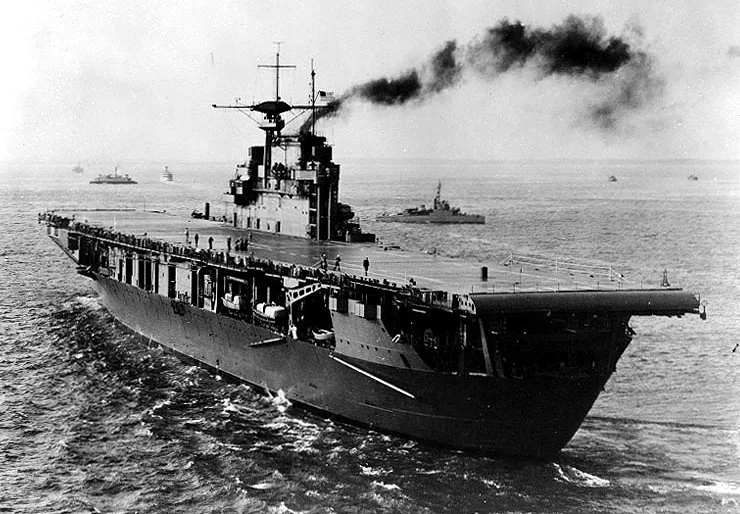
Service
- as Hornet20 October 1941 — 13 January 1943450 days of the war
- Name
- USS Hornet
- Pennant / hull number
- CV-8
- Namesake
- USS Hornet (1805)
- Builder
- Newport News Shipbuilding Company
- Ordered
- 30 March 1939
- Laid down
- 25 September 1939
- Launched
- 14 December 1940
- Commissioned
- 20 October 1941
- Struck
- 13 January 1943
- Fate
- Sunk in the Battle of the Santa Cruz Islands, 27 October 1942 (1942)
- Status
- Wreck
Specifications
- Displacement, standard
- 20,000 long tons (20,321 t)
- Displacement, full load
- 25,500 long tons (25,909 t)
- Length
- 251.16 m (824 ft) OA
- Beam
- 25.3 m (83 ft)
- Draught
- 8.53 m (28 ft)
- Speed
- 32.5 knots (60.2 km/h, 37.4 mph)
- Range
- 12,500 nmi (23,150 km)
- Complement
- 2,919
- Main gun
- 127 mm (5 in)
The seventh Hornet (CV-8) was laid down on 25 September 1939 at Newport News, Va., by Newport News Shipbuilding & Dry Dock Co.; launched on 14 December 1940; sponsored by Mrs. William F. Knox, wife of Secretary of the Navy Frank Knox; and commissioned on 20 October 1941 at the Naval Operating Base (NOB), Norfolk, Va., Capt. Marc A. Mitscher in command.
Hornet shifted to the Norfolk Navy Yard, Portsmouth, Va., on the afternoon of 24 October 1941, then entered dry dock no. 4 on 16 November, remaining there until undocking on the 23rd. She returned to NOB Norfolk on the morning of 6 December. The next afternoon [7 December], after Japan initiated hostilities in the Pacific on a broad front, including a daring attack on the U.S. Pacific Fleet at Pearl Harbor, T.H., Hornet ’s deck log noted the ship receiving a dispatch from the Secretary of the Navy at 1435: “execute WPL 46 against Japan.” The ship immediately began “taking necessary additional security measures.”
Hornet stood out of NOB Norfolk and anchored in Lynnhaven Bay on the afternoon of 10 December 1941, then steamed over the degaussing range the following day. She anchored in Hampton Roads, then in Chesapeake Bay, over the following days, running magnetic compass compensation on the 15th. Hornet , with Noa (DD-343) as her plane guard, carried out aircraft launching and recovery operations on the 16th, and also conducted structural firing tests of all of her guns, from her 5-inch mounts to the 1.1-inch and the 20-millimeters. While conducting flight operations on 17 December, Hornet received a report from Noa that the latter had made what she believed to be a submarine contact and attacked, dropping two depth charges with no observable results. Hornet anchored off the Wolf Trap Range later that afternoon, then returned to NOB Norfolk on the 19th.
Continue to the full service history About 7,905 words
From the Dictionary of American Naval Fighting Ships, compiled by the Naval History and Heritage Command (Hornet VII (CV-8)). A work of the United States Government, in the public domain.
Armament and machinery
Armament and machinery
- Propulsion
- 4 shafts; 4 geared steam turbines
- Power
- 9 × Babcock & Wilcox boilers
- 120000 shp
- Armament
- 8 × single 5 in DP guns
- 4 × quadruple 1.1 in AA guns
- 24 × single .50 in AA MGs
- Armour
- Belt: 2.5 - 4 in
- Deck: 4 in
- Bulkheads: 4 in
- Conning Tower: 4 in
- Steering Gear: 4 in
- Aircraft
- 97 × aircraft
Sister ships
Sources
- Facts harvested from USS Hornet (CV-8) on Wikipedia. Figures only — no wording is taken from it.
- Service history reproduced verbatim from Hornet VII (CV-8) , Dictionary of American Naval Fighting Ships — public domain, a work of the United States Government.
- Photograph: Unknown author — U.S. Navy photo NH 81313 — Public domain — Wikimedia Commons