United States Navy — Destroyer
USS Frank Knox — service history
This is the full service history. For the vessel's particulars, photograph and specifications, see the entry.
In the words of the US Navy. The account below is reproduced verbatim from the Dictionary of American Naval Fighting Ships, compiled by the Naval History and Heritage Command — a work of the United States Government, in the public domain, and the only text on this site not written here.
Before commissioning
Named for William Franklin Knox who was born on 1 January 1874 in Boston, Mass. He attended Alma College in Alma, Michigan. Knox served in Cuba with the First U.S. Volunteer Cavalry, Theodore Roosevelt’s famous "Rough Riders,” in the Spanish-American War, during which time, when he had been temporarily separated from that famed unit he fought alongside the Tenth Cavalry (Colored). “Fought with them shoulder to shoulder,” he wrote, “and in justice to the colored race I must say that I never saw braver men anywhere. Some of those who rushed up [San Juan Hill] will live in my memory forever.”
Knox changed his first name to Frank in about 1900 and became a newspaper reporter in Grand Rapids, Michigan, which was the beginning of a career that grew to include the ownership of several papers. During World War I, Knox advocated preparedness and United States participation. He remained active in the Army Reserve during his distinguished career in journalism and served in France during World War I as an artillery officer, rising to major, and later, colonel.
In 1931, Frank Knox became publisher and part owner of the Chicago Daily News . An active Republican, he was the party's nominee for Vice President under Alf Landon in the 1936 election. They lost to Franklin D. Roosevelt in a landslide, winning only two states in the electoral vote.
Knox was an internationalist. He supported aiding the Allies and opposed isolationism. He was appointed as Secretary of the Navy by President Roosevelt on 11 July 1940 in a demonstration of bipartisan support for naval preparedness. His outstanding service was marked by his brilliant administration of the vast and rapid growth of the Navy. He showed a clear grasp of sea power and its key role in national defense.
Second World War 1939–1945
1944
Secretary Knox worked to expand the Navy into a force capable of fighting in both the Atlantic and Pacific. His selection of new uniformed leadership in the wake of the Pearl Harbor attack was vital in seeing the Navy through the trying months of 1942 and the fighting that followed. Though he tended to leave military matters to the officer corps, his administrative talents and good judgement made invaluable contributions to the victory that he, sadly, would not live to see. On 28 April 1944, following a brief series of heart attacks, Secretary Knox died in Washington, D.C., and was buried at Arlington National Cemetery, Va.
Unfortunately, Knox supported segregation in the U.S. military and encouraged the internment of Japanese Americans, refusing to allow them to serve in the Navy.
Frank Knox (DD-742) was laid down on 8 May 1944 at Bath, Maine, by the Bath Iron Works Corp.; launched on 17 September 1944, sponsored by Mrs. Annie Reid Knox, widow of Secretary Knox; commissioned on 11 December 1944, Cmdr. Joel C. Ford, Jr. in command.
1945 Okinawa

Frank Knox was the first Gearing -class destroyer commissioned. After a six-week shakedown period in Bermuda, she was converted into a radar picket destroyer (DDR) at the Boston Navy Yard. On 16 April 1945 she sailed for the Pacific war zone, and on 20 April, dropped 39 depth charges in an attack on a suspected German submarine off Cape May, N.J., with unknown results. She arrived at San Pedro Bay, Culion Island, the Philippines, on 16 June 1945.
Frank Knox joined the Third Fleet fast carrier task force raids against the Japanese home islands. During July she provided anti-aircraft protection for the fleet and participated in the destruction of multiple Japanese aircraft and rescued downed U.S. pilots from the waters off Hokkaido, Japan. During the Battle of Okinawa, she acted as a radar picket, giving early warning of incoming air raids. On 9 August, Frank Knox was narrowly missed by a kamikaze aircraft after she had expended an estimated 5,000 rounds of anti-aircraft fire against the suicider. The enemy bomber crashed destroyer Borie (DD-704) instead, killing 48 and wounding 66. Frank Knox also dodged four torpedoes in two separate attacks during her time in the Pacific.
On 27 August 1945, she entered Sagami Bay, Japan, and lay in Tokyo Bay for the Japanese surrender on 2 September. After occupation duty in the Far East, she sailed for her home port of San Diego, Calif., on 4 January 1946.
Post-war 1946–1949
1946
Frank Knox operated out of San Diego until November 1946 when she sailed for a deployment to China. On November 7, she collided with her sister ship Higbee (DDR-806) en route to Pearl Harbor, Territory of Hawaii, where she put in for repairs. She arrived in China in February 1947 and operated along the coast until June 1947 when she returned to San Diego. She conducted local operations, visiting San Francisco, Calif., and Seattle, Wash.
1948
In June 1948, Frank Knox returned to China, operating out of Tsingtao. She cruised Chinese and Formosan waters and spent a month at Yokosuka, Japan, to repair damage from rough seas. She returned to San Diego in February 1949 and again operated along the West Coast. During this period, she hosted a Midshipman cruise and underwent a routine maintenance stay at Hunter’s Point Naval Shipyard, San Francisco.
Korean War period 1950–1953
1950 Chosin Reservoir
On 5 July 1950, Frank Knox steamed for the western Pacific to join the Seventh Fleet at the outbreak of the Korean War. As part of Fast Carrier Task Force (TF) 77, she supported air operations against North Korea. In mid-September she supported the Inchon Landings as a shore bombardment unit. On 27 September, Frank Knox joined light cruiser Manchester (CL-83) and Destroyer Division (DesDiv) 112 in shelling shore installations and batteries near the 38th Parallel. She reported destroying one gun emplacement and damaging others while shelling troop positions.
She moved with DesDiv 112 to patrol the Taiwan Straits to deter Communist Chinese designs against Nationalist Chinese Formosa (Taiwan). She was forced to put into Hong Kong in early November due to Typhoon Clara which inflicted substantial structural damage on her.
Frank Knox rejoined TF 77 on 12 December 1950 to screen the U.N. evacuation at Hungnam, North Korea, during the Battle of the Chosin Reservoir. Known as “The Miracle of Christmas,” the Navy deployed seven carriers, battleship Missouri (BB-63), heavy cruiser St. Paul (CA-73) and light cruiser Rochester (CL-124), seven destroyers, including Frank Knox, and three medium landing ships (rocket) to cover the evacuation. By Christmas Eve, approximately 105,000 U.S., Republic of Korea (ROK), and U.N. troops had been lifted from the beaches around Hungnam. Over 100,000 North Korean refugees were also taken on board transports and evacuated to safety.
1951
On 30 January 1951, while Chinese forces were pushing U.N. troops south from the Yalu River, Frank Knox joined in a mock invasion of the North Korean coast at Kojo (Sŏnggol) on the eastern coast. The deception began with an assembled fleet moving close to Vladivostok in Siberia, USSR. When spotted by the Soviets, the North Koreans were notified of a pending assault, and they moved troops from central Korea to defend the beaches. Approximately 50 ships made a show of loading landing craft with marines and sending them towards the shore. Before they reached the beach, the landing craft all turned back and a heavy air assault arrived to bomb and strafe the defending troops, inflicting heavy casualties. Frank Knox , Missouri , Manchester , and other warships contributed to the mayhem with heavy gunfire.
Frank Knox also searched for an aircraft from aircraft carrier Philippine Sea (CV-47), going to within 300 yards of shore. Her search boat was so close that it came under small arms fire, which was returned. Aircraft from Philippine Sea came in to strafe the beach so the boat could continue the search, though with no results.
Due to rotate home on 1 February 1951, Frank Knox and the other ships in DesDiv 112 stayed on station another 40 days and bombarded the east coast rail centers of Chongjin and Songjin, cutting supply and communications routes. Frank Knox returned to San Diego in April and conducted training exercises until August. She and DesDiv 112 moved to Pearl Harbor in August and took up Ready Division status. She returned to San Diego in August and entered the Mare Island Naval Shipyard, Vallejo, Calif., in December for a routine overhaul. Her quad 40 millimeter anti-aircraft guns were removed and replaced with a Mark 56 director system and rapid-fire 3-inch guns. The modern anti-aircraft guns fired 15 to 20, 13-pound rounds a minute with a proximity fuse.
1952
Frank Knox left Mare Island for San Diego on 14 March 1952. She left for Korea after a training period on 19 April and joined Task Force (TF) 77 for Hunter-Killer Group (HUK) antisubmarine duty off Okinawa. With DesDiv 112, she bombarded east coast communist shore installations in July and then returned to TF 77. On 6 August, she rescued five crewmen from aircraft carrier Boxer (CV-21) who had been forced overboard due to a major hanger deck fire. She patrolled off Formosa in September 1952, then returned to Korea to participate in the “Mock Invasion of Kojo,” another invasion landing deception exercise south of Wonsan, North Korea. TF 77 conducted several “Cobra Patrols” along the eastern North Korean coast. These consisted of cruiser-destroyer teams of one each making surprise bombardments of coastal towns. In these raids, Frank Knox destroyed several shore batteries, an ammunition dump, a main highway, and railroad tracks while screening minesweepers from shore battery fire.
On 2 November 1952, Frank Knox sailed for home. She operated out of San Diego and joined a TF 13 HUK exercise along the West Coast. After a short stay in the San Francisco Naval Shipyard, she departed for her third Korean deployment on 21 July 1953. She arrived at Yokosuka, Japan, on 11 August, then joined TF 77 for plane guard and screening duty. On 4 September, Frank Knox joined TF 95 in patrolling off the southern coast of Korea. She joined a Task Group (TG) 96.7 HUK for exercises and training between Japan and Okinawa.
1953
Following a three-week Formosa Patrol in October 1953, Frank Knox called at Kaohsiung, Taiwan, and then sailed north to Kagoshima, Japan. Arriving on 7 November, she became only the second U.S. Navy vessel to visit the port. She was at Sasebo on the 16th and joined TF 95 two days later. She rendezvoused with the Australian aircraft carrier HMAS Sydney (R 17) as plane guard en route to Kure, Japan. Frank Knox rejoined TF 77 on 28 November and participated in the filming of the motion picture The Bridges of Toko-Ri before returning to Yokosuka on 21 December 1953.
Cold War 1954–1963
1954
Frank Knox steamed to Inchon on 18 January 1954 to join five tank landing ships transporting 4,400 Chinese ex-Prisoners-of-War (POWs) to Keelung, Formosa. The POWs had refused repatriation to Communist China under the terms of the Panmunjom Armistice and chose instead to join the Nationalists on Taiwan. The convoy arrived on the 25th to unload the former communist soldiers. Frank Knox sailed for Yokosuka on the 27th for a short availability period and departed for San Diego on 3 February. She arrived home on the 19th, her Korean War service at an end.
After two months at San Diego, Frank Knox entered the Mare Island Naval Shipyard on 29 April 1954 for a major overhaul and upgrade. Her radar picket capabilities were upgraded with new radars and electronics, and much of her existing equipment was overhauled. The tripod mast of earlier DDR versions was removed. She left the shipyard on 28 July and immediately began a series of refresher training exercises. She spent five weeks with the Undersea Training Group focused on all aspects of destroyer warfare. After an availability alongside destroyer tender Prairie (AD-15), she sailed for Pearl Harbor en route to Yokosuka on 3 September 1954.
With DesDiv 112, Frank Knox conducted an exercise escorting six attack transports simulating a merchant convoy. Leaving Pearl Harbor on 27 September, DesDiv 112 and Cruiser Division (CruDiv) 3, composed of heavy cruisers Toledo (CA-133) and Helena (CA-75), conducted a simulated raider attack and defense exercise across the Pacific to Japan. Frank Knox arrived at Yokosuka on 7 October and, after a short repair period alongside destroyer tender Piedmont (AD-17), sailed with DesDiv 112 to join DesDiv 101 for two weeks of HUK operations.
Built around escort carrier Point Cruz (CVE-118), the HUK endured two weeks of rough weather that opened two cracks in the bottom of Frank Knox ’s hull. Nevertheless, she continued on-station and was able to locate and rescue an unidentified Point Cruz flyer. Following the HUK exercise, DesDiv 112 returned to Yokosuka before steaming to the Inland Sea and on to Korea. On 31 October, Frank Knox began two days of at-sea gunnery exercises before returning to Sasebo, Japan.
Frank Knox moored alongside destroyer tender Dixie (AD-14) for temporary repairs to her hull as her schedule did not allow time for dry docking. Still leaking 200 gallons of sea water a day into her bilges, she steamed for Kaohsiung and arrived on 8 November on Formosa Straits patrol off Quemoy Island. Nationalist and communist forces exchanged artillery fire between the island and the mainland throughout Frank Knox ’s 16-day patrol, after which she steamed to Subic Bay, Republic of the Philippines, for dry docking and repairs to her hull cracks.
1955
On 6 December, Frank Knox left Subic and joined an 11-day Seventh Fleet maneuver. She then steamed to Manila, Republic of the Philippines, to serve as a plane guard for aircraft carriers Wasp (CVA-18) and Kearsarge (CVA-33) before returning to Subic Bay for availability alongside Dixie . Frank Knox departed for Hong Kong on 27 December, arrived on the 29th, and departed to join TF 77 on 5 January 1955. She operated with the task force until 15 January when she returned to Subic Bay to prepare for a voyage to Singapore. However, on 21 January, instead of heading to Singapore, Frank Knox and most other ships at Subic Bay steamed to join TF 77 off the Central China coast.
Heightened tensions over the Tachen Islands led to Frank Knox being detached to join TF 75 on 6 February to assist in evacuating Nationalist Chinese forces and civilians. For five days, she patrolled around the islands, guarding against any air, surface, submarine, or artillery interference with the evacuation. At times she was within three miles of communist-held islands. Upon the successful conclusion of the operation, Frank Knox, DesDiv 112, and Toledo proceeded to Yokosuka, arriving on 15 February. On the 25th, she departed for San Diego and arrived on 13 March 1955.
On 31 March, Frank Knox entered the San Diego Naval Repair Facility for her first Board of Inspection and Survey review since 1947. She then began local operations including plane guarding, gunnery practice, sonar training, HUK and antisubmarine (ASW) exercises, and reservist training. She left San Diego for her eighth WestPac trip on 27 September 1955 and arrived at Yokosuka on 26 October. She sailed to Kaohsiung on the 29th for a month’s service with the Formosa Patrol, during which she suffered new hull cracks. She returned in December to the Yokosuka Ship Repair Facility for repairs where, after a fleet review by Secretary of the Navy Charles S. Thomas, she ended the year.
1956
Frank Knox moved into dry dock on 7 January 1956 for hull work. Her anticorrosion zincs, sea valves, and screens were reported in good order. It was noted her sonar dome windows were torn and broken, however. Her port propeller had a four-inch crack on one of the blade tips and pinholes throughout. Nevertheless, on 9 January, she left dry dock to escort aircraft carrier Hancock (CVA-19) to the Okinawa operating area. On the 12th, they joined TG 77.5 where Frank Knox served as Hancock ’s plane guard. TF 77, which included aircraft carrier Bennington (CVA-20) steamed towards Formosa on 19 January. On the 22nd, Bennington was detached and Frank Knox steamed for Hong Kong with Hancock and arrived the following day. She departed for Subic Bay on the 30th and operated off the west coast of Luzon with Hancock and Kearsarge until mooring at Subic Bay on 5 February.
On 18 February, following 13 days of upkeep and repair alongside Dixie , Frank Knox got underway for Guam with DesDiv 112. She arrived on the 22nd and dressed ship in honor of George Washington’s birthday. DesDiv 112 steamed for Pearl Harbor on the 24th and arrived on 3 March 1956. On the 4th, a team of engineers from the Mare Island Naval Shipyard surveyed Frank Knox in preparation for an overhaul at the end of the month. She steamed for San Diego on 5 March and arrived on the 11th. On the 26th, she got underway for Mare Island and the planned overhaul and entered the shipyard on 28 March.
Frank Knox moved into dry dock on 17 April 1956. On 7 May, an attempt to refloat her was aborted due to hull leaks. A second attempt on the 8th was successful, and she moored in the shipyard that evening. Her repair and overhaul work continued through the summer until she returned to San Diego on 31 July 1956. She rejoined DesDiv 112 and commenced local exercises and operations on 6 August.
Frank Knox and DesDiv 112 departed for Pearl Harbor on 25 September and moored there on the 30th. She departed the same day, bound ultimately for Yokosuka. She crossed the Equator on 3 October with appropriate ceremony and arrived at Pago Pago, Tutuila, American Samoa, on the 5th. The next day, Frank Knox sailed for Wellington, New Zealand, and arrived on the 10th for a five-day visit during which she hosted 2,417 visitors. She departed on 15 October, touched at Manus in the Admiralty Islands on the 22nd, and moored at Guam on the 25th.
DesDiv 112 departed Guam on 27 October on the final leg of the journey to Yokosuka and arrived on the 30th. Frank Knox and DesDiv 112 steamed for the Okinawa operating area on 8 November 1956. On the 10th, a helicopter delivered Cmdr. Elmo R. Zumwalt, commanding officer of destroyer Arnold J. Isbell (DD-869) of DesDiv 112, on board Frank Knox for a conference. Zumwalt would go on to become the 19th United States Navy Chief of Naval Operations on 1 July 1970.
Frank Knox operated with Boxer near Okinawa until steaming for Sasebo on 12 November where she moored on the 13th. She departed on the 20th as an escort for aircraft carrier Essex (CVA-9) for flight operations en route to the Subic Bay operating area. Bennington joined the following day to form TG 79.3. Flight exercises ended on 7 December and TG 79.3 sailed for Hong Kong, arriving on the 8th. On 15 December 1956, Essex and DesDiv 112 got underway for Subic Bay and arrived on the 18th. Frank Knox departed for Yokosuka on the 29th, again escorting Essex . She arrived on 5 January 1957.
1957 Operation Home Run
She got underway on 16 January bound for Sasebo and arrived on the 18th. Frank Knox departed the following day escorting Bennington to the Okinawa ops area. The task group proceeded on to Subic Bay where Frank Knox moored at the repair facility on the 26th. She received light repairs and a bottom inspection before departing for Kaohsiung on 9 February. She arrived the following day, refueled, and departed for patrol duty in the Taiwan Straits. On the 13th she steamed from Kaohsiung for Naha, Okinawa, with DesDiv 112 and anchored in Buckner Bay on 15 February. The following day, she and destroyer Ozbourn (DD-846) exercised with submarine Pickerel (SS-524) off Okinawa. Another submarine exercise occurred on the 19th with Arnold J. Isbell before Frank Knox sailed for Kobe, Japan, on 20 February 1957. She moored at Kobe on the 21st, steamed for Yokosuka on 25 February, and arrived the following day.
Frank Knox and DesDiv 112 got underway for San Diego via Midway and Pearl Harbor on 8 March and arrived on 24 March 1957. On the 29th, Frank Knox moved to the Naval Repair Facility and entered dry dock on the 30th for hull work. On 3 May, she left dry dock and was moved to the San Diego Naval Station to begin sea trials and local operations.
On 3 June 1957, Frank Knox got underway to join Operation Home Run with TF 11 off the California coast. She escorted antisubmarine aircraft carrier Princeton (CVS-37) and heavy cruiser Rochester (CA-124) in picket and ASW roles. On the 11th, she was detached to steam to Portland, Oregon, for the 49th Annual Portland Rose Festival. She moored in the Willamette River on 14 June and hosted 2,224 public visitors on the 16th. She sailed for San Diego on 17 June and arrived on the 20th. In early July, Frank Knox acted as escort and plane guard for Kearsarge in the local operating area.
On 9 July, while exercising with radar picket submarine Rock (SSR-274), the sub reported that one of Frank Knox ’s screws had hit the sub’s radar antenna. The destroyer reported no evident damage. Nevertheless, she moved into dry dock at the repair facility for availability on the 12th and remained until 31 July. She departed on 3 August with Task Unit (TU) 16.3.1 with Destroyer Squadron (DesRon) 11 and St. Paul for Seattle. Frank Knox moored at the Seattle Naval Station on 7 August 1957 to participate in the city’s annual SeaFair celebration. She sailed for San Diego on the 12th and arrived home on 15 August to resume local operations.
Frank Knox entered dry dock on 24 September 1957 for a pre-deployment inspection and repair period. She exited on 18 October and on 25 October, in company with DesDiv 112, sailed for Brisbane, Australia. On 1 November, she was detached and ordered to proceed independently to Pearl Harbor with unspecified main engine issues. She arrived on the 3rd and entered the naval shipyard on the 4th. Repairs were completed by the 14th, and Frank Knox steamed for Midway on 16 November. She refueled at Midway and departed for Guam on the 19th. Arriving on the 26th, she put divers over the side to inspect the ship’s screws but found nothing amiss. The balance of DesDiv 112 arrived the following day in Apra Harbor from Australia, and Frank Knox departed with it for Yokosuka on the 28th. They arrived at Yokosuka on 2 December 1957.
An engineering inspection on 5 December was satisfactory, and Frank Knox moved to the Okinawa operation area on the 16th. She joined the escort for aircraft carrier Ticonderoga (CVA-14) on the 18th and suffered a minor collision the following day while refueling from her. Kearsarge joined the exercises on 23 December and Frank Knox joined her screen. On 28 December Kearsarge and DesDiv 112 steamed for Kobe. The following day, with Frank Knox on lifeguard station, two McDonnell F2H Banshee aircraft went into the water. Joining the search and rescue effort, she brought aboard Lt. (j.g.) R.E. Colville just before midnight, cold, wet, but otherwise unharmed. He was transferred to Kearsarge on 30 December.
Frank Knox opened 1958 at sea with TF 77 off the coast of Japan. She moored at Kobe on 2 January and got underway again on the 6th for operations with Kearsarge and DesDiv 112. She moored at the ship repair facility at Yokosuka on 11 January. Frank Knox resumed local exercises with Kearsarge and DesDiv 112 on the 16th. She was detached to rendezvous with light cruiser Roanoke (CL-145) and they rejoined Kearsarge on 19 January. Completing task force exercises, DesDiv 112 steamed for Subic Bay via Okinawa and arrived on the 27th. She entered dry dock the following day, exited on 31 January, and moored in the ship repair facility.
1958
DesDiv 112 and Frank Knox got underway on 7 February 1958 for Formosa Patrol duty out of Kaohsiung. She arrived on the 9th to begin patrols, watching for any aggressive move by communist forces against Taiwan. The patrol assignment ended on 6 March and Frank Knox steamed for Sasebo. She arrived on the 9th and resumed local operations on 18 March. On the 31st she steamed for picket exercises and to rendezvous with Ticonderoga on 1 April to screen her en route to Yokosuka. They arrived on 4 April and DesDiv 112 departed for San Diego via Midway and Pearl Harbor on the 8th. After an uneventful passage, Frank Knox moored at the San Diego Naval Station on 23 April 1958.
Frank Knox was in San Diego until she sailed for gunnery practice en route to Mare Island on 2 June. She entered the naval shipyard on the 6th for an overhaul, repair, and maintenance period. On 12 July, she moved into dry dock and exited on 7 August. After conducting bay and sea trials, Frank Knox departed the shipyard on 23 September 1958 for San Diego where she moored on the 26th.
She began local operations and exercises with DesDiv 112 in the San Diego operations area beginning on 29 September. On 20 October, while approaching to moor alongside destroyer Hollister (DD-788) in San Diego Bay, Frank Knox ’s engines failed to answer maneuvering bells due to excess steam pressure and she ran aground by the stern. Despite assistance from yard craft, she was unable to break free before a falling tide suspended efforts for the night. At 0547 on 21 October, she was freed with the help of fleet tug Chickasaw (ATF-107) and two yard craft. Frank Knox resumed local operations later that morning.
On 17 December 1958, Frank Knox left San Diego with DesDiv 112 for Pearl Harbor. She arrived on the 24th and sailed for Midway on the 26th where she moored on 30 December. After refueling, she steamed for Guam the same day and arrived on 5 January 1959 and entered the ship repair facility. She cleared Guam on 16 January and rendezvoused with aircraft carrier Midway (CVA-41) and TG 77.6 northeast of Luzon, Republic of the Philippines, on the 20th. TG 77.6 and Frank Knox arrived at Manila on 23 January.
1959
The task group departed on the 26th en route to Yokosuka. Frank Knox moored alongside Dixie on 4 February 1959 and got underway again on 14 February to rejoin Midway . TG 77.6 proceeded to the local operations area for maneuvers and exercises. Frank Knox performed plane guard, ASW, and gunnery practice while serving as a part of the carrier’s screen. The exercises ended and she returned to Yokosuka on the 20th.
Another exercise opened on 22 February and Frank Knox joined DesDiv 112 in accompanying TG 70.4 built around antisubmarine warfare support aircraft carrier Yorktown (CVS-10). Air defense and ASW practice were the primary exercises. At the conclusion of the operation on 26 February, DesDiv 112 steamed for Kaohsiung and arrived on 1 March 1959. After fueling, Frank Knox departed to join Ozbourn en route to Hong Kong. They arrived the following day. On 6 March, the Royal Yacht Britannia entered the harbor and Frank Knox ’s crew manned the rails in salute to His Royal Highness Prince Philip, Duke of Edinburgh. Frank Knox departed for Yokosuka via Okinawa on the 8th and arrived at the naval repair facility on 13 March.
Frank Knox put to sea with TG 70.4 on 16 March 1959, bound for Okinawa escorting Yorktown . The screening destroyers, including two Japanese Maritime Self-Defense Force units, conducted ASW exercises en route. The task group anchored at Buckner Bay on the 21st and departed for Subic Bay on the 23rd. Frank Knox arrived on 30 March and went into dry dock on 1 April. After a short hull inspection, she moored back in repair facility yard on the 3rd.
On 6 April 1959, Frank Knox and DesDiv 112 got underway for Singapore as TG 70.4 screening Yorktown . She “crossed the line” on 9 April and was visited by His Majesty Neptunus Rex and his court. The task group reached Singapore on the 10th and moored at the Royal Navy base. Designated a part of TF 270, Frank Knox departed on the 14th to join ships from France, Australia, New Zealand, the U.S, and the U.K. for Southeast Asia Treaty Organization (SEATO) Exercise Sea Demon off Singapore.
Sponsored by Australia, the exercise aimed to enhance regional defense capabilities and cooperation among Southeast Asian nations. As members of SEATO, French, U.S., and U.K. ships participated. Frank Knox screened Australian aircraft carrier HMAS Melbourne (R 21) in company with multi-national escorts, and conducted gunnery, ASW, and air defense exercises. She joined British and Australian escorts to screen Yorktown on 20 April en route to Manila. Sea Demon dissolved in Manila Bay on the 28th, and DesDiv 112 steamed for Subic Bay and arrived the following day.
Frank Knox sailed for Darwin, Australia, with Ozbourn and Hollister on 1 May 1959 and arrived on the 6th. She departed for Perth, Australia, the following day and moored at Freemantle. Australia, on 12 May. She moved on to Adelaide, Australia, on the 15th and arrived to refuel on the 19th. The Naval Officer in Charge for South Australia made an informal visit, and the ship hosted general visiting on the 20th and 21st. She departed for Fiji on 23 May and arrived at Suva on the 30th. The following day, DesDiv 112 was en route to Pearl Harbor and arrived on 6 June 1959. Frank Knox and DesDiv 12 steamed for San Diego the following day, rendering honors to the memorialized battleship Arizona ’s (BB-39) and the remains of her crew as they exited the harbor. Frank Knox arrived home on 13 June 1959 and moored at the San Diego Naval Station. On the 30th she moved into the naval repair facility for post-deployment availability.
On 3 August, Frank Knox departed the repair facility yard. She served an engineering school instruction role in August and September and operated locally. She was open for general visiting in San Diego on 11 October, and on 23 November 1959, while on a local exercise, rescued FN William Buie from destroyer Arnold J. Isbell after he’d been in the water for two hours.
1960
Frank Knox operated out of San Diego until 6 February 1960 when she steamed for Yokosuka with aircraft carrier Ranger (CV-61) and DesDiv 112 as TG 16.1. On the 12th, a Douglas AD-7 Skyraider aircraft crashed into the sea off Ranger and Frank Knox assisted in the unsuccessful search for the pilot. After a stop at Pearl Harbor, she arrived at the Yokosuka Naval Ship Repair Facility on 25 February and entered dry dock on the 27th. She exited on 2 March, left the following day for Hong Kong via Kaohsiung, and arrived on the 9th. Frank Knox returned to Kaohsiung on the 16th, armed her hedgehog rockets, depth charges, and torpedoes, and took up her Taiwan Straits patrol station. She returned to Kaohsiung on 25 March and returned to her patrol station on the 29th. On 4 April she departed for Subic Bay.
On 7 April 1960, Frank Knox moored at Subic to rearm and refuel. She entered the medium auxiliary floating dry dock AFDM-5 the following day and exited on the 15th. She returned to Kaohsiung on 18 April for further patrol duty. She concluded her patrol assignment on the 28th and steamed for Okinawa. On 30 April 1960 she joined the search for a man in the water around Amami Shima and Kakai Shima north of Okinawa. She terminated her search on 1 May. After a stop in Buckner Bay, Frank Knox proceeded to Iwakuni, Japan, with Ticonderoga and TG 77.7 and arrived on the 8th.
Frank Knox steamed from Iwakuni on 14 May with TG 77.7, bound for exercises en route to Luzon. On the 23rd, off the west coast of Luzon, she joined another search and rescue effort before turning north for Yokosuka. She moored at the ship repair facility on 27 May 1960 and, two days later, she sailed for San Diego with DesDiv12. After stops at Midway and Pearl Harbor, Frank Knox moored at the San Diego Naval Station on 14 June.
Local operations commenced on 21 July. Frank Knox hosted 2,000 visitors at the Broadway Dock in San Diego on 6 and 7 August between exercise sorties. She moored in the San Diego Ship Repair Facility on the 19th and moved back to San Diego harbor on the 29th.
FRAM II was a program designed to refocus World War II-era destroyer capabilities from surface attack to antiaircraft defense. It was also intended to extend the useful service life of Gearing and Allen M. Sumner- class ships by up to eight years. A FRAM II refit typically stripped ships of obsolete secondary guns and equipment, installed a DASH anti-submarine helicopter and flight deck, installed new sonar and radar systems, added two Mk. 32 torpedo tubes, and replaced Hedgehog mortars with Mk. 108 ASW rockets (ASROC).
Frank Knox entered Mare Island on 13 October 1960. She entered dry dock on 10 November and exited on 21 January 1961 to moor in the shipyard. Work and post-overhaul trials and tests completed, Frank Knox departed on 18 May 1961 and arrived at San Diego the following day. She began local operations along the California coast between San Diego and Long Beach on 26 June. At the end of September, she entered dry dock in Long Beach in preparation for deployment to Yokosuka.
1961
On 4 October 1961, Frank Knox steamed for Pearl Harbor and arrived on the 9th. She departed on the 11th as part of DesDiv 91 with destroyers Duncan (DDR-874), De Haven (DD-727), and Mansfield (DD-728) for Midway. DesDiv 91 arrived on the 14th, refueled, and headed for Yokosuka, her homeport for the next 33 months, the same day. They moored next to Piedmont on 21 October, and on the 24th, Frank Knox moved into dry dock. She exited on the 29th and moored at the Yokosuka Naval Base.
She began operations on 7 November 1961, sailing to Okinawa with Ranger , heavy cruiser Los Angeles (CA-135), and three other destroyers as TG 77.7. The task group moored at Buckner Bay on the 12th and on the 13th, Frank Knox steamed independently for Kaohsiung. She arrived on the 15th and on 17 November proceeded to her Taiwan Strait patrol station. After three patrol assignments, she sailed for Yokosuka on 12 December. Frank Knox moored on the 16th and moved into dry dock on the 19th. She moved to the Yokosuka Ship Repair Facility on the 28th, where she ended 1961.
1962
Frank Knox departed Yokosuka on 2 January 1962 for Subic Bay with DesDiv 91. She arrived on the 7th and began local operations the following day with a shore bombardment exercise. On the 12th she joined TG 77.4 in the South China Sea with aircraft carrier Coral Sea (CVA-43) for maneuvers and exercises. She returned to Subic on 19 January. Frank Knox returned to sea on 24 January escorting helicopter landing ship Princeton (LPH-5) for exercises off the South Vietnamese coast. She returned to Subic on the 28th.
On 29 January 1962 she got underway to participate in the filming of a commercial motion picture off Subic Bay. During staged explosive detonations off her stern, a charge exploded prematurely about one foot below the main deck level, fatally injuring MM1 James R. McLean who was attached to the naval ammunition facility at Subic Bay. A Philippine civilian technician, also aboard to assist in the staged detonations, suffering critical injuries. The explosion blew a 5-inch by 17-inch hole in the ship’s transom and destroyed stern light wiring and lifelines. Frank Knox returned to Subic Bay where the injured civilian was transported ashore to a hospital and the remains of MM1 McLean were taken ashore. Despite the accident, filming was resumed and completed on the 30th, and Frank Knox departed Subic on 31 January to join TG 77.4.
Frank Knox joined squadron mates Duncan and De Haven to escort Coral Sea into Subic Bay on 1 February 1962. TG 77.4 put to sea the following day for exercises in the South China Sea. The task group moved south past Okinawa and Kyushu, Japan, conducting flight, ASW, and underway replenishment (unrep) operations. On 12 February, DesDiv 91 was detached from TG 77.4 and the destroyers steamed for Yokosuka, arriving the following day. On the 22nd Frank Knox moved into a Yokosuka Repair Facility dry dock and exited on 2 March. She rendezvoused with Coral Sea on 6 March 1962 south of Honshu, Japan, and escorted it into Yokosuka on the 7th. She conducted operations including extensive maneuvers off the Honshu coast in the second half of March through early April.
She entered dry dock at Yokosuka on 11 April 1962 and left on the 18th to moor at the repair facility. Operations resumed on the 23rd when Frank Knox rendezvoused with Coral Sea and TG 77.4 for a two-week exercise period south of Japan. She moored at Kobe on 9 May and returned to Yokosuka on the 15th. She departed for Kaohsiung on the 30th, arrived on 3 June 1962, and immediately departed for Hong Kong to assume station ship duties. Her duty ended on 26 June and she returned to Kaohsiung on the 27th. She departed on patrol duty that afternoon and was on station until 2 July when she moored at Keelung, Taiwan.
Frank Knox resumed patrol duty from the 6th until 9 July when she departed to avoid Typhoon Joan . She arrived at Kaohsiung on 12 July, resumed her patrol station on the 16th, and returned to Kaohsiung on the 19th. After fueling, she, Mansfield , and De Haven departed for Yokosuka and arrived on 23 July 1962. She operated out of Yokosuka in August and September. On 15 October, Frank Knox joined TG 77.6 and aircraft carrier Kitty Hawk (CVA-63) for exercises south of Okinawa. On the 25th, a man went overboard from the carrier and Frank Knox joined the unsuccessful search. The task group moored at Sasebo on the 27th and resumed operations south of Kyushu on 1 November 1962.
DesDiv 91 moored in Buckner Bay on 10 November and got underway to avoid Typhoon Karen on the 14th. TG 77.6 moved into the South China Sea and on 26 November, Frank Knox arrived at Subic Bay. She rejoined Kitty Hawk on the 30th for exercises south of Luzon before turning north to operate between Okinawa and the South China Sea. Frank Knox arrived at Hong Kong on 10 December and sailed with TG 77.6 on the 17th. DesDiv 91 was detached to head for Yokosuka and arrived on 21 December 1962.
Frank Knox began 1963 by dry docking at Yokosuka on 11 January for two weeks. She exited on the 24th and began a month of local exercises. On 19 February, while operating with TF 77 south of Kyushu, she searched for a downed Ling-Temco-Vought F8C Crusader from Ranger. She found wreckage but no sign of the pilot. On the 21st, she and DesDiv 91 steamed for Subic Bay and arrived on the 23rd. After gunnery exercises off Luzon, she moored at Yokosuka on the 5 February.
1963

Exercises with TG 77.7 and Ranger resumed on 11 March 1963 between Honshu and Okinawa and paused on the 20th at Kobe. On 23 March, the task group returned to sea for flight operations and tactical exercises south of Honshu. On the 26th Frank Knox arrived at Yokosuka to rendezvous with fleet oiler Passumpsic (AO-107) and escort her to waters south of Honshu with Mansfield for unrep operations. They joined Ranger and TG 77.7 on 29 March. Following unreps, TG 77.7 operated south of Shikoku, Japan, and on 2 April anchored at Beppu, Japan. She moved to Uno, Japan, on the 5th, and on 8 April departed for Yokosuka where she moored the following day.
While moored on 29 April 1963, Frank Knox was scraped along her port side by Mansfield while that ship came alongside. Two stanchions were ripped away from Frank Knox and a four-foot long, three-inch deep dent left on her side. A 4-inch by one-half-inch hole was punched in her side. There were no casualties.
Frank Knox got underway for Subic Bay on 5 May. She arrived on the 9th. On 11 May, she steamed for Project Mercury Recovery Station 11-1 as one of the recovery ships. Recovery Station 11-1 was an alternate capsule landing site northeast of Mindanao, Republic of the Philippines. Mercury IX, piloted by Col. L. Gordon Cooper, U.S. Air Force, was the last of the Project Mercury space flights. Frank Knox ’s crew watched as the Faith VII capsule streaked by overhead “like a bright star” as it headed for a successful splash-down southeast of Midway Island and was recovered by Kearsarge. Frank Knox returned to Yokosuka, arriving on 21 May 1963.
On 24 May, she put to sea to join TG 77.4 and aircraft carrier Constellation (CVA-64) for exercises off the southern Honshu coast. The task group proceeded south to the Philippine Sea east of Taiwan and Frank Knox was detached to steam to Kaohsiung and arrived on 1 June. She sailed on the 2nd for Hong Kong and moored there the following day. She departed for Kaohsiung on 17 June and arrived on the 18th to refuel before departing for Yokosuka. She arrived on the 21st.
Frank Knox exercised with Constellation and TG 77.4 in July. On the 8th her rescue swimmers help recover Lt. (j.g.) D.R. Gissel whose Douglas A4C Skyhawk went into the water upon launching. Unfortunately Lt. (j.g.) Gissel later died of his injuries aboard Constellation . After stops at Okinawa, Beppu, and Kure, Frank Knox returned to Yokosuka on 29 July. On 19 August 1963, while exercising with TG 77.4, she unsuccessfully searched for a crashed Constellation McDonnell F4B Phantom II.
Operations resumed on 5 September 1963 when Frank Knox departed Yokosuka for the South China Sea. She rendezvoused with TG 77.4 and Hancock on the 8th near Subic Bay. Then she proceeded independently to join TG 77.5 with aircraft carrier Oriskany (CVA-34) off the east coast of South Vietnam for plane guard and rescue duty. She was detached on the 16th to join TG 77.7 ( Hancock ), arriving on 19 September to operate east of Taiwan. TG 77.7 proceeded north and on the 26th moored at Yokosuka.
On 27 October, Frank Knox got underway with DesDiv 92 and three support ships for Convoy Exercise Pierhead. She anchored in Buckner Bay on the 31st. DesDiv 92 steamed for Subic Bay on 1 November 1963 and arrived on the 3rd for local operations. Frank Knox arrived back at Yokosuka on the 13th. On 17 November, she was notified that crewman RMSM Thomas L. Carter, USNR, had died in a traffic accident that injured two other crew members. At 0430 on 23 November (22 November in the U.S.) Frank Knox learned that President John F. Kennedy had been assassinated in Dallas, Texas. She got underway on the 30th to rendezvous with TG 77.6 and Midway on 2 December off the Honshu coast en route to Subic Bay.
After maneuvers in the South China Sea, Frank Knox arrived at Subic on 7 December. She got underway on the 11th for a rendezvous with TG 70.4. She joined antisubmarine warfare support aircraft carrier Hornet (CVS-12) on the 15th for ASW exercises in the Philippine Sea. DesDiv 92 was detached to steam to Yokosuka on 20 December 1963 and arrived the following day.
Vietnam War period 1964–1975
1964
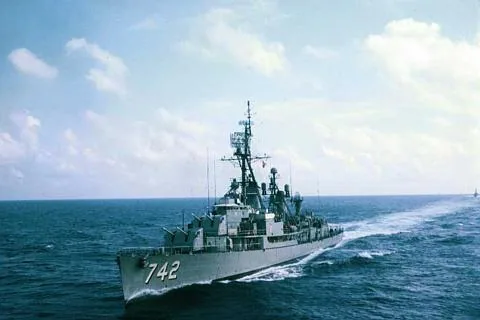
Frank Knox sailed from Yokosuka with TG 77.4 and Kitty Hawk on 6 January 1964 for exercises that stretched from Japan to Taiwan. After calling at Hong Kong, the task group returned north and arrived at Yokosuka on 10 February. Frank Knox began an upkeep period working on boilers, electronics, and hull maintenance. However, on the 18th, she was ordered to get underway to join TG 77.6. She departed the following day, still reassembling one boiler and reinstalling electronic equipment, to join Midway south of Honshu on the 20th. At 2105, a McDonnel F4B Phantom II crashed on takeoff from Midway. Frank Knox maneuvered to rescue Lt. D.W. Hanna and Lt. (j.g.) F.O. Boone of VF-21 and brought them aboard. They were returned to Midway on 21 February in return for five gallons of ice cream.
On 27 February 1964 Frank Knox was detached from TG 77.6 and ordered south to join TG 77.7 at Subic Bay. She arrived on 1 March and on the 3rd sailed from Subic with aircraft carrier Bon Homme Richard (CVA-31) and two destroyers for two weeks of exercises in the South China Sea. On the 21st, the task group steamed from Subic to Hong Kong for five days before returning.
On 31 March, TF 90, designated the Concord Squadron , consisting of Bon Homme Richard , Frank Knox , Shelton (DD-790), Blue (DD-744), and Hassayampa (AO-145), steamed from Subic Bay for the first U.S. goodwill tour into the Indian Ocean and the Persian Gulf. For 47 days, the squadron demonstrated U.S. naval power in action with air exercises and surface exercises. The ships called at Diego Suarez [Antsiranana], Madagascar; Mombasa, Kenya; Aden; and the Gulf of Oman. On 2 May 1964 the Shah of Iran, Mohammad Reza Pahlavi, flew on board Bon Homme Richard to observe air operations. Frank Knox demonstrated her naval gunnery and ASW capabilities. The Concord Squadron returned to Subic Bay on 15 May where, after a voyage of 18,113 miles, it was dissolved. Frank Knox , Shelton , and Blue steamed for Yokosuka and arrived on the 20th.
Frank Knox sailed with DesDiv 92 on 2 June 1964 and joined TG 77.6 and Constellation in the South China Sea on the 6th. She was assigned a radar picket position 100 miles from the task force and only saw it one time in the next 22 days. She was relieved on 28 June, directed to Subic Bay, and arrived on the 30th after dodging Typhoon Winnie . She departed the same day for Yokosuka and, after avoiding Typhoon Betty , moored on 5 July to begin an upkeep period until the 17th.
On 18 July 1964, DesDiv 92 and Frank Knox departed Yokosuka for her reassigned home port of San Diego. Steaming via Australia, Pago Pago, and Pearl Harbor, she arrived on 31 August. After a leave and upkeep period, she moored at the Long Beach Naval Shipyard on 24 September 1964 for a regular overhaul. The overhaul provided new and improved ASW capabilities and communications, and overhauled electronic, gunnery, and engineering equipment. She returned to San Diego on 14 January 1965 to begin two weeks of local operations and exercises.
On 8 February, Frank Knox sailed for Pearl Harbor for refresher training. She arrived on the 15th and immediately began exercises. While mooring on the 17th, she suffered a minor collision with destroyers Nicholas (DD-449) and radar picket escort ship Wilhoite (DER-397) due to an onsetting wind. All ships suffered dents and scrapes, with Nicholas damaging two deck stanchions and Wilhoite having superficial damage to her port bow. No injuries occurred.
1965 Operation Market Time
Frank Knox continued her refresher training into March and on the 17th recovered Lt. Cmdr. James W. Ryan and Lt. (j.g) B.R. Scott from aircraft carrier Midway ’s (CVA-41) VF-21 when they ejected from their McDonnell F4B Phantom II. She returned to San Diego on 1 April and departed for the western Pacific with TU 14.6.6 on 4 June 1965. The task unit consisted of guided missile light cruiser Galveston (CLG-9), fleet oiler Caliente (AO-53), and twelve destroyers including Frank Knox , bound for Subic Bay and, ultimately, Operation Market Time off the coast of South Vietnam.
Market Time was the effort by the U.S. Navy, Republic of Vietnam Navy, and the Royal Australian Navy, begun on 11 March 1965, to stop the flow of troops, war material, and supplies from North Vietnam into the south by sea, coast, and river. Frank Knox was among the first ships to join the operation from the West Coast.
Steaming non-stop across the Pacific, Frank Knox arrived at Subic on 22 June and on the 28th departed for her first Market Time assignment. From 30 June until 16 July she patrolled the Vietnamese coast, inspecting ships and junks for materials destined for Viet Cong forces. On 3 July, she bombarded Viet Cong shore positions at Ba Dong, South Vietnam. Her 5-inch guns fired 250 rounds into troop concentrations, supply buildings, and junks. She received a “Great Job!” report from her forward air controller. Upon completion of her assignment, she steamed for Kaohsiung for a port call.
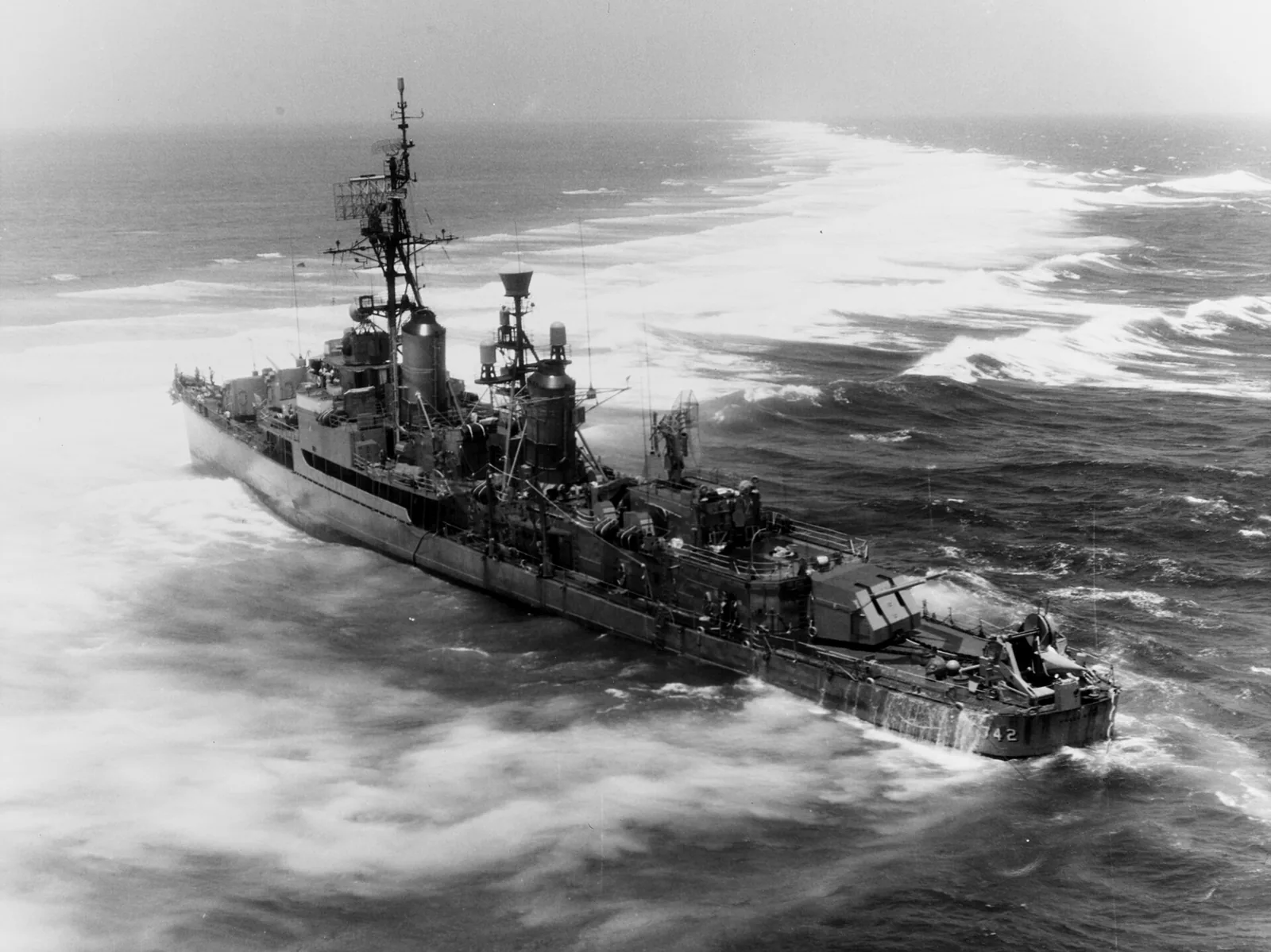
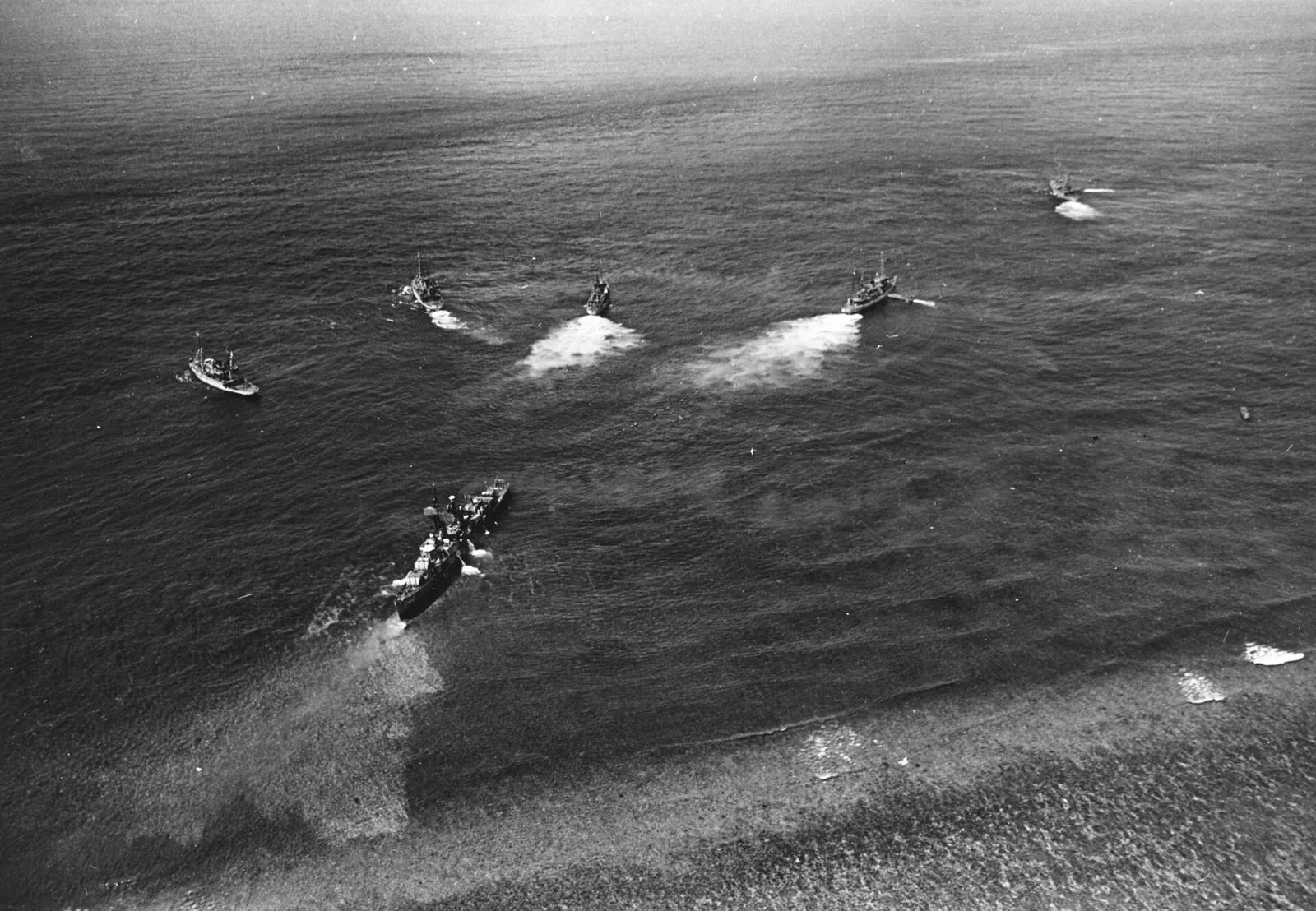
En route at 0231, 18 July 1965, Frank Knox ran aground on Paratus Reef, 180 miles southeast of Hong Kong. For the balance of the day, as sister ship Southerland (DD-743) stood by, she attempted to free herself through her engines, the shifting of fuel and water loads, shifting weight, and moving her crew from side to side. The ship developed a 4º starboard list. Swimmers reported that both screws were badly bent and the sonar dome had been sheared off. Leaks and frame damage were reported but flooding was under control. On the morning of the 19th, the fleet tugs Cocopa (ATF-101) and Munsee (ATF-111), and the salvage vessel Grapple (ARS-53) arrived to assist. G uided missile destroyer Joseph Strauss (DDG-16) also arrived. A salvage officer and team boarded Frank Knox , and while divers examined her hull damage, the two attending destroyers were released to resume their duties. U.S. Army barge #6535 came alongside and unloaded Frank Knox ’s forward ammunition supply. A forward fuel tank and bilge oil were pumped over the side to raise the bow off the reef. Fleet tug Mahopac (ATF-196) arrived that night.
On the morning of 20 July, Frank Knox unloaded 53,000 gallons of fuel oil into a barge alongside her. An attempt to pull her free was unsuccessful and opened new hull leaks, but the inflow was controlled. Wind and sea conditions made the salvage operation more difficult as water broke over Frank Knox ’s starboard quarter. Midway arrived on the 21st and 155 of Frank Knox ’s complement were transferred to her by helicopter with 92 men remaining on board. Work continued through the day with the ship rolling slightly with waves from Tropical Storm Gilda .
Work continued through the 22nd and additional ships arrived to support the operation. Split seams were reported and, on 23 July, a large hole was discovered in the hull between the forward fire and engine rooms, both of which were flooded. An attempt to refloat the ship on the 25th was unsuccessful, and it was decided to remove all classified material for safekeeping on board the amphibious assault ship Iwo Jima (LPH-2). Attempts to free Frank Knox on 26 July moved her astern ten feet before being halted. That evening, all ships were ordered to leave the area to avoid a typhoon. Only Iwo Jima , combat stores ship Mars (AFS-1), and salvage ship Conserver (ARS-39) remained with the grounded destroyer. Additional ships returned on the 28th.
Attempts to free Frank Knox continued into August. Equipment removed to lighten her included the port Hedgehog mount and the gun barrels from Mounts 51 and 52. On 5 August, a water displacing foam was pumped into her compartments. All remaining ammunition was removed on the 14th and the first underwater charge to break up the coral reef was detonated on 9 August, which ruptured a gas line and started a fire on board her.
In the end, it took over 100 charges to blast enough coral away to allow two pontoons to be lashed to her bow to lift her off the reef. At 0535 on 24 August 1965, Frank Knox floated free of Paratus Reef. She was rigged for towing by Conserver and departed for Kaohsiung, arriving on the 26th. She entered dry dock the following day where the extent of her damage could be assessed, which was significant. Her hull was holed and cracked; compartments had been flooded and then filled with foam; equipment and weapons had been removed to lighten her; and frame and machinery damage from flooding, explosive detonations, and wave-caused working of the hull on the reef was extensive. It had taken 37 days and the combined efforts of over 20 ships to free her.
At Kaohsiung work focused on restoring crew habitability and carrying out hull repairs. On 20 September, Frank Knox sailed under her own power, on one screw and with a tow assist from Munsee, for Yokosuka. They paused at Sasebo to avoid a typhoon and arrived on the 27th. Frank Knox entered dry dock on 29 September. The Navy decided to restore her to pre-grounding conditions, and that work would take until late 1966.
1966
Frank Knox was in dry dock at Yokosuka until 13 September 1966. She moored by the dry dock at the Naval Repair Facility and on the 19th her crew rescued an unidentified sailor from De Haven who had fallen into the dry dock and transported him to the naval hospital. She put to sea for the first time in over a year on 18 October for sea trials and an in-service inspection. After further trials and testing, she returned to duty on 21 November 1966, escorting Constellation to San Diego from Yokosuka.
En route on 25 November, Constellation and her escorts were battered by gale force winds for 24 hours. Newly repaired Frank Knox suffered sea water down a main deck hatch that shorted out her steering system, forcing her to use after steering control for the rest of the voyage. She arrived at San Diego on 3 December and Frank Knox served as flagship for DesDiv 172 from 5 until 30 December 1966.
1967
Routine but extensive local operations in the Southern California area occupied the first six months of 1967. On 25 July, Frank Knox steamed for Yokosuka via Pearl Harbor, accompanying Coral Sea and TG 17.2. En route on 11 August 1967, Coral Sea launched Combat Air Patrol (CAP) aircraft upon the detection of Soviet bloc aircraft at 150 miles range. The Soviet planes overflew the U.S. formation escorted by the CAP and departed the area at 0858. A second unidentified aircraft at 1653 prompted a second CAP launch, but the intruder was identified as friendly and the CAP returned to the carrier. The task group arrived at Yokosuka without further incident on 13 August and on the 17th departed for Subic Bay.
On 19 August, a Coral Sea Douglas A-1 Skyraider crashed into the sea 1,000 yards from Frank Knox ’s starboard bow. The airplane swiftly sank, and Frank Knox launched her whaleboat to search for the pilot. A Coral Sea rescue helicopter and destroyer Theodore E. Chandler (DD-717) joined the search but only recovered wreckage. The pilot, Lt. Cmdr. Fred H. Gates II, was deemed lost, and the search concluded. Frank Knox arrived at Subic on 22 August 1967 for a second Vietnam tour and departed Subic on the 25th with Coral Sea and four other destroyers bound for flight operations and naval gunfire support (NGS) duty in the South China Sea. Along with guided missile destroyer Benjamin Stoddert (DDG-22), Frank Knox fired on North Vietnamese shore targets on the evening of 29 and the morning of 31 August 1967.
NGS duties continued on 2 and 3 September with Frank Knox firing over 600 rounds of 5-inch ammunition. She fired another 203 rounds on the 4th before taking on 800 additional 5-inch rounds from ammunition ship Haleakala (AK-25) and firing another 200 on the 5th. She rejoined Coral Sea for flight operations on Yankee Station in the Gulf of Tonkin that evening. On 13 September, Frank Knox joined TG 77.8 and Oriskany for air operations. She rejoined Coral Sea on the 15th for screening, plane guard, and pilot rescue duties, and participated in ASW training in the Tonkin Gulf. In late September, Frank Knox operated jointly with Coral Sea and antisubmarine warfare support aircraft carrier Intrepid (CVS-11) on Yankee Station.
While conducting antisubmarine exercises on 23 September 1967, Frank Knox positioned herself between operations and the Soviet intelligence gathering ship Ampemeter which departed without further interference. On the morning of 30 September, Frank Knox and TG 77.3 joined TG 77 ( Constellation ) in the Gulf of Tonkin and proceeded to Subic Bay. They arrived on 2 October.
Frank Knox got underway on 11 October in company with Coral Sea and TG 77.3, bound for the Tonkin Gulf. On the 14th, the task group was shadowed during operations by two Soviet intelligence gathering ships, Ampemeter and Deflector . Ampemeter departed the area and Frank Knox was ordered to observe Deflector as the Soviet trailed the task group. On the 22nd, Frank Knox was detached and rendezvoused with Kearsarge at Subic Bay on 24 October.
On 3 November 1967, Frank Knox sortied from Subic to avoid Typhoon Emma . On the 5th, she, Coral Sea , and destroyer Hamner (DD-718) as TG 77.3 were directed to steam for Hong Kong. The following day she was detached to search for a downed aircraft but was recalled to the task group. Later that evening, the task group redirected to Paratus Reef and the grounded merchant vessel Loyal Fortunes . They arrived at the scene of Frank Knox ’s 1965 grounding on 7 November and Coral Sea took aboard 37 Loyal Fortunes crewmen. The task group proceeded to Hong Kong and arrived on the 8th.
TG 77.3 steamed for the Tonkin Gulf on 11 November 1967, and Coral Sea commenced air operations the following day. Frank Knox was detached on the afternoon of the 12th to take in tow an abandoned Fast Patrol Torpedo (PTF) boat that had become unseaworthy. Frank Knox and her tow proceeded toward Da Nang, and on 14 November the patrol boat was turned over to ocean minesweeper Conquest (MSO-488). Frank Knox then joined DesDiv 252 (guided missile destroyer Goldsborough (DDG-20) and Blue ) for patrol and NGS duty.
At 2204 on 14 November, DesDiv 252 opened fire on pre-selected North Vietnamese targets. Firing assignments continued over the next 10 days, aimed at watercraft moving supplies and reinforcements south and shore targets. On 18 November, while conducting shore bombardment, Frank Knox received counter fire from North Vietnamese shore batteries. She recorded 109 nearby shell splashes but suffered no damage or casualties. In exchange, she fired 129 5-inch rounds of various types ashore. On the 24th, she departed the Tonkin Gulf for Kaohsiung, having fired over 1,600 5-inch rounds at enemy targets. She had been refueled and rearmed three times during her patrol.
Frank Knox arrived at Kaohsiung on 26 November 1967 and departed on the 29th for the Tonkin Gulf. She rendezvoused with Coral Sea and TG 77.3 on 1 December for screening and rescue duty. On the 4th she joined TG 77.8 and Oriskany for similar duty. Detached again on the 6th, Frank Knox joined guided missile cruiser Chicago (CG-11) on a Positive Identification Radar Advisory Zone (PIRAZ) station to surveille and identify any aircraft that might pose a threat to nearby carriers and ships. Frank Knox was detached from PIRAZ duty and departed for ASW training on Yankee Station on 13 December.
She arrived on the 14th to exercise with destroyer John W. Thomason (DD-760) and submarine Sabalo (SS-302). Frank Knox completed training on 16 December and joined Ranger and TG 77.7 on the 17th. She joined fleet ocean tug Abnaki (ATF-96) for enemy trawler surveillance and resumed flight operation duties with Ranger on the 18th. Frank Knox was detached to proceed to Subic Bay on 19 December and arrived on the 21st for a general upkeep period. While moored there on 30 December 1967, word was received that crewman FN Randall Thornton had died of cardiac arrest at the U.S. Air Force hospital at Clark Air Force Base, Republic of the Philippines.
1968
On 2 January 1968, Frank Knox sailed for San Diego via Australia, New Zealand, Pago Pago, and Pearl Harbor. She arrived at the San Diego Naval Station on 6 February. After an upkeep period between 9 February and 21 March, she operated along the West Coast between San Diego and Astoria, Oregon. She had two more upkeep periods, one in September and the other in November, and from 9 until 31 December 1968, underwent pre-deployment preparation at San Diego.
Frank Knox was awarded the Arleigh Burke Fleet Trophy for 1968. The trophy is awarded each year to the ship in the U.S. Pacific Fleet which displays the greatest improvement in battle efficiency during the competitive year.
1969
On 1 January 1969, Frank Knox was redesignated as DD-742. The Navy had determined that her capabilities and mission profile no longer required the “DDR” (radar picket destroyer) designation. She was still a destroyer, but the change in hull number format from DDR to DD indicated she was no longer primarily serving a radar picket role. This reclassification was part of a broader Navy practice of updating hull numbers to reflect current mission and equipment standards.
Frank Knox departed San Diego on 6 January 1969 for Vietnam. Sailing via Pearl Harbor, Midway, and Guam, she arrived at Subic Bay on the 29th. On 2 February, she was on the NGS gun line off Qui Nhon, South Vietnam, in support of the Republic of Korea’s Capital Division. For two weeks she provided NGS, firing 1,571 5-inch rounds on enemy ground positions. After a short upkeep at Subic, she was on PIRAZ duty in the Tonkin Gulf from 26 February until 5 March 1969 and was on SAR station duty until the 9th. She returned to PIRAZ duty until she steamed for Sasebo and two weeks of upkeep and “R&R.”
She sailed on 8 April 1969 from Sasebo for Subic and arrived on the 12th. She proceeded to Hong Kong. On 17 April, two North Korean MiG-21 aircraft shot down a U.S. Lockheed EC-121M Warning Star reconnaissance aircraft over the Sea of Japan, killing all 31 servicemen aboard. The Seventh Fleet ordered a mobilization and, just 27 hours after arriving at Hong Kong, Frank Knox put to sea. She was in the Tonkin Gulf by 18 April, screening Kitty Hawk with destroyer Black (DD-666). On 8 May, Frank Knox aided an injured Chinese fisherman by taking him aboard, transferring him to Kitty Hawk for treatment, and returning him to his boat.
After a month on screening and plane guard duty, Frank Knox steamed for Sasebo and arrived on 16 May. She returned to Hong Kong on 1 June, and by the 8th was back on the gun line in Da Nang Harbor, supporting the 26th U.S. Marine Regiment. She was off Vung Tau, South Vietnam, from 13 to 18 June providing NGS to the U.S. Navy Advisory Group. She fired 1,536 rounds of 5-inch ammunition on these two assignments.
Frank Knox departed the western Pacific on 19 June 1969 for San Diego via Subic Bay; Manus Island; Townsend, Hayman Island, and Brisbane, Australia; Pago Pago; and Pearl Harbor. She arrived at San Diego on 27 July. After upkeep in August, Frank Knox began local operations on 2 September in various roles including NGS exercises, plane guard duty, and underway training. From 24 November to 11 December, she served as an engineering school ship. She ended the year moored in San Diego.
1970
Local operations resumed on 2 February 1970 in the Southern California operating area and continued until May. On 13 May, Frank Knox steamed for her last deployment to the western Pacific when she rendezvoused on the 15th with Oriskany , bound for Pearl Harbor. En route on the 18th, she stood by a disabled sailboat until the U.S. Coast Guard arrived to take over. Frank Knox moored on the 22nd and began local operations with Oriskany on the 23rd. On 26 May, Oriskany , escort ship Davidson (DE-1045), and Frank Knox departed for Subic Bay as TU 17.5. On 5 June, a man went overboard from Oriskany and was rescued by one of her helicopters while Frank Knox ’s whaleboat attended the recovery. The task unit arrived at Subic on 7 June 1970.
Frank Knox sailed for Yankee Station in the Gulf of Tonkin on 10 June with Oriskany . On station on the 14th, the Soviet intelligence trawler Protraktor began maneuvering to approach Oriskany . Frank Knox sounded a short siren blast to warn her away. The Soviet ship backed off but continued to follow the formation at various distances with Davidson , Arnold J. Isbell , and Frank Knox screening the carrier.
On the morning of 17 June, Frank Knox was detached for a gun line assignment. On the 19th, she anchored off the coast and opened harassment and interdiction (H&I) fire on targets in the IV Corps area of South Vietnam near the Mekong River. The mission lasted until 4 July and involved almost daily H&I and NGS assignments. She departed on the 5th for Subic Bay and arrived on the 7th.
On 13 July, Frank Knox steamed for the south SAR station in the Tonkin Gulf where she joined guided missile frigate Josephus Daniels (DLG-27) on the 15th on patrol. She was relieved of SAR duty by destroyer Bausell (DD-845) on 20 July and steamed to join TG 77.5 for tactical air navigation (TACAN) duty. She arrived the following day and assumed her patrol position covering Oriskany . Her assignment only lasted a day as she was detached for Subic Bay on 22 July and arrived on the 24th.
She was back on Yankee Station on 5 August 1970 to escort aircraft carrier Shangri-La (CVA-38) and TG 77.4. On 25 August, Frank Knox departed the Tonkin Gulf for Hong Kong and arrived on the 27th. From Hong Kong, she arrived at Subic with Oriskany on 5 September and was back on Yankee Station with aircraft carrier America (CVA-66) on the 17th. The following day, Frank Knox joined Shangri-La for flight operations duty.
On 23 September, Frank Knox assisted in the rescue of Lt. (j.g.) J.G. Hartmann, pilot of a Douglas A-4 Skyhawk that went into the water from Shangri-La. On the 28th, she was released to Kaohsiung but was recalled due to bad weather on 1 October. She rejoined TG 77.5 and Oriskany on the 3rd. On the 10th she investigated a Soviet tanker refueling an intelligence trawler in the area. Frank Knox was detached on 11 October to take up an NGS position off Tuy Hoa, South Vietnam. She provided H&I and NGS fire from the 13th until the 18th of October and then returned to Yankee Station. She joined Bon Homme Richard and TG 77.3 on the 19th, which proceeded to Subic Bay on 20 October, arriving on the 22nd.
Frank Knox steamed for San Diego on 28 October 1970 in company with Bon Homme Richard and Davidson . She arrived at the San Diego Naval Station on 12 November to begin preparations for decommissioning and transfer to the Royal Hellenic (Greek) Navy. At 1019 on 30 January 1971, the colors were hauled down aboard Frank Knox , the watch was secured, and she was decommissioned at the San Diego Naval Station.
1971
Frank Knox was transferred to the Royal Hellenic Navy (the Hellenic Navy since 1973) on 3 February 1971. Renamed Themistoklis (D-210) after the Athenian statesman who persuaded Athens to build a navy and then led it to victory over the Persians, she served until 31 August 1992. She was sunk as a target by a torpedo from the Greek submarine Nireus (S-111) on 12 September 2001.
Frank Knox received one battle star for World War II service: Third Fleet operations against Japan (10 July – 15 August 1945).
She received five stars for Korean service: North Korean Aggression (18 July – 3 August 1950); Inchon Landing (13-17 September 1950); Communist China Aggression (6 November 1950 – 19 January 1951); First UN Counteroffensive (25 January – 22 March 1951); Korean Defense, Summer-Fall (17 May – 19 October 1952).
She received nine campaign starts for Vietnam service: Vietnam Advisory (16 March 1962 – 7 March 1965); Vietnam Defense (8 March – 24 December 1965): Vietnam Counteroffensive Phase II (1 July 1966 – 31 May 1967); Vietnam Counteroffensive Phase III (1 June 1967 – 29 January 1968); Vietnam Counteroffensive Phase VI (2 November 1968 – 22 February 1969); Tet 69 Counteroffensive (23 February – 8 June 1969); Vietnam Summer – Fall 1969 (9 June – 31 October 1969); Sanctuary Counteroffensive (1 May – 30 June 1970); Vietnam Counteroffensive Phase VII (1 July 1970 – 30 June 1971).
Other photographs
Held for this vessel, and not tied to any part of the account above.

References
Every work this entry draws on. There are no numbered markers in the text above: what we hold is the provenance of the page — this history, this article, these photographs.
- History Frank Knox (DD-742) Dictionary of American Naval Fighting Ships, Naval History and Heritage Command. A work of the United States Government, in the public domain — the only text on this site reproduced verbatim.
- Facts USS Frank Knox Structured facts only — dates, dimensions, armament and fate. No wording is taken from it. Harvested 1 August 2026.
- Photograph USS Frank Knox (DD-742) underway off Hawaii in 1969 USN — Official U.S. Navy photo K-67405 from the U.S. Navy Naval History and Heritage Command — Public domain — Wikimedia Commons
- Photograph USS Frank Knox aground on Pratas Reef 1965 U.S. Navy — Official U.S. Navy photo USN 1114711 from the U.S. Navy Naval History and Heritage Command — Public domain — Wikimedia Commons
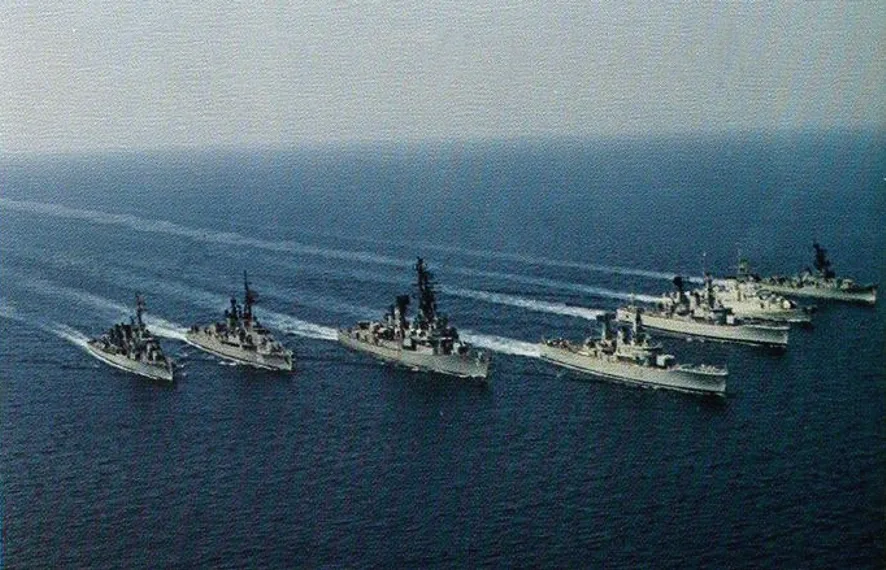
- Photograph NATO Standing Naval Force ships underway in the Mediterranean Sea 1972 U.S. Navy — U.S. Navy photo [1] from the USS Charles F. Adams (DDG-2) 1972 cruise book available at Navysite.de — Public domain — Wikimedia Commons
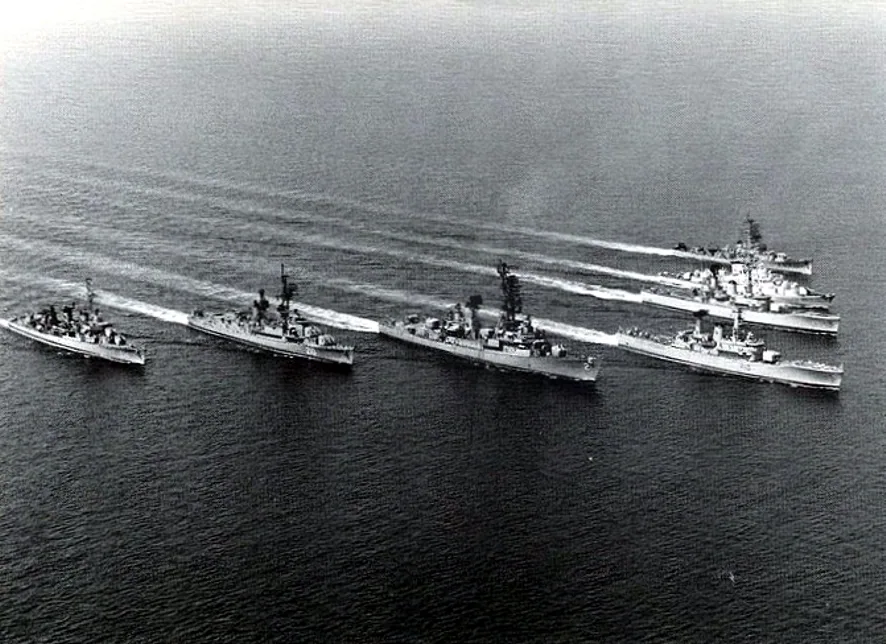
- Photograph NATO Standing Naval Force ships underway in the Mediterranean Sea, in 1972 U.S. Navy — U.S. Navy photo [1] from the USS Charles F. Adams (DDG-2) 1972 cruise book available at Navysite.de — Public domain — Wikimedia Commons
- Photograph Tugs pull USS Frank Knox (DDR-742) from Pratas Reef, South China Sea, on 24 August 1965 (NH 74179) Unknown author — U.S. Navy photo NH 74179 — Public domain — Wikimedia Commons
- Photograph USS Frank Knox (DD-742) in San Francisco Bay on 26 September 1947 (6098724011) Bill Larkins — USS Frank Knox DD742 — CC BY-SA 2.0 — Wikimedia Commons
- Photograph USS Frank Knox (DD-742) underway in 1945 Australian armed forces — Public domain — Wikimedia Commons
- Photograph USS Frank Knox (DDR-742) underway at sea c1963 U.S. Navy — U.S. Navy photo [1] from the USS Hornet (CVS-12) 1963-1964 cruise book available at Navysite.de — Public domain — Wikimedia Commons
- Photograph USS Frank Knox (DDR-742) underway in the Indian Ocean, circa 1964 U.S. Navy — U.S. Navy photo [1] available at Navsource.org — Public domain — Wikimedia Commons