USS Gridley (DD-380)
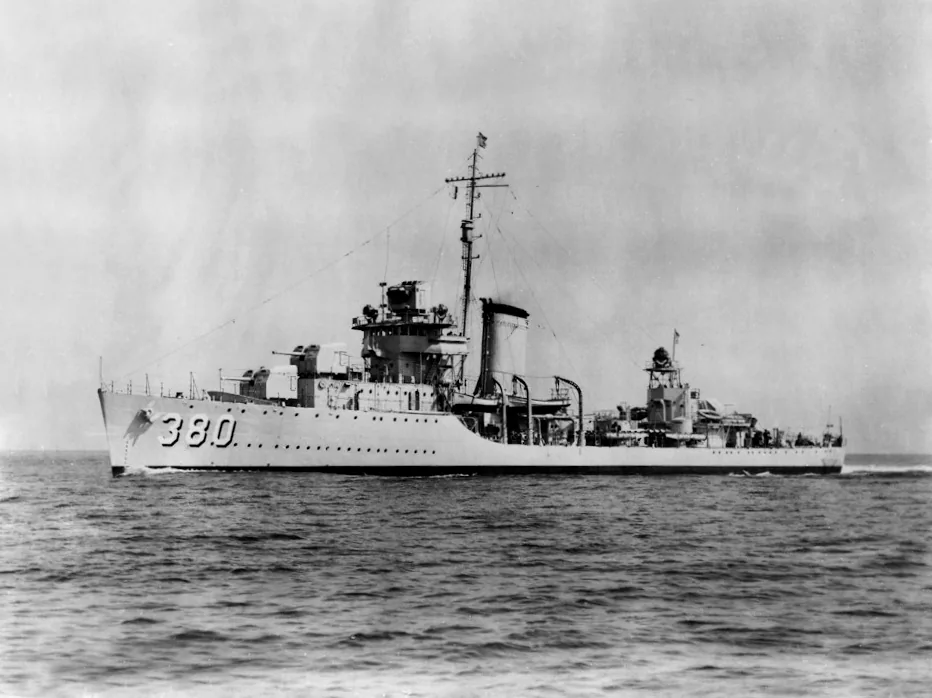
Service
- as Gridley24 June 1937 — 18 April 19462,193 days of the war
- Name
- USS Gridley
- Pennant / hull number
- DD-380
- Namesake
- Charles Vernon Gridley
- Builder
- Bethlehem Shipbuilding Corporation, Fore River Shipyard
- Laid down
- 3 June 1935
- Launched
- 1 December 1936
- Commissioned
- 24 June 1937
- Decommissioned
- 18 April 1946
- Struck
- 25 February 1947
- Fate
- Sold 20 August 1947 and scrapped (1947)
- Status
- Scrapped
Specifications
- Displacement, standard
- 1,590 long tons (1,616 t)
- Length
- 103.63 m (340 ft)
- Beam
- 10.67 m (35 ft)
- Draught
- 3.66 m (12 ft)
- Speed
- 38.5 knots (71.3 km/h, 44.3 mph)
- Range
- 6,500 nmi (12,038 km)
- Complement
- 158
- Main gun
- 127 mm (5 in)
Charles Vernon Gridley was born 24 November 1844 in Logansport, Ind., and was appointed to the Naval Academy in 1860. Reporting for duty with his class in September 1863, Gridley joind the sloop-of-war Oneida with the West Gulf Blockading Squadron and distinguished himself with Farragut at the Battle of Mobile Bay 5 August 1864. Promoted to Lieutenant in 1867 and Commander in 1882, he spent the next 30 years at various stations around the world, including a tour as instructor at the Naval Academy. Captain Gridley took command of Olympia, Admiral Dewey 's famous flagship, 27 April 1898, a post which he held despite failing health during the Battle of Manila Bay 1 May 1898. It was that morning that Dewey gave his famous command: "You may fire when you are ready, Gridley," immortalizing the doughty captain. After the destruction of the Spanish squadron and the capture of Manila, Gridley was obliged to leave his command because of his health, and died en route to the United States at Kobe, Japan, 25 May 1898.
The second Gridley was launched at the Fore River plant of Bethlehem Shipbuilding Corp., Quincy, Mass., 1 December 1936; sponsored by Mrs. Lewis Buddy III, daughter of Captain Gridley; and commissioned 24 June 1937, Comdr. Leroy W. Busbey, Jr., in command.
Gridley fitted out at Boston Navy Yard, and conducted shakedown in the Caribbean area until 27 October 1938, visiting Puerto Rico, Cuba, and Venezuela. She then underwent alterations at the Boston Navy Yard until 13 June 1938, when she departed that port, transited the Panama Canal, and entered San Diego harbor 5 July 1938. Joining Destroyer Division 11, Gridley spent the next months in tactical maneuvers off the coast of California, and 4 January 1939 departed with the Battle Force for combined maneuvers in the Caribbean. She participated in Fleet Problem 20 with the Fleet off Cuba and Haiti, after which she returned to Boston for repairs.
Continue to the full service history About 1,066 words
From the Dictionary of American Naval Fighting Ships, compiled by the Naval History and Heritage Command (Gridley II (DD-380)). A work of the United States Government, in the public domain.
Armament and machinery
Armament and machinery
- Propulsion
- 50000 shp Bethlehem geared turbines, 2 screws
- Armament
- 4 x 5 in/38 cal. guns
- 4 x .50 cal (12.7 mm) machine guns
- 16 x 21 inch (533 mm) torpedo tubes
Sister ships
Sources
- Facts harvested from USS Gridley (DD-380) on Wikipedia. Figures only — no wording is taken from it.
- Service history reproduced verbatim from Gridley II (DD-380) , Dictionary of American Naval Fighting Ships — public domain, a work of the United States Government.
- Photograph: USN — Official U.S. Navy photo [1] / [2] from the ship's entry in the U.S. Navy Dictionary of American Naval Fighting Ships (DANFS) available at the Naval History and Heritage Command — Public domain — Wikimedia Commons