USS Maury (DD-401)
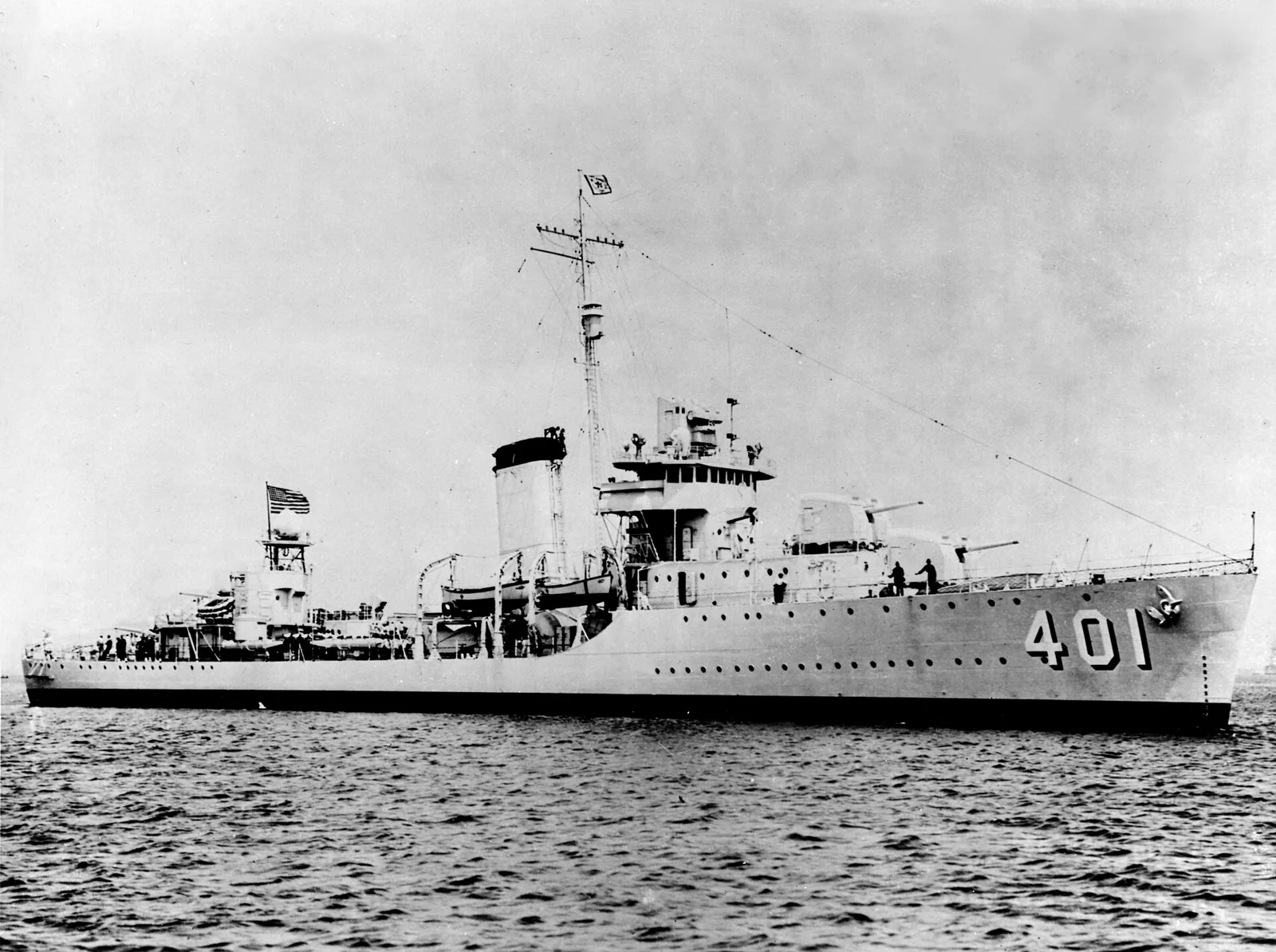
Service
- as Maury5 August 1938 — 19 October 19452,193 days of the war
- Name
- USS Maury
- Pennant / hull number
- DD-401
- Namesake
- Matthew Fontaine Maury
- Builder
- Union Plant, Bethlehem Shipbuilding Corporation, San Francisco, California
- Laid down
- 24 March 1936
- Launched
- 14 February 1938
- Commissioned
- 5 August 1938
- Decommissioned
- 19 October 1945
- Struck
- 1 November 1945
- Fate
- Sold for scrapping, 13 June 1946 (1946)
- Status
- Scrapped
Specifications
- Displacement, standard
- 1,500 long tons (1,524 t)
- Length
- 103.94 m (341 ft)
- Beam
- 10.67 m (35 ft)
- Draught
- 4.27 m (14 ft)
- Speed
- 36.5 knots (67.6 km/h, 42 mph)
- Range
- 5,000 nmi (9,260 km)
- Complement
- 176
- Main gun
- 127 mm (5 in)
Comdr. Matthew Fontaine Maury , astronomer and hydrographer, was born in Spotsylvania County, Va., 14 January 1806. Appointed midshipman 1 February 1825, he achieved the rank of commander 14 September 1855. He was appointed Superintendent of the Department of Charts and Instruments in 1842, and upon the establishment of the Naval Observatory in 1844 became its first superintendent, holding that position until his resignation in April 1861. During this period, he published some of his best known scientific works, and his "Wind and Current Charts," "Sailing Directions," and "Physical Geography of the Sea" remain standard. He became world famous as "Pathfinder of the Seas," the leading oceanograpber of history. Following his resignation at the outbreak of the Civil War , he joined the Confederate Navy, in which he attained the rank of commodore. At the end of the war he occupied the chair of physics at the Virginia Military Institute. He died at Lexington, Va., 1 February 1873.
The second Maury (DD‑401) was laid down 24 March 1936 by Union Plant, Bethlehem Shipbuilding Corp., San Francisco, Calif.; launched 14 February 1938; sponsored by Miss Virginia Lee Maury Werth, granddaughter of Commander Maury; and commissioned 5 August 1938, Lt. Comdr. Edward M. Thompson in command.
Assigned to the Pacific Fleet after commissioning, Maury was operating out of Pearl Harbor when the United States entered World War II. She was steaming with Enterprise, (CV-6),en route to Hawaii from TF 8 operations near Wake, when word of the Japanese attack reached her soon after 0900, 7 December 1941. The ship went to general quarters as the force began an unsuccessful search for the Japanese Fleet. By the time the force returned to Pearl Harbor only one enemy vessel had been sighted and sunk, by carrier aircraft, the submarine 1‑70 on the 10th. For the remainder of 1941, Maury, in the screen of Enterprise, stayed in the Hawaiian area to guard against a followup attack by the Japanese.
Continue to the full service history About 1,346 words
From the Dictionary of American Naval Fighting Ships, compiled by the Naval History and Heritage Command (Maury II (DD-401)). A work of the United States Government, in the public domain.
Armament and machinery
Armament and machinery
- Propulsion
- 50000 shp Bethlehem geared turbines, 2 screws
- Armament
- 4 × 5 in/38 cal. guns
- 16 × 21 inch (533 mm) torpedo tubes
Sister ships
Sources
- Facts harvested from USS Maury (DD-401) on Wikipedia. Figures only — no wording is taken from it.
- Service history reproduced verbatim from Maury II (DD-401) , Dictionary of American Naval Fighting Ships — public domain, a work of the United States Government.
- Photograph: Unknown author — U.S. Navy photo NH 42150 — Public domain — Wikimedia Commons