United States Navy — Destroyer
USS Hambleton — service history
This is the full service history. For the vessel's particulars, photograph and specifications, see the entry.
In the words of the US Navy. The account below is reproduced verbatim from the Dictionary of American Naval Fighting Ships, compiled by the Naval History and Heritage Command — a work of the United States Government, in the public domain, and the only text on this site not written here.
Before commissioning
Samuel Hambleton was born in 1777 in Talbot County, Md. Entering the Navy as a Purser 6 December 1806, he served as Acting Lieutenant in Lawrence during the battle of Lake Erie in the War of 1812. Commodore Oliver Hazard Perry commended Hambleton for gallant conduct in encouraging his men and personally working a gun until severely wounded. Until 1832 Purser Hambleton served actively in the Navy, attached to Java and Columbus during Mediterranean cruises and to John Adams and Erie in the West Indies. With the exception of a tour of duty at the Philadelphia Navy Yard from 1843 to 1845, Hambleton remained on leave or waiting order from 1832 until his death 17 January 1851 in Talbot County.
Second World War 1939–1945
1940
Hambleton (DD-455) was laid down by the Federal Shipbuilding & Drydock Co., Kearney, N.J., 16 December 1940, launched 26 September 1941; sponsored by Mrs. Nannie Hambleton Martin, great grandniece of Samuel Hambleton; and commissioned 22 December 1941, Cmdr. Forrest Close in command.
1942
Departing Norfolk 31 January 1942, in company with her sister ship Emmons, Hambleton began a shakedown, unique in wartime, that took her through the Panama Canal to Callao, Peru; Valparaiso, Chile; Guayaquil, Ecuador; Cartagena, Colombia; and Balboa, C.Z. She was diverted for antisubmarine search north of Cuba in early March and on 15 March 1942 rescued six men on a life raft who had survived the torpedoing of SS Ceibra. After antisubmarine patrol along the East Coast and intensive training in Casco Bay, Maine, Hambleton sailed as escort to Augusta, and Ranger 14 April. Reaching Africa's Gold Coast 10 May, Ranger launched her cargo of P-40 fighter planes for the North African fighting and headed back to the West Indies. In heavy rain and low visibility 17 May Hambleton collided with Ellyson (DD-454) and had to proceed to San Juan and then Charleston for repairs.
Hambleton joined a fast troop transport out of New York 1 July, sailed for Ireland and arrived 11 July. Immediately she reported for duty with the joint British and American Naval Forces in Europe. With Royal Navy personnel on board as communications liaison, she conducted antisubmarine patrols and served as plane guard for HMS Duke of York through August She then returned to the United States for duty along the coast in preparation for Operation "Torch," the forthcoming invasion of North Africa.
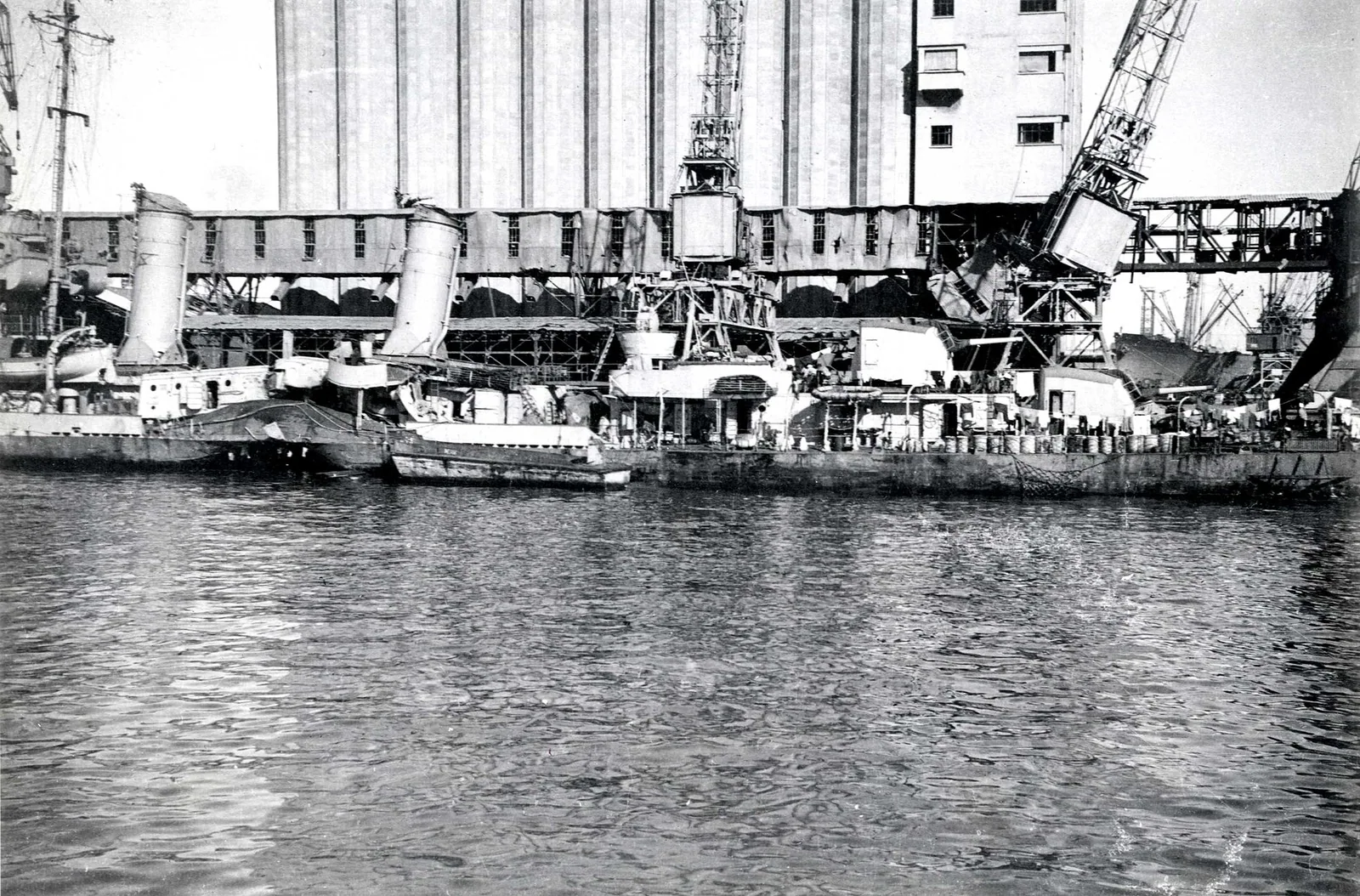
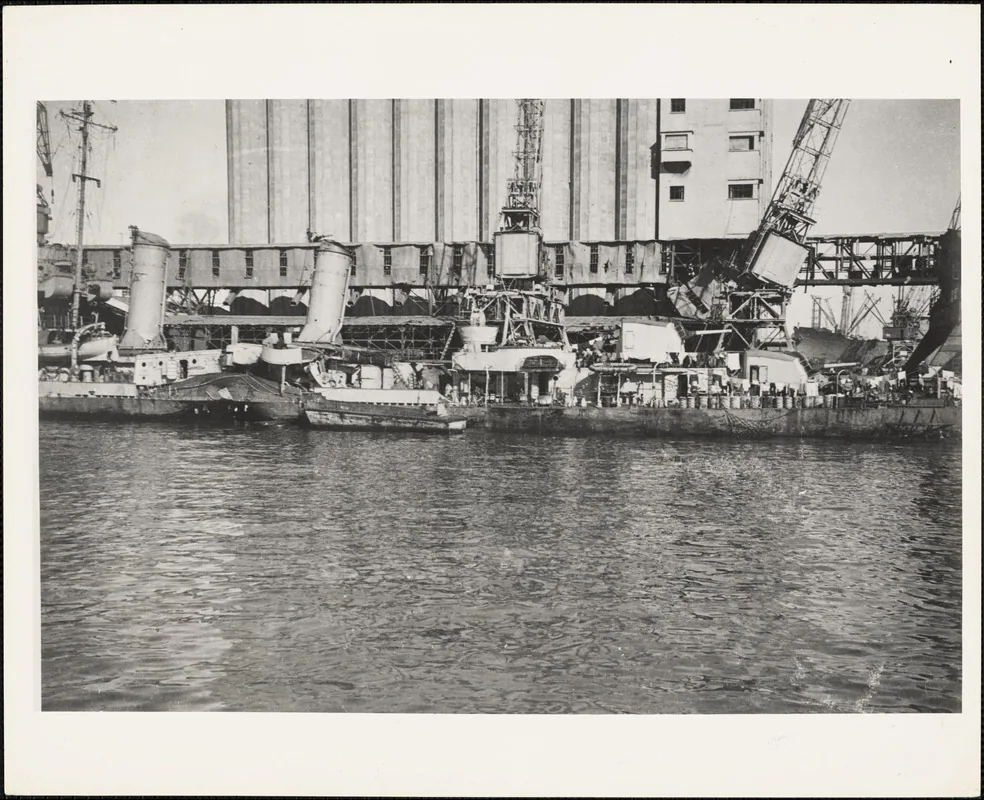
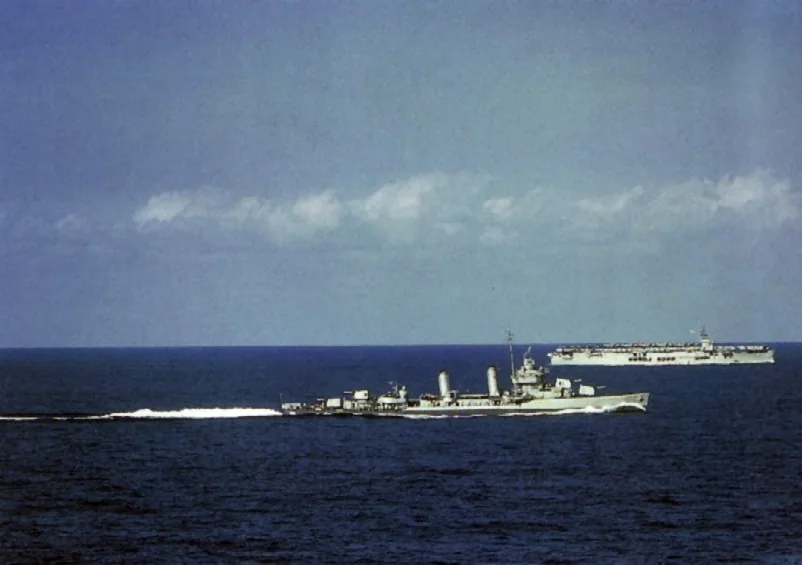
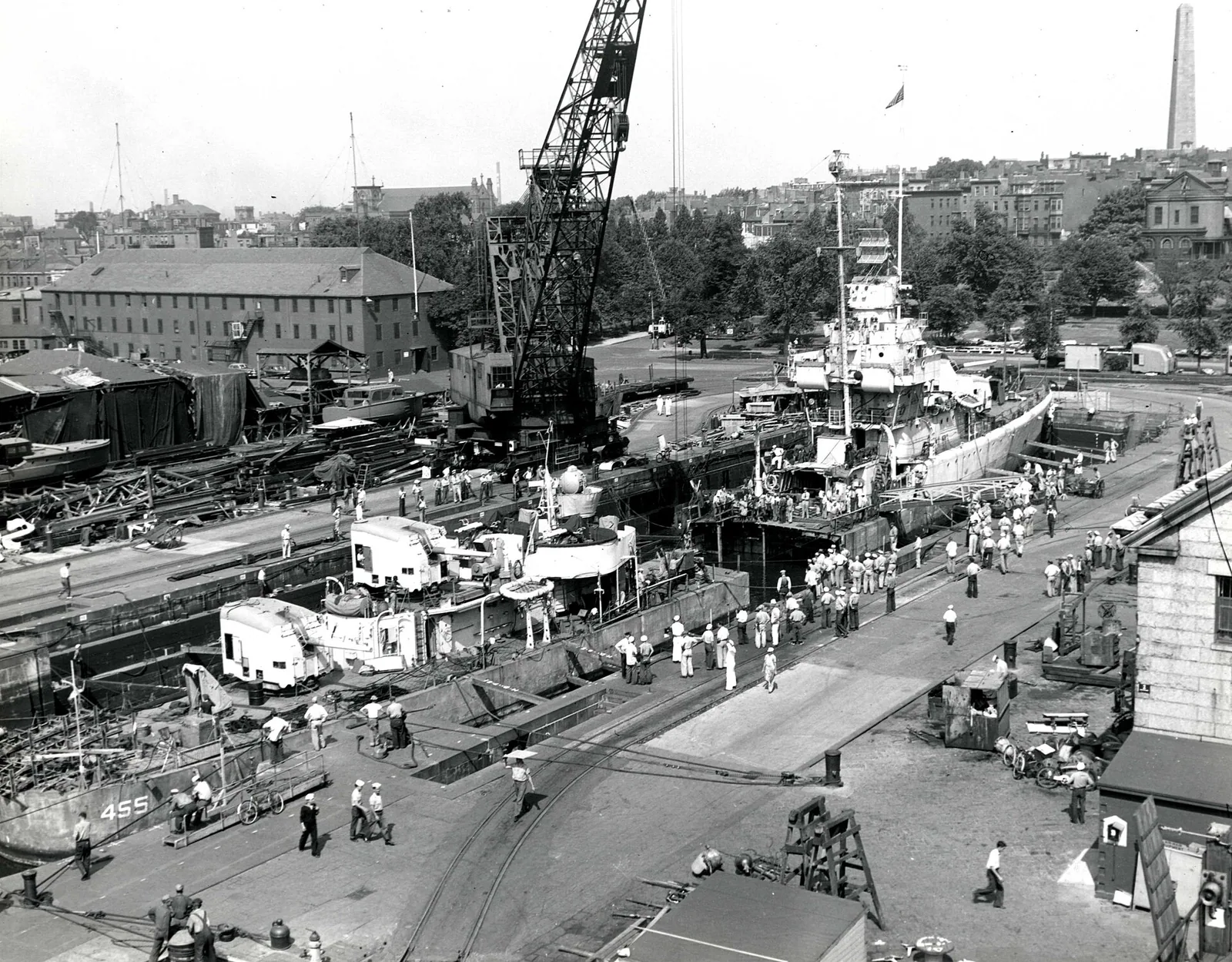
Hambleton joined the invasion fleet 28 October; and, as part of Admiral H. K. Hewitt's Western Naval Task Force, she screened the carrier Sangamon during operations against airfields in French Morocco on D-day, 8 November. As she lay anchored by Winooski off Fedala in the evening of 11 November 1942, Hambleton was struck amidships on the port side by a U-boat torpedo. With all power gone, the destroyer took a 12 degree list to starboard as her damage control parties worked swiftly to jettison topside weights and shore up weakened bulkheads. The crippled ship was towed to Casablanca for temporary repairs. Seabees there cut the ship in two, removed a 40-foot section of her damaged hull, then joined the two remaining halves together. Escorted by a tug, Hambleton reached Boston 28 June for permanent repairs.
1944
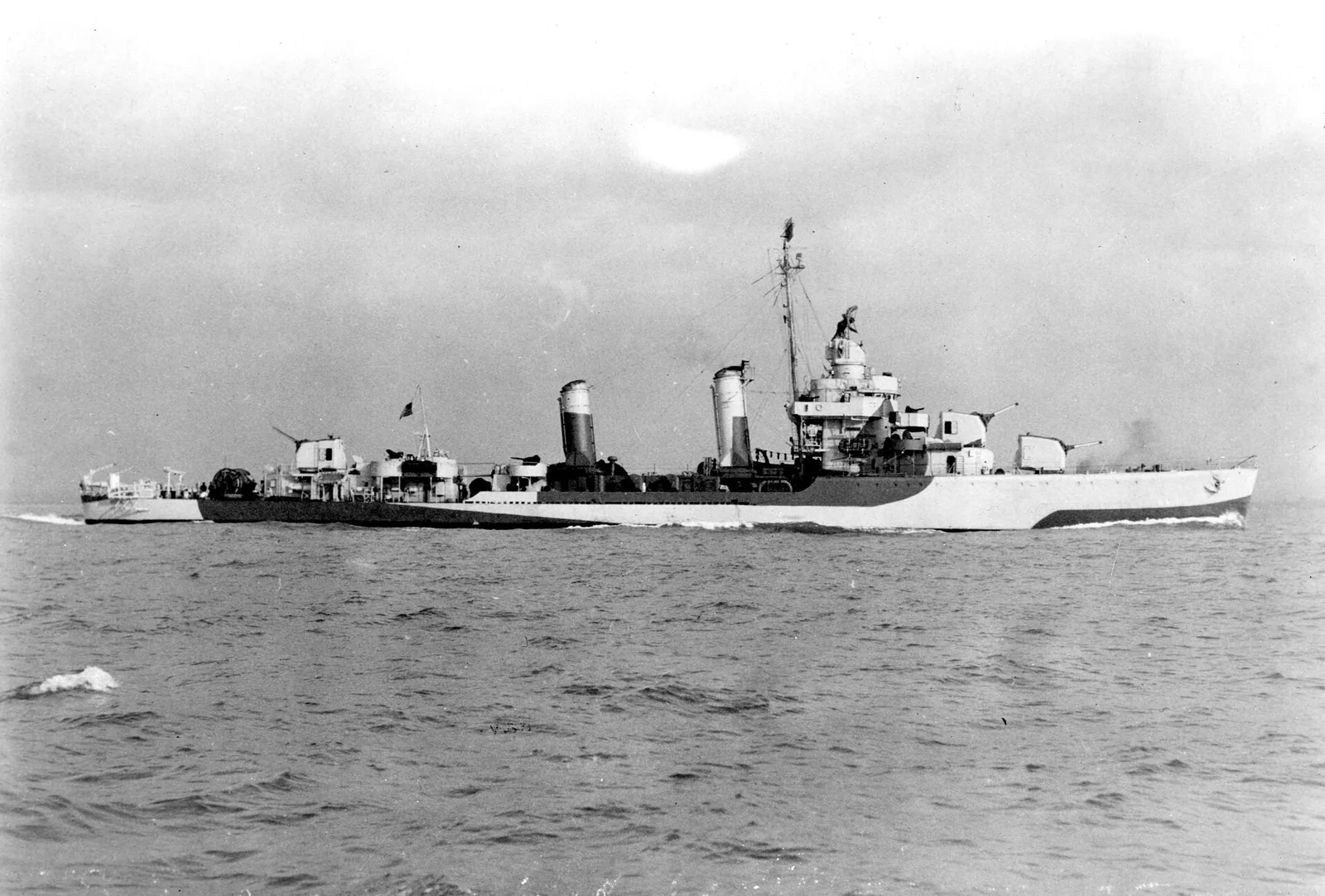
After a second shakedown in the Caribbean and training along the East Coast, Hambleton escorted a convoy to Oran in April 1944, and began to prepare for her role in the Normandy Invasion. Operating in the Western Mediterranean with seven other destroyers and British scout planes, she sank U-616 on 17 May after an intensive 4-day pursuit of the German marauder. From the Mediterranean Hambleton sailed to Plymouth, England, staging area for the epochal invasion. She escorted a large convoy of LST's to the landing areas on 7 June, D-day plus 1, and remained off Omaha Beach for critical shore bombardment and screening duties. In the early morning hours of 9 June Sambleton's radar picked up several contacts, soon determined to be Nazi E-boats. Her guns blazing, Hambleton set out after the enemy. In a 4-hour running gun battle she sank one and severely damaged another of the five German boats. After returning for provisions at Porlant, England, Hambleton was back on the line for the bombardment of Cherbourg 25 June.
1945 Okinawa
Hambleton departed Belfast, Ireland, 4 July and steamed to the Mediterranean, touching Oran, Algeria, 10 July and reaching Naples, Italy, 15 July. On 11 August she participated in the bombardment of shore positions on the southern coast of France prior to Operation "Anvil," the invasion of that vital area. Hambleton remained in the Mediterranean for patrol and screening duty until sailing for Boston 25 October. Arriving Boston 8 November, the battle-training destroyer was converted into a high speed mine sweeper and redesignated DMS-20 on 15 November. Hambleton emerged from the yard 19 December and sailed for the Pacific 30 December. Steaming via San Diego, Pearl Harbor, and Eniwetok, she arrived Ulithi 9 March 1945, to prepare for the invasion of Okinawa, the largest amphibious assault in the Pacific. Departing 19 March, she arrived off Okinawa, the gateway to the heart of the Japanese Empire, 23 March. Prior to the invasion 1 April, she cleared channels and anchorages for the 1,200 ships taking part in the invasion. During the long campaign that followed she operated off Okinawa to sweep, screen, patrol, and provide fire support. She was under almost constant attack from the air. Although, damaged 3 April by a kamikaze which splashed close aboard her port quarter, Hambleton remained on duty as part of the mighty fleet that had come to the Ryukyus to stay, despite all the Japanese could unleash.
With Okinawa nearly secured, Hambleton and her sister ships deployed to the East China Sea in mid-July to begin massive sweeping of this area. In a month they cleared more than 600 miles from the 7,200 square mile area in one of the largest sweep operations yet launched. Hambleton was in the East China Sea for a second such mission when Japanese acceptance of peace terms was announced 15 August. Joining Admiral Halsey's 3d Fleet off Tokyo, Hambleton steamed into Tokyo Bay 28 August, to clear the way for the occupation forces. In the next few months Hambleton swept a total of 184 mines from Japanese minefields in various straits and channels. During this period she rode out four typhoons, one of which battered her with 60-foot waves. Departing Japanese waters 20 November, Hambleton steamed via Eniwetok, Pearl Harbor, and San Diego to Norfolk arriving late December.
Based at Charleston, S.C., the veteran minesweeper maintained an operational pattern that kept her prepared to meet our nation's needs in the emerging cold war struggle. During the next decade Hambleton participated in fleet and tactical exercises in the Caribbean and along the East Coast. In 1949, 1952, and 1954 she deployed to the Mediterranean and operated with the mighty 6th Fleet from the shores of North Africa to the turbulent Middle East while helping to preserve freedom and maintain peace in that unsettled area of the world.
Cold War 1954–1963
1954
After returning to Charleston from her third Medlterrean cruise 6 July 1954, Hambleton decommissioned 15 January 1955, and entered the Atlantic Reserve Fleet. She was reclassifled DD-455 the same day. At present she is berthed at Orange, Tex.
Other photographs
Held for this vessel, and not tied to any part of the account above.


References
Every work this entry draws on. There are no numbered markers in the text above: what we hold is the provenance of the page — this history, this article, these photographs.
- History Hambleton (DD-455) Dictionary of American Naval Fighting Ships, Naval History and Heritage Command. A work of the United States Government, in the public domain — the only text on this site reproduced verbatim.
- Facts USS Hambleton Structured facts only — dates, dimensions, armament and fate. No wording is taken from it. Harvested 1 August 2026.
- Photograph USS Hambleton (DD-455) underway in February 1944 (7321565) Department of the Navy. First Naval District. Office of the Assistant Chief of Staff for Administration. Office of the Historical Officer. — Public domain — Wikimedia Commons
- Photograph USS Hambleton (DD-455) torpedoed in November 1942 Department of the Navy. First Naval District. Office of the Assistant Chief of Staff for Administration. Office of the Historical Officer. — Public domain — Wikimedia Commons
- Photograph USS Hambleton (DMS-20) at sea c1944 Department of the Navy. First Naval District. Office of the Assistant Chief of Staff for Administration. Office of the Historical Officer. — Public domain — Wikimedia Commons
- Photograph DD-455 USS HAMBLETON Shown at Casablanca shortly after being torpedoed - DPLA - 2824d68349145cff607dccd2fbc45476 United States. Navy. Naval District, 1st — This file was contributed to Wikimedia Commons by National Archives at Boston as part of a cooperation project. The donation was facilitated by the Digital Public Library of America , via its partner Digital Commonwealth . Record in source catalog DPLA identifier: 2824d68349145cff607dccd2fbc45476 National Archives at Boston identifier: Local accession: 1138081 — Public domain — Wikimedia Commons
- Photograph DD-455 USS HAMBLETON-Torpedoed 11 November 1942-Picture shows vessel after being cut in half in Drydock-1 - DPLA - ab85c5d17f34034d62392fd5a29c6c9c United States. Navy. Naval District, 1st — This file was contributed to Wikimedia Commons by National Archives at Boston as part of a cooperation project. The donation was facilitated by the Digital Public Library of America , via its partner Digital Commonwealth . Record in source catalog DPLA identifier: ab85c5d17f34034d62392fd5a29c6c9c National Archives at Boston identifier: Local accession: 1138081 — Public domain — Wikimedia Commons
- Photograph DD-455 USS Hambleton. Repaired by NYBos -Later converted to DMS-20 - DPLA - 3a45e40d0d7b362615658958248617e3 United States. Navy. Naval District, 1st — This file was contributed to Wikimedia Commons by National Archives at Boston as part of a cooperation project. The donation was facilitated by the Digital Public Library of America , via its partner Digital Commonwealth . Record in source catalog DPLA identifier: 3a45e40d0d7b362615658958248617e3 National Archives at Boston identifier: Local accession: 1138081 — Public domain — Wikimedia Commons
- Photograph DMS-20 Former DD-455 USS HAMBLETON-Rebuilt and converted by NYBos - DPLA - 05d5f35fac0ecc199f49b458b2476a8b United States. Navy. Naval District, 1st — This file was contributed to Wikimedia Commons by National Archives at Boston as part of a cooperation project. The donation was facilitated by the Digital Public Library of America , via its partner Digital Commonwealth . Record in source catalog DPLA identifier: 05d5f35fac0ecc199f49b458b2476a8b National Archives at Boston identifier: Local accession: 1138081 — Public domain — Wikimedia Commons
- Photograph USS Hambleton (DD-455) and USS Sangamon (ACV-26) 1942 USN — U.S. Navy photo [1] available on navsource.org — Public domain — Wikimedia Commons
- Photograph USS Hambleton (DD-455) at the Boston Navy Yard in 1943 Department of the Navy. First Naval District. Office of the Assistant Chief of Staff for Administration. Office of the Historical Officer. — Public domain — Wikimedia Commons