USS Hambleton
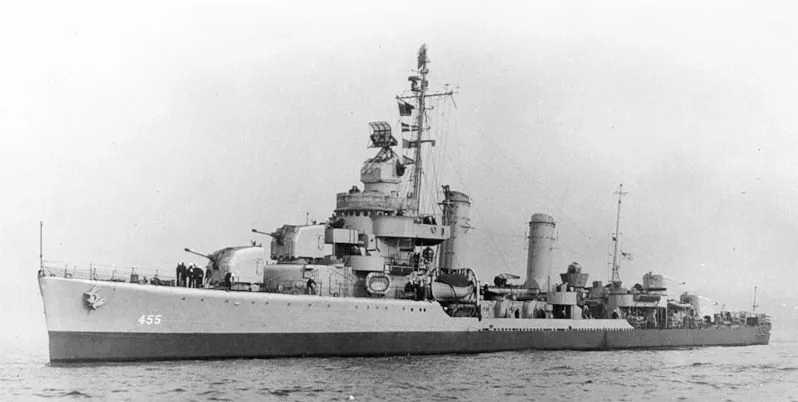
Service
- as Hambleton22 December 1941 — 15 January 19551,350 days of the war
- Name
- USS Hambleton
- Pennant / hull number
- DD-455
- Namesake
- Samuel Hambleton
- Builder
- Federal Shipbuilding & Drydock Co.
- Laid down
- 16 December 1940
- Launched
- 26 September 1941
- Commissioned
- 22 December 1941
- Decommissioned
- 15 January 1955
- Struck
- 1 June 1971
- Fate
- Sold for scrap
22 November 1972 - Status
- Scrapped
Specifications
- Displacement, standard
- 2,200 long tons (2,235 t)
- Length
- 105.77 m (347 ft)
- Beam
- 10.97 m (36 ft)
- Draught
- 4.57 m (15 ft)
- Speed
- 35 knots (64.8 km/h, 40.3 mph)
- Range
- 6,500 nmi (12,038 km)
- Complement
- 272
- Main gun
- 127 mm (5 in)
Samuel Hambleton was born in 1777 in Talbot County, Md. Entering the Navy as a Purser 6 December 1806, he served as Acting Lieutenant in Lawrence during the battle of Lake Erie in the War of 1812. Commodore Oliver Hazard Perry commended Hambleton for gallant conduct in encouraging his men and personally working a gun until severely wounded. Until 1832 Purser Hambleton served actively in the Navy, attached to Java and Columbus during Mediterranean cruises and to John Adams and Erie in the West Indies. With the exception of a tour of duty at the Philadelphia Navy Yard from 1843 to 1845, Hambleton remained on leave or waiting order from 1832 until his death 17 January 1851 in Talbot County.
Hambleton (DD-455) was laid down by the Federal Shipbuilding & Drydock Co., Kearney, N.J., 16 December 1940, launched 26 September 1941; sponsored by Mrs. Nannie Hambleton Martin, great grandniece of Samuel Hambleton; and commissioned 22 December 1941, Cmdr. Forrest Close in command.
Departing Norfolk 31 January 1942, in company with her sister ship Emmons, Hambleton began a shakedown, unique in wartime, that took her through the Panama Canal to Callao, Peru; Valparaiso, Chile; Guayaquil, Ecuador; Cartagena, Colombia; and Balboa, C.Z. She was diverted for antisubmarine search north of Cuba in early March and on 15 March 1942 rescued six men on a life raft who had survived the torpedoing of SS Ceibra. After antisubmarine patrol along the East Coast and intensive training in Casco Bay, Maine, Hambleton sailed as escort to Augusta, and Ranger 14 April. Reaching Africa's Gold Coast 10 May, Ranger launched her cargo of P-40 fighter planes for the North African fighting and headed back to the West Indies. In heavy rain and low visibility 17 May Hambleton collided with Ellyson (DD-454) and had to proceed to San Juan and then Charleston for repairs.
Continue to the full service history About 1,135 words
From the Dictionary of American Naval Fighting Ships, compiled by the Naval History and Heritage Command (Hambleton (DD-455)). A work of the United States Government, in the public domain.
Armament and machinery
Armament and machinery
- Propulsion
- 50000 shp
- 2 propellers
- Armament
- 4 × 5 in dual purpose guns
- 4 × Bofors 40 mm guns
- 5 × Oerlikon 20 mm cannons
- 5 × 21 in torpedo tubes
- 6 × depth charge projectors
- 2 × depth charge tracks
Sister ships
- USS Aaron Ward (DD-483)
- USS Baldwin
- USS Beatty (DD-640)
- USS Bristol (DD-453)
- USS Buchanan (DD-484)
- USS Butler
- USS Carmick
- USS Corry (DD-463)
- USS Cowie
- USS Davison
- USS Doran (DD-634)
- USS Doyle (DMS-34)
- USS Duncan (DD-485)
- USS Earle
- USS Eberle
- USS Edison (DD-439)
- USS Edwards (DD-619)
- USS Ellyson
- USS Emmons
- USS Endicott
- USS Ericsson (DD-440)
- USS Fitch
- USS Forrest
- USS Frankford
Sources
- Facts harvested from USS Hambleton on Wikipedia. Figures only — no wording is taken from it.
- Service history reproduced verbatim from Hambleton (DD-455) , Dictionary of American Naval Fighting Ships — public domain, a work of the United States Government.
- Photograph: Department of the Navy. First Naval District. Office of the Assistant Chief of Staff for Administration. Office of the Historical Officer. — Public domain — Wikimedia Commons