United States Navy — Destroyer
USS King (DD-242) — service history
This is the full service history. For the vessel's particulars, photograph and specifications, see the entry.
In the words of the US Navy. The account below is reproduced verbatim from the Dictionary of American Naval Fighting Ships, compiled by the Naval History and Heritage Command — a work of the United States Government, in the public domain, and the only text on this site not written here.
Before commissioning
The first King was named after Frank Ragan King, born 15 October 1884 in Montevallo, Ala. He was appointed midshipman at the Naval Academy 6 May 1903 and graduated 11 February 1907. After serving as passed midshipman, he was commissioned Ensign 12 February 1909. He served in Arkansas, Hartford, Milwaukee, Pennsyl vania, and Illinois before attaining the rank of Commander 21 September 1918. He assumed command of trawler Richard Buckley 7 July 1919 during minesweeping operations in the North Sea. On 12 July 1919 his ship struck a mine and went down in only 7 minutes.
During the crisis King exerted himself to see that all of his crew might be saved. King's feeling for his men was evidenced by the fact that his final act before going down with his ship was to strap his own life preserver to a stunned sailor and help him over the side. Comdr. King received the Distinguished Service Medal for his valor.
The second King (DLG-10) was named after Ernest Joseph King, born 23 November 1878 in Lorain, Ohio. He was appointed to the Naval Academy in 1897. In July 1898, during the Spanish-American War, he served as Naval Cadet in San Francisco, flagship of the Northern Patrol Squadron. Upon graduation from the Academy he was commissioned Ensign 7 June 1903.
Prior to World War I King served in the Asiatic Fleet, Atlantic Fleet, and shore duty at Annapolis, Md. During World War I he served as Aide and Squadron Engineer to Admiral Mayo, Commander in Chief, Atlantic Fleet. After the war, with the rank of Captain, he again served at the Naval Academy as head of the Postgraduate Department.
Interwar 1919–1938
1928

King next turned his attention to submarines and the expanded role of naval aviation. After training at Pensacola, he received his wings. He was named Assistant Chief of the Bureau of Aeronautics, Navy Department in August 1928. After promotion to Rear Admiral 26 April 1933 King served as Chief of the Bureau.
On 1 February 1941 he was designated Commander in Chief, Atlantic Fleet with the rank of Admiral. Soon after the United States entered World War II, President Roosevelt appointed King Chief of Naval Operations and the Senate confirmed the appointment 18 March 1942. In this office, with wisdom, inflexible integrity, and determination, he mapped out the strategy and vigorously directed the operations of the unprecedented naval campaigns which led to victory over Axis powers in Europe and crushed Japan in the Pacific. By act of Congress 14 December 1944, the grade of Fleet Admiral U.S. Navy was established; his appointment to that rank was confirmed the same day.
After he was relieved by Fleet Admiral Nimitz as Chief of Naval Operations, King continued to serve on active duty in an advisory capacity in the Office of the Secretary of the Navy. He died at the Naval Hospital,. Portsmouth, N.H., 25 June 1956. During his naval career, Fleet Admiral King received the Navy Cross, and the Distinguished Service Medal with two Gold Stars, in addition to many other awards from the United States and foreign governments.
The first King (Destroyer No. 242) was laid down 28 April 1919 by the New York Shipbuilding Corp., Camden, N.J.; launched 14 October 1920; sponsored by Mrs. Allene A. King, widow of Oomdr. King; and commissioned 16 December 1920, Lt. Comdr. R. C. Smith, in command.
After shakedown and training operations along the Atlantic Coast King cleared Hampton Roads 2 October 1921 for her first Mediterranean cruise. Arriving Smyrna, Turkey, 8 November, the destroyer received 300 Greek refugees for transport to Mitylene, Greece. The destroyer served as station ship during the Crimean Crisis, remaining in Turkish waters until June 1923.
Upon return to the United State during the summer, King joined the Atlantic Scouting Fleet and from 1923 to 1930 engaged in fleet exercises and reserve training cruises along the coast and in the Caribbean. She sailed for the Pacific 15 April 1925 for maneuvers in Hawaiian waters. During the spring of 1927, she patrolled waters off Nicaragua to protect American citizens and interests during civil war in that country. King decommissioned at Philadelphia 10 March 1931.
1932

She recommissioned 13 June 1932 and departed Hampton Roads 18 August to join the Pacific Scouting Force. King operated out of California for the next 6 years, engaging in central Pacific exercises, reserve cruises and training maneuvers to strengthen America's powerful sea force. The destroyer decommissioned at San Diego 21 September 1938.
Second World War 1939–1945
1939
Soon after Nazi aggression plunged Europe into war, King recommissioned 26 September 1939, Lt. Comdr. E. E. Berthold in command. The veteran destroyer cleared San Diego 13 November to join the Caribbean Neutrality Patrol. Following arrival at Norfolk 22 February 1940, the destroyer operated along the East Coast on Neutrality Patrol out of Boston and Key West, before returing to the West Coast during the fall. She continued patrol and maneuvers out of San Francisco, operating in that area at the outbreak of hostilities with Japan.
1942
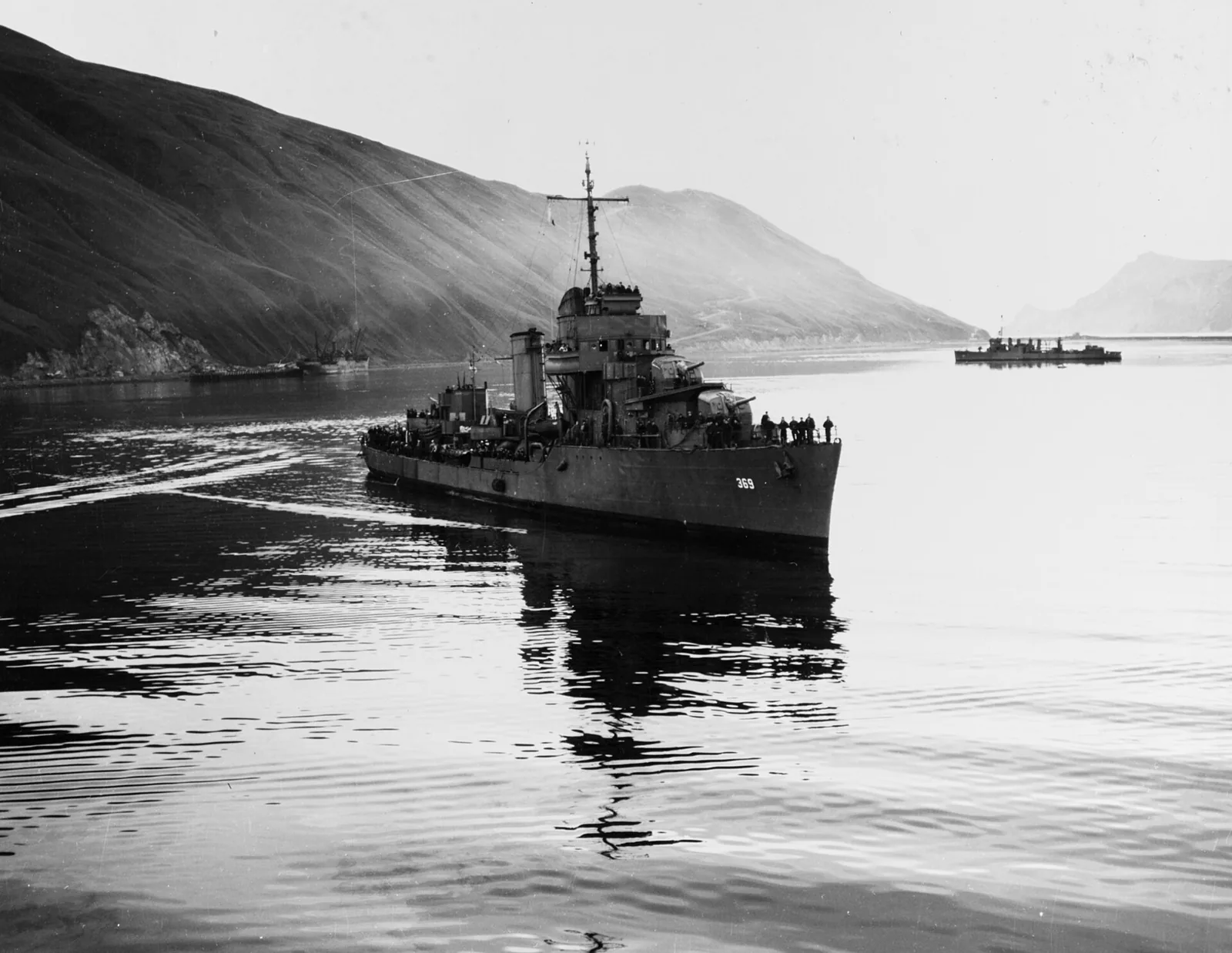
During the first 5 months of the war, King operated on patrol and escort duty along the West Coast. Departing Mare Island 22 May 1942, she joined Task Force 8 escorting troop transport President Fillmore to the Aleutians. Arriving Dutch Harbor 3 June, King operated on ASW and screening patrols in the Aleutians throughout the summer, and fought with Task Group 8.6 during the bombardment of Kiska in August. She remained in the frigid Aleutians until she sailed for San Francisco 22 December 1943.
1945
After overhaul, King operated off the West Coast for the rest of the war, as patrol vessel and an ASW screen. She departed Treasure Island 28 August 1945 arriving Philadelphia 20 September. King decommissioned there 23 October 1945, and was sold to Boston Metals for scrapping on 29 September 1946.
Other photographs
Held for this vessel, and not tied to any part of the account above.
References
Every work this entry draws on. There are no numbered markers in the text above: what we hold is the provenance of the page — this history, this article, these photographs.
- History King I (Destroyer No. 242) Dictionary of American Naval Fighting Ships, Naval History and Heritage Command. A work of the United States Government, in the public domain — the only text on this site reproduced verbatim.
- Facts USS King (DD-242) Structured facts only — dates, dimensions, armament and fate. No wording is taken from it. Harvested 1 August 2026.
- Photograph USS King (DD-242) underway before World War II U.S. Navy — Official U.S. Navy photo NH 68331 from the U.S. Navy Naval History and Heritage Command — Public domain — Wikimedia Commons
- Photograph USS Dobbin (AD-3) at anchor with destroyers off Gonaïves, Haiti, in March 1928 (NH 61556) Unknown author — U.S. Naval History and Heritage Command photo NH 61556 — Public domain — Wikimedia Commons
- Photograph USS Dobbin (AD-3) with destroyers at San Diego in 1932 USN — Official U.S. Navy photo NH 65009 from the U.S. Navy Naval History and Heritage Command — Public domain — Wikimedia Commons
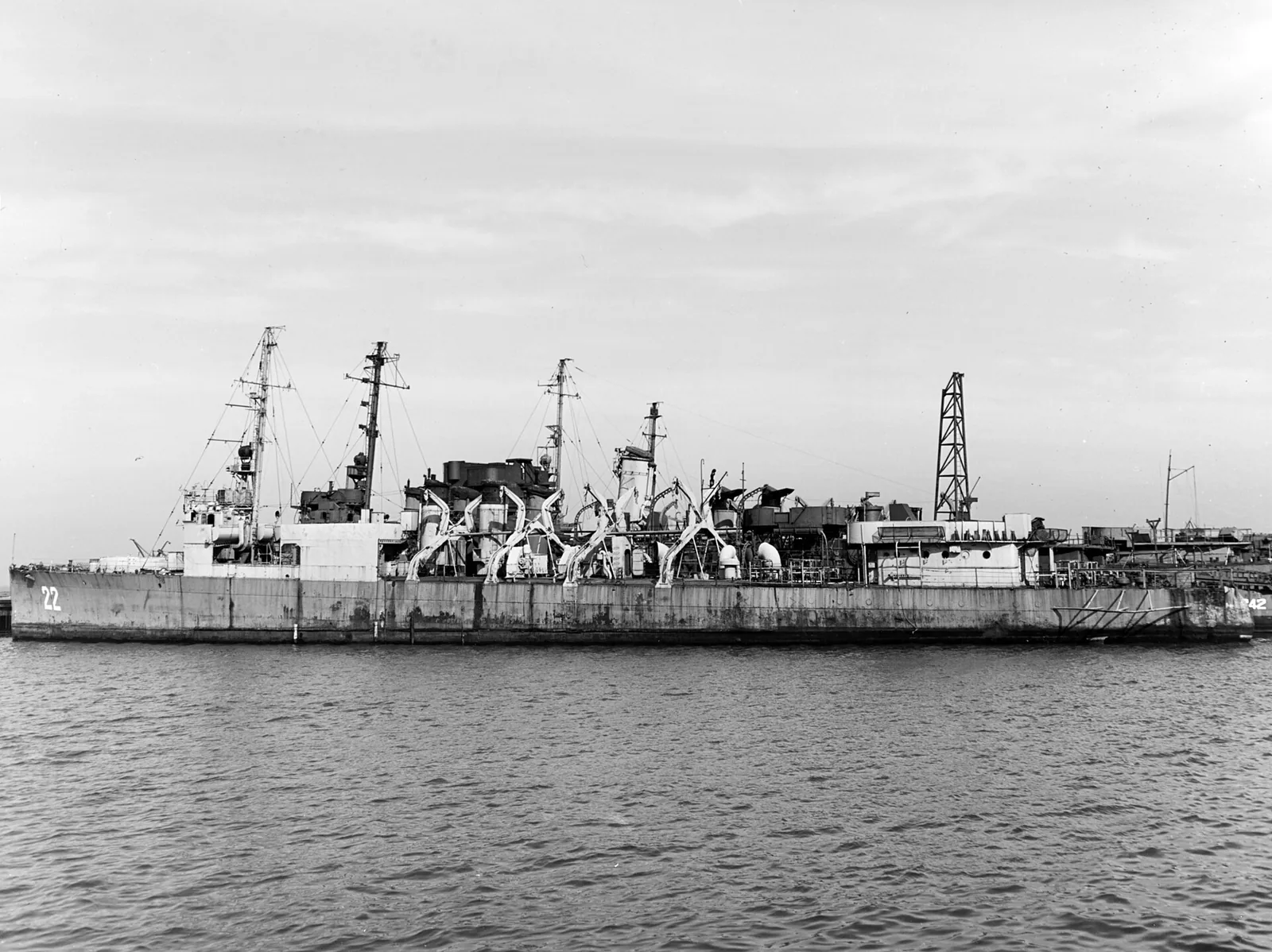
- Photograph USS Herbert (APD-22) at Cape May in January 1946 Ted Stone, U.S. Navy — Official U.S. Navy photo NH 66836 from the U.S. Navy Naval History and Heritage Command — Public domain — Wikimedia Commons
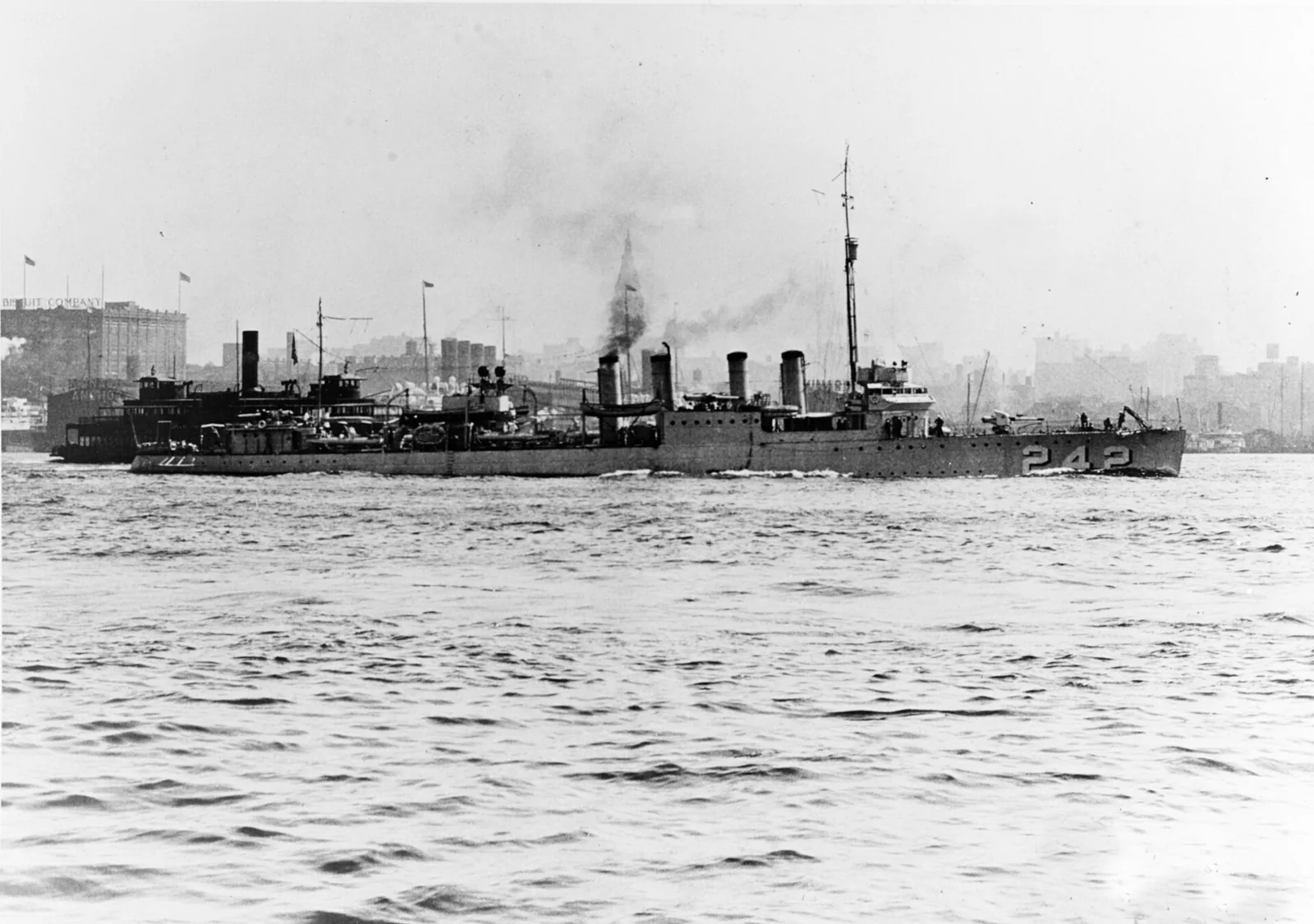
- Photograph USS King (DD-242) off New York City on 19 September 1925 U.S. Navy — Official U.S. Navy photo NH 83735 from the U.S. Navy Naval History and Heritage Command — Public domain — Wikimedia Commons
- Photograph USS Reid (DD-369) at Dutch Harbor, Alaska, on 6 September 1942 U.S. Navy — Official U.S. Navy photo 80-G-215364 from the U.S. Navy Naval History and Heritage Command — Public domain — Wikimedia Commons