United States Navy — Destroyer
USS Leary (DD-158) — service history
This is the full service history. For the vessel's particulars, photograph and specifications, see the entry.
In the words of the US Navy. The account below is reproduced verbatim from the Dictionary of American Naval Fighting Ships, compiled by the Naval History and Heritage Command — a work of the United States Government, in the public domain, and the only text on this site not written here.
Before commissioning
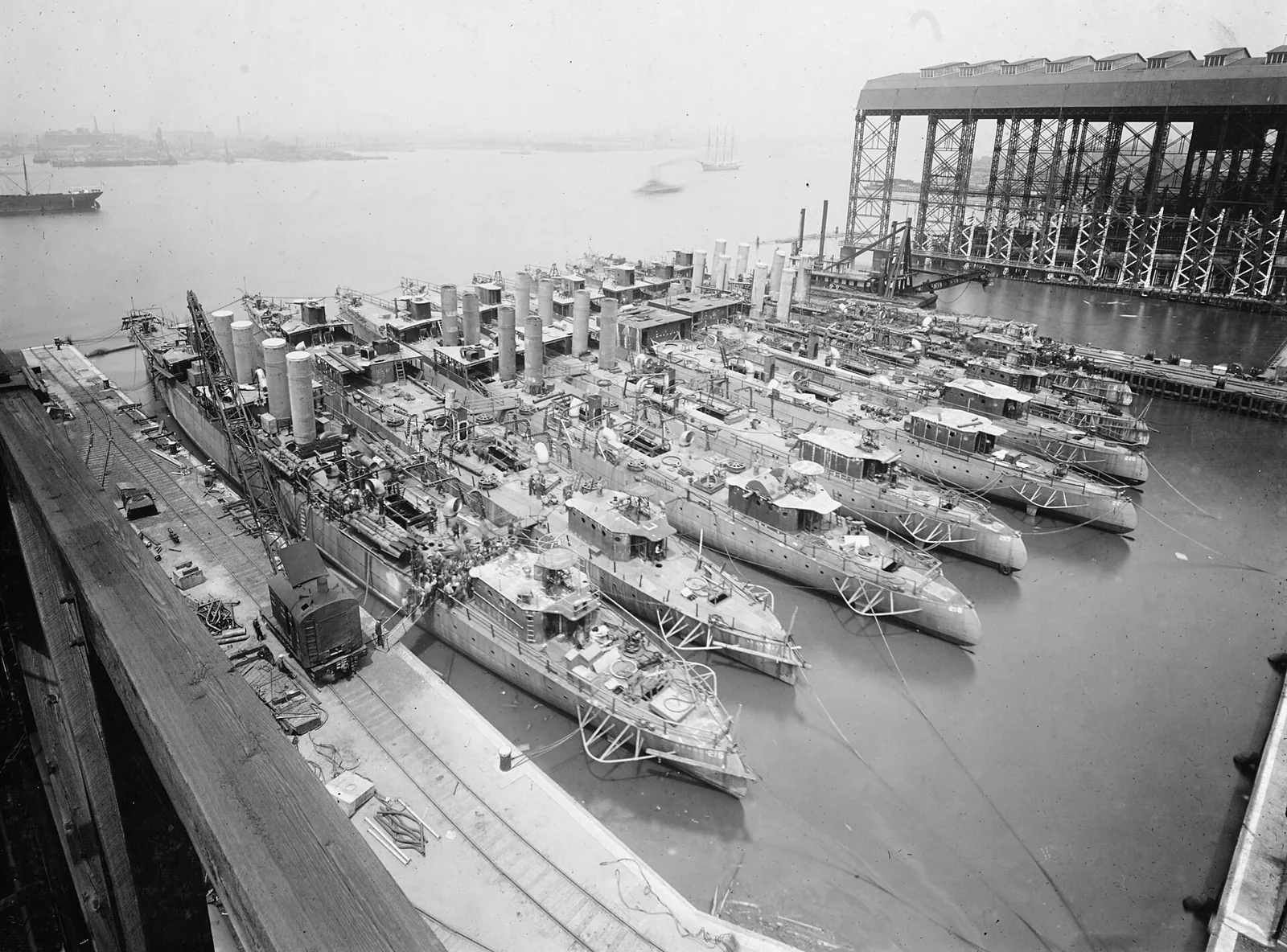
Born in Fowey, England, 11 January 1894, Clarence Frederick Leary came to the United States with his family as a boy. After the United States entered World War I he was commissioned lieutenant in the Naval Reserve 12 June 1918, and appointed executive officer in Carlton Hall. He died of burns and smoke inhalation when he entered the ship's burning hold 20 July in an attempt to save both ship and crew. He was posthumously awarded the Navy Cross for his self-sacrificing valor.
Great War and before
1918
The first Leary (Destroyer No. 158) was laid down 6 March 1918 by New York Shipbuilding Corp., Camden, N.J.; launched 18 December 1918; sponsored by Mrs. Anne Leary, mother of Lt. C. F. Leary; and commissioned 5 December 1919, Comdr. F. C. Martin in command.
Interwar 1919–1938
1920
Leary departed Boston 28 January 1920 for Guantanamo on shakedown and training, then continued her training in northern waters before transiting the Panama Canal 22 January 1921 to join the Battle Fleet in the Pacific. Upon completion of large-scale maneuvers off the coast of Peru in February, she returned to the Caribbean where in June she observed the effects of seaplane bombardment upon ex-German ships. In the wake of the Washington Naval Disarmament Conference, Leary was placed out of commission in reserve at Philadelphia Navy Yard 29 June 1922.
1930
Reactivating 8 years later, on 1 May 1930 she joined the Atlantic Fleet with Newport, R.I., as her home port. In addition to annual exercises in the Caribbean, every other year she operated off the West Coast in joint maneuvers with the Pacific Fleet. After 1935 training cruises for reserves and midshipmen occupied most of her time.
Second World War 1939–1945
1939
The rising war clouds over Europe changed this schedule. In September 1939 destroyers Leary and Hamilton (DD-141) established a continuous antisubmarine patrol off the lower New England coast. The following year her patrol functions enlarged and 9 September 1941 she began a series of hazardous escort missions to Iceland. On 19 November Leary became the first American ship to make radar contact with a U-boat. After 26 February 1942 she spent a year escorting convoys from the midocean meeting point to various Icelandic ports.
1943
Leary departed this duty 7 February 1943 for Boston and a new area of service. Emerging from drydock the old four-stacker departed Boston 1 March for Guantanamo Naval Base where she engaged in antisubmarine exercises with R-5 before resuming escort duty, guarding four convoys to Trinidad, British West Indies, between mid-March and mid-June 1943. She returned to New York 25 June.
Leary now began transatlantic escort voyages to guard ever-increasing amounts of supplies from the United States to the Mediterranean. She picked up a convoy off New York harbor 7 July, sailed first to Aruba, Dutch West Indies, and then across to Algiers, arriving the 31st. A return convoy using the same route entered New York 27 August. A second voyage concluded 30 October but Leary would not return from her third transatlantic assignment of 1943.
Late in November she departed the East Coast with escort carrier Card (CVE-11) on a hunter-killer operation. Early in the mid-watch 24 December, Leary suddenly found herself in the midst of a German submarine pack. Leary took two torpedoes within minutes of her discovery of the enemy and a third torpedo finally sank this valiant ship. Ninety-seven members of the ship's company were lost, including her commanding officer, Comdr. James E. Keyes.
Other photographs
Held for this vessel, and not tied to any part of the account above.



References
Every work this entry draws on. There are no numbered markers in the text above: what we hold is the provenance of the page — this history, this article, these photographs.
- History Leary I (Destroyer No. 158) Dictionary of American Naval Fighting Ships, Naval History and Heritage Command. A work of the United States Government, in the public domain — the only text on this site reproduced verbatim.
- Facts USS Leary (DD-158) Structured facts only — dates, dimensions, armament and fate. No wording is taken from it. Harvested 1 August 2026.
- Photograph USSLearyDD158 Unknown author — Unknown source — Public domain — Wikimedia Commons
- Photograph 80-G-44231 (30954523060) National Museum of the U.S. Navy — 80-G-44231 — Public domain — Wikimedia Commons
- Photograph 80-G-700310 (27933832346) National Museum of the U.S. Navy — 80-G-700310 — Public domain — Wikimedia Commons
- Photograph 80-G-700318 (27688535480) National Museum of the U.S. Navy — 80-G-700318 — Public domain — Wikimedia Commons
- Photograph Camden Shipyard 1919 U.S. Navy — Official U.S. Navy photo NH 43196 from the U.S. Navy Naval History and Heritage Command — Public domain — Wikimedia Commons
- Photograph NH 51279 (25938882106) National Museum of the U.S. Navy — NH 51279 — Public domain — Wikimedia Commons
- Photograph USS Leary (DD-158)- Cross Sections; inboard Profile; Main Deck - NARA - 78116793 Unknown author or not provided — U.S. National Archives and Records Administration — Public domain — Wikimedia Commons
- Photograph USS Leary (DD-158)- Midship Section - NARA - 78116791 Unknown author or not provided — U.S. National Archives and Records Administration — Public domain — Wikimedia Commons
- Photograph USS Leary (DD-158)- Tank Capacities; General Information - NARA - 78116795 Unknown author or not provided — U.S. National Archives and Records Administration — Public domain — Wikimedia Commons
- Photograph Nowy Jork. Port w Brooklyn (2-2624) Unknown author — https://audiovis.nac.gov.pl/obraz/3012/ — Public domain — Wikimedia Commons