USS Leary (DD-158)
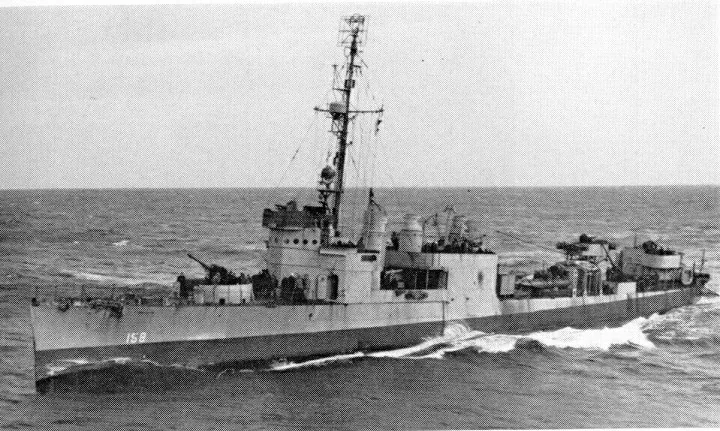
Service
- as Leary5 December 1919 — 24 December 19431,575 days of the war
- Name
- USS Leary
- Pennant / hull number
- DD-158
- Namesake
- Clarence F. Leary
- Builder
- New York Shipbuilding, Camden, New Jersey
- Laid down
- 6 March 1918
- Launched
- 18 December 1918
- Commissioned
- 5 December 1919
- Decommissioned
- 29 June 1922
- Recommissioned
- 1 May 1930
- Fate
- Sunk, 24 December 1943 (1943)
- Status
- Wreck
Specifications
- Displacement, standard
- 1,090 long tons (1,107 t)
- Length
- 95.71 m (314 ft)
- Beam
- 9.3 m (30.5 ft)
- Draught
- 3.66 m (12 ft)
- Speed
- 35 knots (64.8 km/h, 40.3 mph)
- Complement
- 176
- Main gun
- 76 mm (3 in)
Born in Fowey, England, 11 January 1894, Clarence Frederick Leary came to the United States with his family as a boy. After the United States entered World War I he was commissioned lieutenant in the Naval Reserve 12 June 1918, and appointed executive officer in Carlton Hall. He died of burns and smoke inhalation when he entered the ship's burning hold 20 July in an attempt to save both ship and crew. He was posthumously awarded the Navy Cross for his self-sacrificing valor.
The first Leary (Destroyer No. 158) was laid down 6 March 1918 by New York Shipbuilding Corp., Camden, N.J.; launched 18 December 1918; sponsored by Mrs. Anne Leary, mother of Lt. C. F. Leary; and commissioned 5 December 1919, Comdr. F. C. Martin in command.
Leary departed Boston 28 January 1920 for Guantanamo on shakedown and training, then continued her training in northern waters before transiting the Panama Canal 22 January 1921 to join the Battle Fleet in the Pacific. Upon completion of large-scale maneuvers off the coast of Peru in February, she returned to the Caribbean where in June she observed the effects of seaplane bombardment upon ex-German ships. In the wake of the Washington Naval Disarmament Conference, Leary was placed out of commission in reserve at Philadelphia Navy Yard 29 June 1922.
Continue to the full service history About 530 words
From the Dictionary of American Naval Fighting Ships, compiled by the Naval History and Heritage Command (Leary I (Destroyer No. 158)). A work of the United States Government, in the public domain.
Armament and machinery
Armament and machinery
- Armament
- 6 × 3 in/23 guns
- 6 × 21 in torpedo tubes
- 2 × depth charge tracks
- 1 × Y-gun
Sister ships
- HMCS Annapolis (I04)
- HMCS Caldwell (I20)
- HMCS Chelsea (I35)
- HMCS Columbia (I49)
- HMCS Georgetown (I40)
- HMCS Hamilton (I24)
- HMCS Leamington (G19)
- HMCS Lincoln (G42)
- HMCS Mansfield (G76)
- HMCS Montgomery (G95)
- HMCS Niagara (I57)
- HMCS Richmond (G88)
- HMCS Salisbury (I52)
- HMCS St. Clair (I65)
- HMS Bath (I17)
- HMS Brighton (I08)
- HMS Caldwell (I20)
- HMS Campbeltown (I42)
- HMS Castleton (I23)
- HMS Charlestown (I21)
- HMS Chelsea (I35)
- HMS Georgetown (I40)
- HMS Hamilton (I24)
- HMS Lancaster (G05)
Sources
- Facts harvested from USS Leary (DD-158) on Wikipedia. Figures only — no wording is taken from it.
- Service history reproduced verbatim from Leary I (Destroyer No. 158) , Dictionary of American Naval Fighting Ships — public domain, a work of the United States Government.
- Photograph: Unknown author — Unknown source — Public domain — Wikimedia Commons