USS Lexington (CV-2)
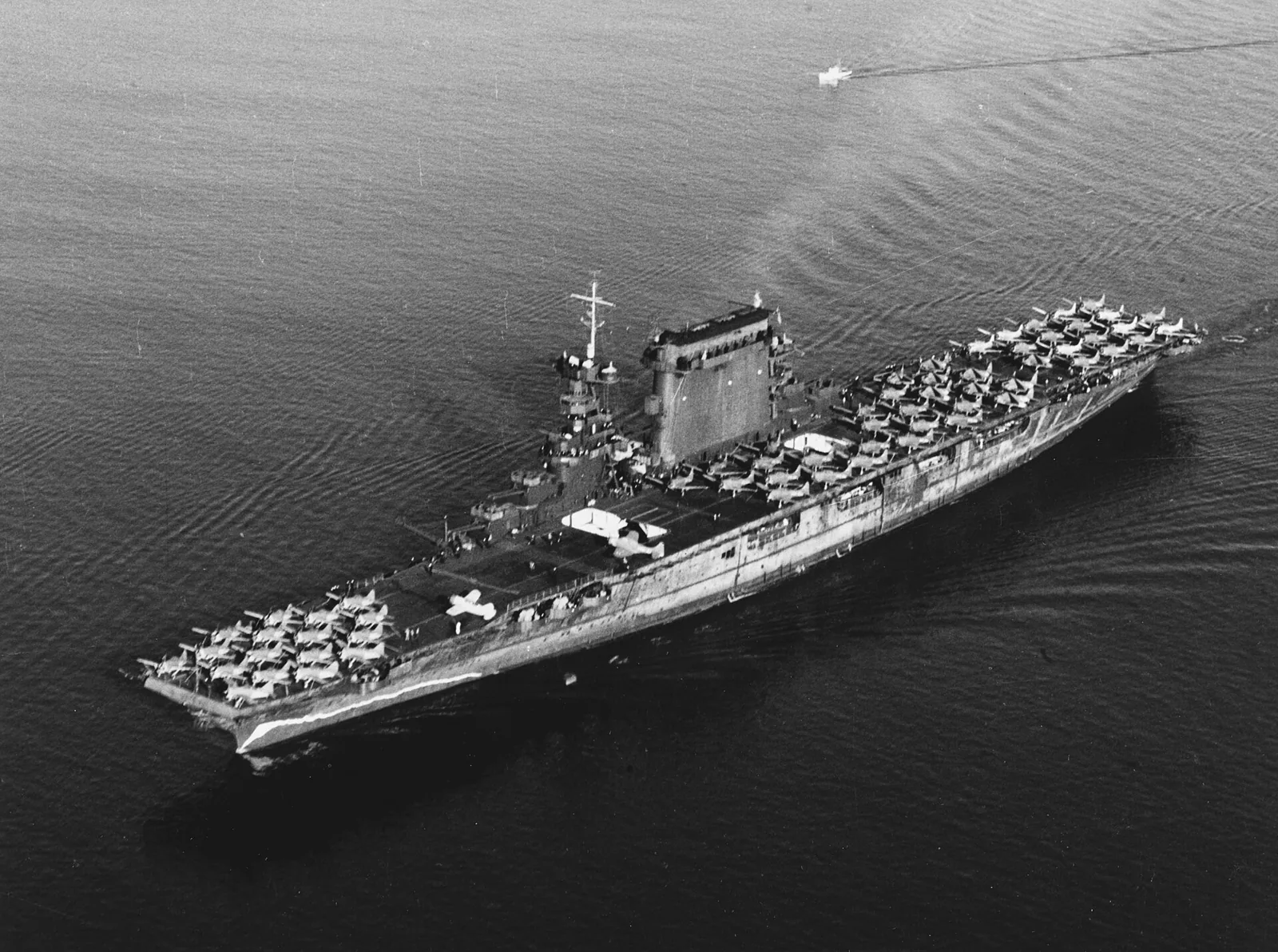
Service
- as Lexington14 December 1927 — 24 June 19421,027 days of the war
- Name
- USS Lexington
- Pennant / hull number
- CV-2
- Namesake
- Battle of Lexington
- Builder
- Fore River Ship Building Co., Quincy, Massachusetts, US
- Ordered
- 1916
- Laid down
- 8 January 1921
- Launched
- 3 October 1925
- Commissioned
- 14 December 1927
- Struck
- 24 June 1942
- Fate
- Scuttled after the Battle of the Coral Sea, 8 May 1942
Shipwreck found, 4 March 2018 (1942) - Status
- Wreck
Specifications
- Displacement, standard
- 36,000 long tons (36,578 t)
- Displacement, full load
- 47,700 long tons (48,465 t)
- Length
- 270.66 m (888 ft)
- Beam
- 32.61 m (107 ft)
- Draught
- 9.75 m (32 ft)
- Speed
- 33.3 knots (61.6 km/h, 38.3 mph)
- Range
- 10,000 nmi (18,520 km)
- Complement
- 2,791
- Main gun
- 203 mm (8 in)
Minutemen fought a detachment of British troops at Lexington, Mass., 19 April 1776 opening the Revolutionary War with "the shot heard round the world."
The fourth Lexington (CV-2) was originally designated CC-1; laid down as a battle cruiser 8 January 1921 by Fore River Shipbuilding Co., Quincy, Mass.; authorized to be completed as an aircraft carrier 1 July 1922; launched 3 October 1925; sponsored by Mrs. Theodore Douglas Robinson, wife of the Assistant Secretary of the Navy; and commissioned 14 December 1927, Capt. Albert W. Marshall in command.
After fitting out and shakedown, Lexington joined the battle fleet at San Pedro, Calif., 7 April 1928. Based there, she operated on the west coast with Aircraft Squadrons, Battle Fleet, in flight training, tactical exercises, and battle problems. Each year she participated in fleet maneuvers in the Hawaiians, in the Caribbean, off the Panama Canal Zone, and in the eastern Pacific. In the fall of 1941 she sailed with the battle force to the Hawaiians for tactical exercises.
Continue to the full service history About 837 words
From the Dictionary of American Naval Fighting Ships, compiled by the Naval History and Heritage Command (Lexington IV (CV-2)). A work of the United States Government, in the public domain.
Armament and machinery
Armament and machinery
- Propulsion
- 4 shafts, 4 sets turbo-electric drive
- Power
- 16 Yarrow boilers
- 180000 shp
- Armament
- 4 × twin 8 in guns
- 12 × single 5 in AA guns
- Armour
- Belt: 5 - 7 in
- Deck: 0.75 - 2 in
- Gun turrets: 0.75 in
- Bulkheads: 5 - 7 in
- Aircraft
- 78
Sister ships
Sources
- Facts harvested from USS Lexington (CV-2) on Wikipedia. Figures only — no wording is taken from it.
- Service history reproduced verbatim from Lexington IV (CV-2) , Dictionary of American Naval Fighting Ships — public domain, a work of the United States Government.
- Photograph: Unknown author — U.S. Navy photo 80-G-416362 — Public domain — Wikimedia Commons