USS Saratoga (CV-3)
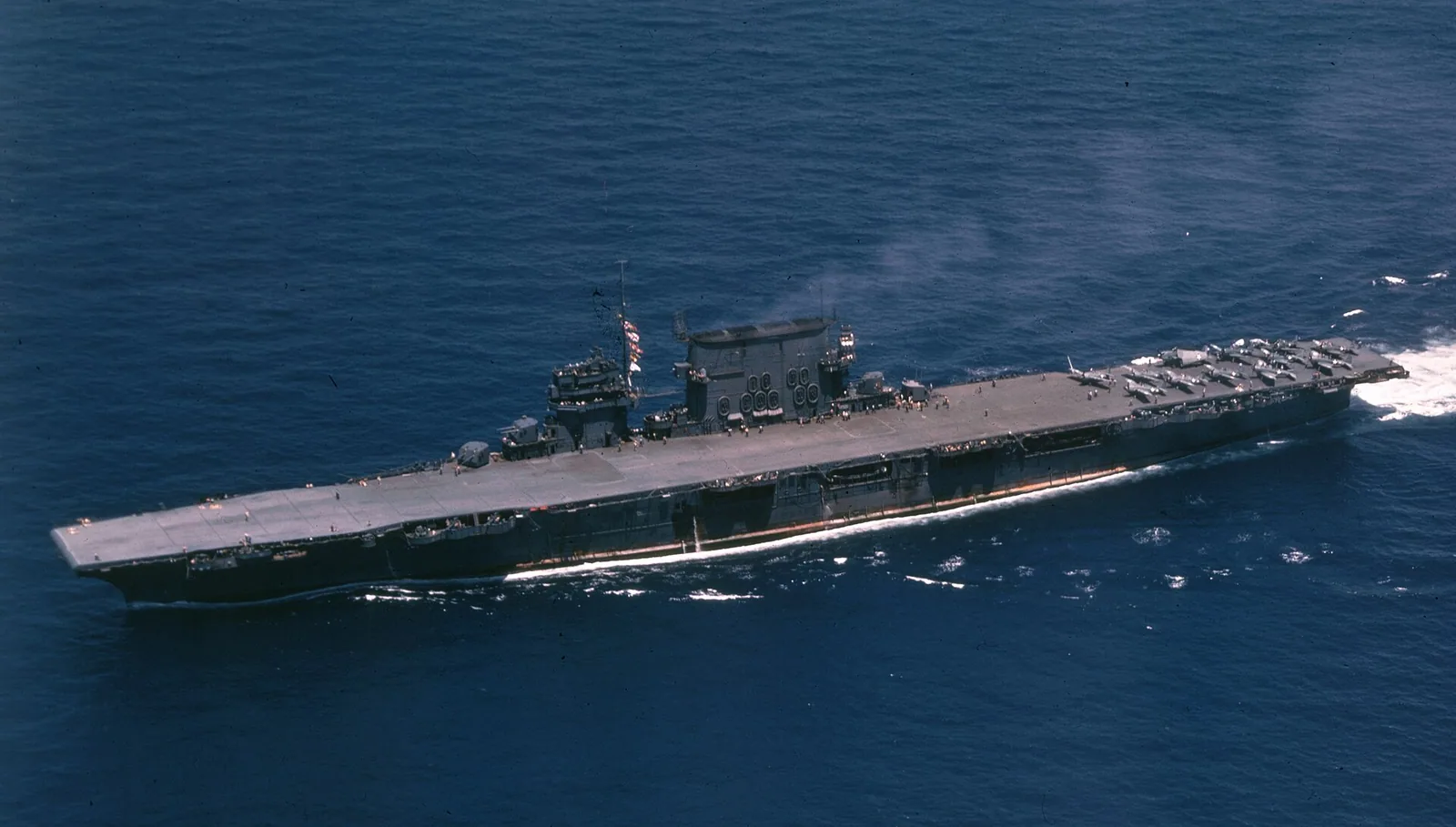
Service
- as Saratoga16 November 1927 — 15 August 19462,193 days of the war
- Name
- USS Saratoga
- Pennant / hull number
- CV-3
- Namesake
- Battles of Saratoga
- Builder
- New York Shipbuilding Corporation
- Ordered
- 1917
- Laid down
- 25 September 1920
- Launched
- 7 April 1925
- Commissioned
- 16 November 1927
- Struck
- 15 August 1946
- Fate
- Sunk during Operation Crossroads atomic bomb testing, 25 July 1946 (1946)
- Status
- Wreck
Specifications
- Displacement, standard
- 36,000 long tons (36,578 t)
- Length
- 270.66 m (888 ft)
- Beam
- 32.31 m (106 ft)
- Draught
- 9.14 m (30 ft)
- Speed
- 33.3 knots (61.6 km/h, 38.3 mph)
- Range
- 10,000 nmi (18,520 km)
- Complement
- 2,791
- Main gun
- 203 mm (8 in)
The fifth Saratoga (Battle Cruiser No. 3) was laid down on 25 September 1920 at Camden, N.J., by the New York Shipbuilding Co.; ordered converted to an aircraft carrier and reclassified CV-3 on 1 July 1922 in accordance with the Washington Treaty limiting naval armaments; launched on 7 April 1925; sponsored by Mrs. Curtis D. Wilbur, wife of the Secretary of the Navy; and commissioned on 16 November 1927. Capt. Harry E. Yarnell in command.
Saratoga, the first fast carrier in the United States Navy, quickly proved the value of her type. She sailed from Philadelphia on 6 January 1928 for shakedown; and, on 11 January, her air officer, the future World War II hero, Marc A. Mitscher, landed the first aircraft on board. In an experiment on 27 January, the rigid airship Los Angeles (ZR-3) moored to Saratoga's stern and took on fuel and stores. The same day, Saratoga sailed for the Pacific via the Panama Canal. She was diverted briefly between 14 and 16 February to transport .marines to Corinto, Nicaragua, and finally joined the Battle Fleet at San Pedro, Calif., on 21 February. She spent the rest of the year in training and final machinery shakedown.
On 15 January 1929, Saratoga sailed from San Diego with the Battle Fleet to participate in her first fleet exercise, Fleet Problem IX. In a daring move, Saratoga was detached from the fleet with only a single cruiser as escort to make a wide sweep to the south and "attack" the Panama Canal, which was defended by the Scouting Fleet and Saratoga's sister ship, Lexington (CV-2). She successfully launched her strike on 26 January, and despite being -sunk- three times later in the day, proved the versatility of a fast task force centered around a carrier. The idea was incorporated into fleet doctrine and reused the following year in Fleet Problem X in the Caribbean. This time, however, Saratoga and carrier, Langley, were "disabled" by a surprise attack from Lexington, showing how quickly air power could swing the balance in a naval action. Following the fleet concentration in the Caribbean, Saratoga took part in the Presidential Review at Norfolk in May and returned to San Pedro on 21 June 1930.
Continue to the full service history About 2,760 words
From the Dictionary of American Naval Fighting Ships, compiled by the Naval History and Heritage Command (Saratoga V (CV-3)). A work of the United States Government, in the public domain.
Armament and machinery
Armament and machinery
- Propulsion
- 4 shafts; 4 sets turbo-electric drive
- Power
- 16 water-tube boilers
- 180000 shp
- Armament
- 4 × twin 8 in guns
- 12 × single 5 in AA guns
- Armour
- Belt: 5 - 7 in
- Deck: 0.75 - 2 in
- Gun turrets: 0.75 in
- Bulkheads: 5 - 7 in
- Aircraft
- 78
Sister ships
Sources
- Facts harvested from USS Saratoga (CV-3) on Wikipedia. Figures only — no wording is taken from it.
- Service history reproduced verbatim from Saratoga V (CV-3) , Dictionary of American Naval Fighting Ships — public domain, a work of the United States Government.
- Photograph: Unknown author — Public domain — Wikimedia Commons