USS New Jersey (BB-62)
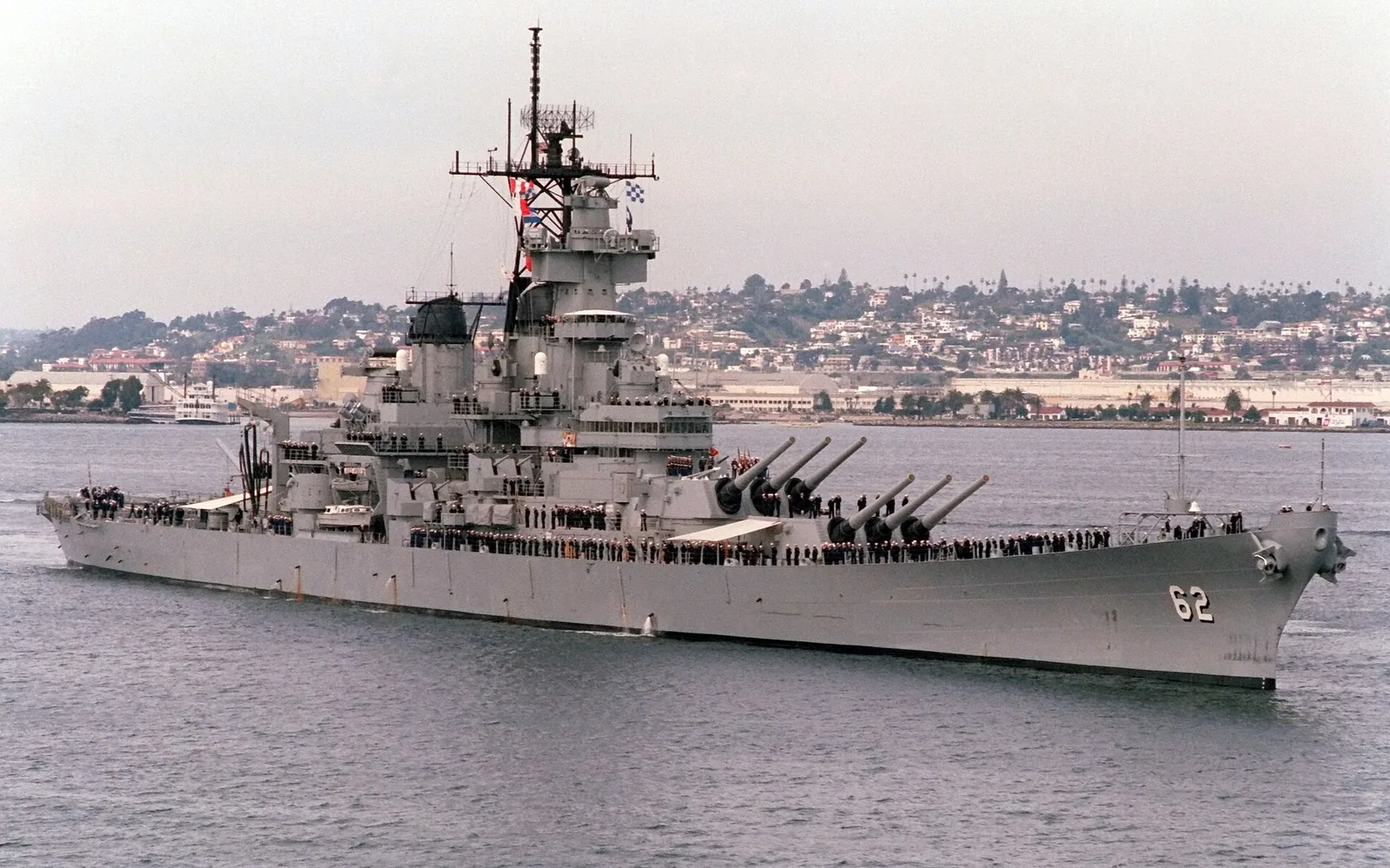
Service
- 23 May 1943 — 8 February 1991833 days of the war
- Name
- USS New Jersey
- Pennant / hull number
- BB-62
- Namesake
- State of New Jersey
- Builder
- Philadelphia Naval Shipyard
- Ordered
- 1 July 1939
- Laid down
- 16 September 1940
- Launched
- 7 December 1942
- Commissioned
- 23 May 1943
- Decommissioned
- 30 June 1948
- Recommissioned
- 21 November 1950
- Struck
- 4 January 1999
- Fate
- Museum ship
- Status
- Preserved
Specifications
- Displacement, standard
- 49,657 long tons (50,454 t)
- Displacement, full load
- 58,132 long tons (59,065 t)
- Length
- 270.36 m (887 ft)
- Beam
- 32.92 m (108 ft)
- Draught
- 11.28 m (37 ft)
- Speed
- 33 knots (61.1 km/h, 38 mph)
- Complement
- 1,921
- Main gun
- 406 mm (16 in)
The second New Jersey (BB-62) was launched 7 December 1942 by the Philadelphia Naval Shipyard; sponsored by Mrs. Charles Edison, wife of Governor Edison of New Jersey, former Secretary of the Navy; and commissioned at Philadelphia 23 May 1943, Captain Carl F. Holden in command.
New Jersey completed fitting out and trained her initial crew in the Western Atlantic and Caribbean. On 7 January 1944 she passed through the Panama Canal war-bound for Funafuti, Ellice Islands. She reported there 22 January for duty with the Fifth Fleet, and three days later rendezvoused with Task Group 58.2 for the assault on the Marshall Islands. New Jersey screened the carriers from enemy attack as their aircraft flew strikes against Kwajalein and Eniwetok 29 January-2 February, softening up the latter for its invasion and supporting the troops who landed 31 January.
New Jersey began her distinguished career as a flagship 4 February in Majuro Lagoon when Admiral Raymond A. Spruance, commanding the Fifth Fleet, broke his flag from her main. Her first action as a flagship was a bold two-day surface and air strike by her task force against the supposedly impregnable Japanese fleet base on Truk in the Carolines. This blow was coordinated with the assault on Kwajalein, and effectively interdicted Japanese naval retaliation to the conquest of the Marshalls. On 17 and 18 February, the task force accounted for two Japanese light cruisers, four destroyers, three auxiliary cruisers, two submarine tenders, two submarine chasers, an armed trawler, a plane ferry, and 23 other auxiliaries, not including small craft. New Jersey destroyed a trawler and, with other ships, sank destroyer Maikaze, as well as firing on an enemy plane which attacked her formation. The task force returned to the Marshalls 19 February.
Continue to the full service history About 4,175 words
From the Dictionary of American Naval Fighting Ships, compiled by the Naval History and Heritage Command (New Jersey II (BB-62)). A work of the United States Government, in the public domain.
Armament and machinery
Armament and machinery
- Propulsion
- 4 x 53,000 hp Westinghouse Electric Corporation steam turbines powered by 8 x 650 psi m type boilers
- Armament
- 1943:
- 9 × 16 in (406 mm) 50 cal. Mark 7 guns
- 20 × 5 in (127 mm) 38 cal. Mark 12 guns
- 80 × 40 mm 56 cal. anti-aircraft guns
- 49 × 20 mm 70 cal. anti-aircraft guns
- 1968:
- 9 × 16 in (406 mm) 50 cal Mark 7 guns
- 20 × 5 in (127 mm) 38 cal Mark 12 guns
- 1982:
- 9 × 16 in (406 mm) 50 cal. Mark 7 guns
- 12 × 5 in (127 mm) 38 cal. Mark 12 guns
- 32 × BGM-109 Tomahawk cruise missiles
- 16 × RGM-84 Harpoon Anti-Ship missiles
- 4 × 20 mm/76 cal. Phalanx CIWS
- Armour
- Belt: 12.1 in
- Bulkheads: 11.3 in
- Barbettes: 11.6 to 17.3 in
- Turrets: 19.5 in
- Decks:
- main 1.5 in
- second 6.0 in
- Aircraft
- 1943:
- 2 catapults
- 3 Vought OS2U Kingfisher Floatplanes
- 1950s:
- Sikorsky H-5
- 1968–1969:
- Gyrodyne QH-50 DASH drone
- 1982:
- Deck for up to 4 helicopters but replaced with 1 RQ-2 Pioneer UAV
Sister ships
Sources
- Facts harvested from USS New Jersey (BB-62) on Wikipedia. Figures only — no wording is taken from it.
- Service history reproduced verbatim from New Jersey II (BB-62) , Dictionary of American Naval Fighting Ships — public domain, a work of the United States Government.
- Photograph: Camera Operator: PH3 BRYANT — Defense Visual Information Center — Public domain — Wikimedia Commons