United States Navy — Battleship
USS New Jersey (BB-62) — service history
This is the full service history. For the vessel's particulars, photograph and specifications, see the entry.
In the words of the US Navy. The account below is reproduced verbatim from the Dictionary of American Naval Fighting Ships, compiled by the Naval History and Heritage Command — a work of the United States Government, in the public domain, and the only text on this site not written here.
Second World War 1939–1945
1942
The second New Jersey (BB-62) was launched 7 December 1942 by the Philadelphia Naval Shipyard; sponsored by Mrs. Charles Edison, wife of Governor Edison of New Jersey, former Secretary of the Navy; and commissioned at Philadelphia 23 May 1943, Captain Carl F. Holden in command.
1944 Marshall Islands
New Jersey completed fitting out and trained her initial crew in the Western Atlantic and Caribbean. On 7 January 1944 she passed through the Panama Canal war-bound for Funafuti, Ellice Islands. She reported there 22 January for duty with the Fifth Fleet, and three days later rendezvoused with Task Group 58.2 for the assault on the Marshall Islands. New Jersey screened the carriers from enemy attack as their aircraft flew strikes against Kwajalein and Eniwetok 29 January-2 February, softening up the latter for its invasion and supporting the troops who landed 31 January.
New Jersey began her distinguished career as a flagship 4 February in Majuro Lagoon when Admiral Raymond A. Spruance, commanding the Fifth Fleet, broke his flag from her main. Her first action as a flagship was a bold two-day surface and air strike by her task force against the supposedly impregnable Japanese fleet base on Truk in the Carolines. This blow was coordinated with the assault on Kwajalein, and effectively interdicted Japanese naval retaliation to the conquest of the Marshalls. On 17 and 18 February, the task force accounted for two Japanese light cruisers, four destroyers, three auxiliary cruisers, two submarine tenders, two submarine chasers, an armed trawler, a plane ferry, and 23 other auxiliaries, not including small craft. New Jersey destroyed a trawler and, with other ships, sank destroyer Maikaze, as well as firing on an enemy plane which attacked her formation. The task force returned to the Marshalls 19 February.
Between 17 March and 10 April, New Jersey first sailed with Rear Admiral Marc A. Mitscher's flagship Lexington (CV-16) for an air and surface bombardment of Mille, then rejoined Task Group 58.2 for a strike against shipping in the Palaus, and bombarded Woleai. Upon his return to Majuro, Admiral Spruance transferred his flag to Indianapolis (CA35).
New Jersey's next war cruise, 13 April-4 May, began and ended at Majuro. She screened the carrier striking force which gave air support to the invasion of Aitape, Tanahmerah Bay and Humboldt Bay, New Guinea, 22 April, then bombed shipping and shore installations at Truk 29-30 April. New Jersey and her formation splashed two enemy torpedo bombers at Truk. Her sixteen-inch salvos pounded Ponape 1 May, destroying fuel tanks, badly damaging the airfield, and demolishing a headquarters building.
After rehearsing in the Marshalls for the invasion of the Marianas, New Jersey put to sea 6 June in the screening and bombardment group of Admiral Mitscher's Task Force. On the second day of preinvasion air strikes, 12 June, New Jersey downed an enemy torpedo bomber, and during the next two days her heavy guns battered Saipan and Tinian, throwing steel against the beaches the Marines would charge 15 June.
The Japanese response to the Marianas operation was an order to its Mobile Fleet; it must attack and annihilate the American invasion force. Shadowing American submarines tracked the Japanese fleet into the Philippine Sea as Admiral Spruance joined his task force with Admiral Mitscher's to meet the enemy. New Jersey took station in the protective screen around the carriers on 19 June as American and Japanese pilots dueled in the Battle of the Philippine Sea. That day and the next were to pronounce the doom of Japanese naval aviation; in this "Marianas Turkey Shoot," the Japanese lost some 400 planes. This loss of trained pilots and aircraft was equalled in disaster by the sinking of three Japanese carriers by submarines and aircraft, and the damaging of two carriers and a battleship. The anti-aircraft fire of New Jersey and the other screening ships proved virtually impenetrable. Only two American ships were damaged, and those but slightly. In this overwhelming victory but 17 American planes were lost to combat.
New Jersey's final contribution to the conquest of the Marianas was in strikes on Guam and the Palaus from which she sailed for Pearl Harbor, arriving 9 August. Here she broke the flag of Admiral William F. Halsey, Jr., 24 August, becoming flagship of the Third Fleet. For the eight months after she sailed from Pearl Harbor 30 August, New Jersey was based at Ulithi. In this climactic span of the Pacific War, fast carrier task forces ranged the waters off the Philippines, Okinawa, and Formosa, striking again and again at airfields, shipping, shore bases, invasion beaches. New Jersey offered the essential protection required by these forces, always ready to repell enemy air or surface attack.
In September the targets were in the Visayas and the southern Philippines, then Manila and Cavite, Panay, Negros, Leyte, and Cebu. Early in October raids to destroy enemy air power based on Okinawa and Formosa were begun in preparation for the Leyte landings 20 October.
This invasion brought on the desperate, almost suicidal, last great sortie of the Imperial Japanese Navy. Its plan for the Battle for Leyte Gulf included a feint by a northern force of planeless heavy attack carriers to draw away the battleships, cruisers and fast carriers with which Admiral Halsey was protecting the landings. This was to allow the Japanese Center Force to enter the gulf through San Bernadino Strait. At the opening of the battle, planes from the carriers guarded by New Jersey struck hard at both the Japanese Southern and Center Forces, sinking a battleship 23 October. The next day Halsey shaped his course north after the decoy force had been spotted. Planes from his carriers sank four of the Japanese carriers, as well as a destroyer and a cruiser, while New Jersey steamed south at flank speed to meet the newly developed threat of the Center Force. It had been turned back in a stunning defeat when she arrived.
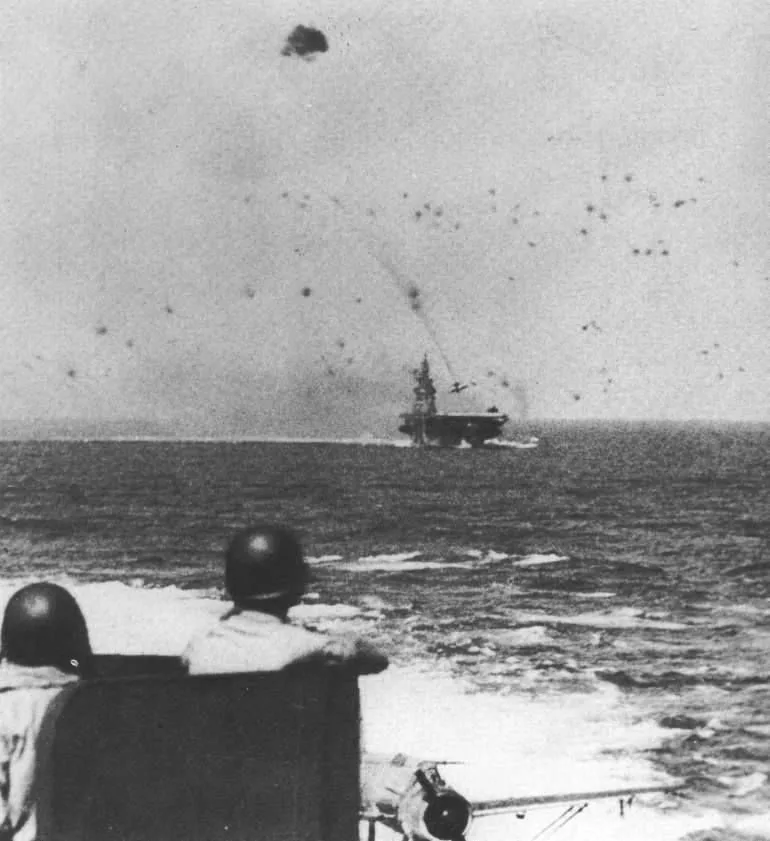
New Jersey rejoined her fast carriers near San Bernadino 27 October for strikes on central and southern Luzon. Two days later, the force was under suicide attack. In a melee of anti-aircraft fire from the ships and combat air patrol, New Jersey shot down a plane whose pilot maneuvered it into Intrepid's (CV - 11) port gun galleries, while machine gun fire from Intrepid wounded three of New Jersey's men. During a similar action 25 November three Japanese planes were splashed by the combined fire of the force, part of one flaming onto Hancock's (CV-19) flight deck. Intrepid was again attacked, shot down one would-be suicide, but was crashed by another despite hits scored on the attacker by New Jersey gunners. New Jersey shot down a plane diving on Cabot (CVL-28) and hit another which smashed into Cabot's port bow.
In December, New Jersey sailed with the Lexington task group for air attacks on Luzon 14-16 December, then found herself in the furious typhoon which sank three destroyers. Skillful seamanship brought her through undamaged. She returned to Ulithi on Christmas Eve to be met by Fleet Admiral Chester W. Nimitz.
1945 Iwo Jima
New Jersey ranged far and wide from 30 December to 25 January 1945 on her last cruise as Admiral Halsey's flagship. She guarded the carriers in their strikes on Formosa, Okinawa, and Luzon, on the coast of Indo-China, Hong Kong, Swatow and Amoy, and again on Formosa and Okinawa. At Ulithi 27 January Admiral Halsey lowered his flag in New Jersey, but it was replaced two days later by that of Rear Admiral Oscar Badger commanding Battleship Division Seven.
In support of the assault on Iwo Jima, New Jersey screened the Essex (CV-9) group in air attacks on the island 19-21 February, and gave the same crucial service for the first major carrier raid on Tokyo 25 February, a raid aimed specifically at aircraft production. During the next two days, Okinawa was attacked from the air by the same striking force.
New Jersey was directly engaged in the conquest of Okinawa from 14 March until 16 April. As the carriers prepared for the invasion with strikes there and on Honshu, New Jersey fought off air raids, used her seaplanes to rescue downed pilots, defended the carriers from suicide planes, shooting down at least three and assisting in the destruction of others. On 24 March she again carried out the vital battleship role of heavy bombardment, preparing the invasion beaches for the assault a week later.
Post-war 1946–1949
1946
During the final months of the war, New Jersey was overhauled at Puget Sound Naval Shipyard, from which she sailed 4 July for San Pedro, Pearl Harbor, and Eniwetok bound for Guam. Here on 14 August she once again became flagship of the Fifth Fleet under Admiral Spruance. Brief stays at Manila and Okinawa preceded her arrival in Tokyo Bay 17 September, where she served as flagship for the successive commanders of Naval Forces in Japanese waters until relieved 28 January 1946 by Iowa (BB-61). New Jersey took aboard nearly a thousand homeward-bound troops with whom she arrived at San Francisco 10 February.
1947
After west coast operations and a normal overhaul at Puget Sound, New Jersey's keel once more cut the Atlantic as she came home to Bayonne, New Jersey, for a rousing fourth birthday party 23 May 1947. Present were Governor Alfred E. Driscoll, former Governor Walter E. Edge and other dignitaries.
Between 7 June and 26 August 1 New Jersey formed part of the first training squadron to cruise Northern European waters since the beginning of World War II. Over two thousand Naval Academy and NROTC midshipmen received seagoing experience under the command of Admiral Richard L. Connoly, Commander Naval Forces Eastern Atlantic and Mediterranean, who broke his flag in New Jersey at Rosyth, Scotland 23 June. She was the scene of official receptions at Oslo, where King Haakon VII of Norway inspected the crew 2 July, and at Portsmouth, England. The training fleet was westward bound 18 July for exercises in the Caribbean and Western Atlantic.
1948

After serving at New York as flagship for Rear Admiral Heber H. McClean, Commander, Battleship Division One, 12 September-18 October, New Jersey was inactivated at the New York Naval Shipyard. She was decommissioned at Bayonne 30 June 1948 and assigned to the New York Group, Atlantic Reserve Fleet.
Korean War period 1950–1953
1950
New Jersey was recommissioned at Bayonne 21 November 1950, Captain David M. Tyree in command. In the Caribbean she welded her crew into an efficient body which would meet with distinction the demanding requirements of the Korean War. She sailed from Norfolk 16 April 1951 and arrived from Japan off the east coast of Korea 17 May. Vice Admiral Harold M. Martin, commanding the Seventh Fleet, placed his flag in New Jersey for the next six months.
New Jersey's guns opened the first shore bombardment of her Korean career at Wonsan 20 May. During her two tours of duty in Korean waters, she was again and again to play the part of seaborne mobile artillery. In direct support to United Nations troops, or in preparation for ground actions, in interdicting Communist supply and communication routes, or in destroying supplies and troop positions, New Jersey hurled a weight of steel fire far beyond the capacity of land artillery, moved rapidly and free from major attack from one target to another, and at the same time could be immediately available to guard aircraft carriers should they require her protection. It was on this first such mission at Wonsan that she received her only combat casualties of the Korean War. One of her men was killed and two severely Wounded when she took a hit from a shore battery on her number one turret and received a near miss aft to port.
Between 23 and 27 May, and again 30 May New Jersey pounded targets near Yangyang and Kansong, dispersing troop concentrations, dropping a bridge span, and destroying three large ammunition dumps. Air spotters reported Yangyang abandoned at the end of this action, while railroad facilities and vehicles were smashed at Kansong. On 24 May, she lost one of her helicopters when its crew pushed to the limit of their fuel searching for a downed aviator. They themselves were able to reach friendly territory and were later returned to their ship.
With Admiral Arthur W. Radford, Commander in Chief Pacific Fleet, and Vice Admiral C. Turner Joy, Commander Naval Forces Far East aboard, New Jersey bombarded targets at Wonsan 4 June. At Kansong two days later she fired her main battery at an artillery regiment and truck encampment, with Seventh Fleet aircraft spotting targets and reporting successes. On 28 July off Wonsan the battleship was again taken under fire by shore batteries. Several near misses splashed to port, but New Jersey's precision fire silenced the enemy and destroyed several gun emplacements.
Between 4 and 12 July, New Jersey supported a United Nations push in the Kansong area, firing at enemy buildup and reorganization positions. As the Republic of Korea's First Division hurled itself on the enemy, shore fire control observers saw New Jersey's salvos hit directly on enemy mortar emplacements, supply and ammunition dumps, and personnel concentrations. New Jersey returned to Wonsan 18 July for an exhibition of perfect firing: five gun emplacements demolished with five direct hits.
New Jersey sailed to the aid of troops of the Republic of Korea once more 17 August, returning to the Kansong area where for four days she provided harrassing fire by night, and broke up counterattacks by day, inflicting a heavy toll on enemy troops. She returned to this general area yet again 29 August, when she fired in an amphibious demonstration staged behind enemy lines to ease pressure on the Republic of Korea's troops. The next day she began a three-day saturation of the Changjon area, with one of her own helicopters spotting the results: four buildings destroyed, road junctions smashed, railroad marshalling yards afire, tracks cut and uprooted, coal stocks scattered, many buildings and warehouses set blazing.
Aside from a brief break in firing 23 September to take aboard wounded from the Korean frigate Apnok (PF-62), damaged by gunfire, New Jersey was heavily engaged in bombarding the Kansong area, supporting the movement of the U.S. Tenth Corps. The pattern again was harassing fire by night, destruction of known targets by day. Enemy movement was restricted by the fire of her big guns. A bridge, a dam, several gun emplacements, mortar positions, pillboxes, bunkers, and two ammunition dumps were demolished.
On 1 October, General Omar Bradley, Chairman of the Joint Chiefs of Staff, and General Matthew B. Ridgeway, Commander in Chief Far East, came on board to confer with Admiral Martin.
Between 1 and 6 October New Jersey was in action daily at Kansong, Hamhung, Hungnam, Tanchon, and Songjin. Enemy bunkers and supply concentrations provided the majority of the targets at Kansong; at the others New Jersey fired on railroads, tunnels, bridges, an oil refinery, trains, and shore batteries, destroying with five-inch fire a gun that straddled her. The Kojo area was her target 16 October, as she sailed in company with HMS Belfast, pilots from HMAS Sydney spotting. The operation was well-planned and coordinated and excellent results were obtained.
Another highly satisfactory day was 16 October, when the spotter over the Kansong area reported "beautiful shootingevery shot on target-most beautiful shooting I have seen in five years." This five hour bombardment leveled ten artillery positions, and in smashing trenches and bunkers inflicted some 500 casualties.
New Jersey dashed up the North Korean coast raiding transportation facilities from 1 to 6 November. She struck at bridges, road and rail installations at Wonsan, Hungnam, Tanchon, lowon, Songjin, and Chongjin, and left smoking behind her four bridges destroyed, others badly damaged, two marshalling yards badly torn up, and many feet of track destroyed. With renewed attacks on Kansong and near the Chang-San-Got Peninsula 11 and 13 November, New Jersey completed this tour of duty.
1952
Relieved as flagship by Wisconsin (BB-64), New Jersey cleared Yokosuka for Hawaii, Long Beach and the Panama Canal, and returned to Norfolk 20 December for a six-month overhaul. Between 19 July 1952 and 5 September, she sailed as flagship for Rear Admiral H. R. Thurber, who commanded the NROTC midshipman training cruise to Cherbourg, Lisbon, and the Caribbean. Now New Jersey prepared and trained for her second Korean tour, for which she sailed from Norfolk 5 March 1953.
Shaping her course via the Panama Canal, Long Beach, and Hawaii, New Jersey reached Yokosuka 5 April, and next day relieved Missouri (BB-63) as flagship of Vice Admiral Joseph H. Clark, Commander Seventh Fleet. Chongjin felt the weight of her shells 12 April, as New Jersey returned to action; in seven minutes she scored seven direct hits, blowing away half the main communications building there. At Pusan two days later, New Jersey manned her rails to welcome the President of the Republic of Korea and Madame Rhee, and American Ambassador Ellis O. Briggs.
New Jersey fired on coastal batteries and buildings at Kojo 16 April; on railway track and tunnels near Hungnam 18 April; and on gun emplacements around Wonsan Harbor 20 April, silencing them in five areas after she had herself taken several near misses. Songiin provided targets 23 April. Here New Jersey scored six direct 16-inch hits on a railroad tunnel, and knocked out two rail bridges.
New Jersey added her muscle to a major air and surface strike on Wonsan 1 May, as Seventh Fleet planes both attacked the enemy and spotted for the battleship. She knocked out eleven Communist shore guns that day, and four days later destroyed the key observation post on the island of Hodo Pando, commanding the harbor. Two days later Kalmagak at Wonsan was her target.
Her tenth birthday, 23 May, was celebrated at Inchon, with President and Madame Rhee, Lieutenant General Maxwell D. Taylor, and other dignitaries on board. Two days later New Jersey was all war once more, returning to the west coast at Chinampo to knock out harbor defense positions.
The battleship was under fire at Wonsan 27-29 May, but her five-inch guns silenced the counter-fire, and her 16-inch shells destroyed five gun emplacements and four gun eaves. She also hit a target that flamed spectacularly: either a fuel storage area or an ammunition dump.
New Jersey returned to the key task of direct support to troops at Kosong 7 June. On her first mission, she completely destroyed two gun positions, an observation post, and their supporting trenches, then stood by on call for further aid. Then it was back to Wonsan for a day-long bombardment 24 June, aimed at guns placed in eaves. The results were excellent, with eight direct hits on three eaves, one cave demolished, and four others closed. Next day she returned to troop support at Kosong, her assignment until 10 July, aside from necessary withdrawal for replenishment.
At Wonsan 11-12 July, New Jersey fired one of the most concentrated bombardments of her Korean duty. For nine hours the first day, and for seven the second, her guns slammed away on gun positions and bunkers on Hodo Pando and the mainland, with telling effect. At least ten enemy guns were destroyed, many damaged, and a number of eaves and tunnels sealed. New Jersey smashed radar control positions and bridges at Kojo 13 July, and was once more on the east coast bombline 22-24 July to support South Korean troops near Kosong. These days found her gunners at their most accurate and the devastation wrought was impressive. A large cave, housing an important enemy observation post was closed, the end of a month-long United Nations effort. A great many bunkers, artillery areas, observation posts, trenches, tanks and other weapons were destroyed.
At sunrise 25 July New Jersey was off the key port, rail and communications center of Hungnam, pounding coastal guns, bridges, a factory area, and oil storage tanks. She sailed north that afternoon, firing at rail lines and railroad tunnels as she made for Tanchon, where she launched a whaleboat in an attempt to spot a train known to run nightly along the coast. Her big guns were trained on two tunnels between which she hoped to catch the train, but in the darkness she could not see the results of her six-gun salvo.
New Jersey's mission at Wonsan, next day, was her last. Here she destroyed large-caliber guns, bunkers, caves and trenches. Two days later, she learned of the truce. Her crew celebrated during a seven day visit at Hong Kong, where she anchored 20 August. Operations around Japan and off Formosa were carried out for the remainder of her tour, which was highlighted by a visit to Pusan. Here President Rhee came aboard 16 September to present the Korean Presidential Unit Citation to the Seventh Fleet.
Relieved as flagship at Yokosuka by Wisconsin 14 October, New Jersey was homeward bound the next day, reaching Norfolk 14 November. During the next two summers she crossed the Atlantic with midshipmen on board for training, and during the rest of the year sharpened her skills with exercises and training maneuvers along the Atlantic coast and in the Caribbean.
Cold War 1954–1963
1955
New Jersey stood out of Norfolk 7 September 1955 for her first tour of duty with the Sixth Fleet in the Mediterranean. Her ports of call included Gibraltar, Valencia, Cannes, Istanbul, Suda Bay, and Barcelona. She returned to Norfolk 17 January 1956 for the spring program of training operations. That summer she again carried midshipmen to Northern Europe for training, bringing them home to Annapolis 31 July. New Jersey sailed for Europe once more 27 August as flagship of Vice Admiral Charles Wellborn, Jr., Commander Second Fleet. She called at Lisbon, participated in NATO exercises off Scotland, and paid an official visit to Norway where Crown Prince Olaf was a guest. She returned to Norfolk 15 October, and 14 December arrived at New York Naval Shipyard for inactivation. She was decommissioned and placed in reserve at Bayonne 21 August 1957.
Vietnam War period 1964–1975
1968
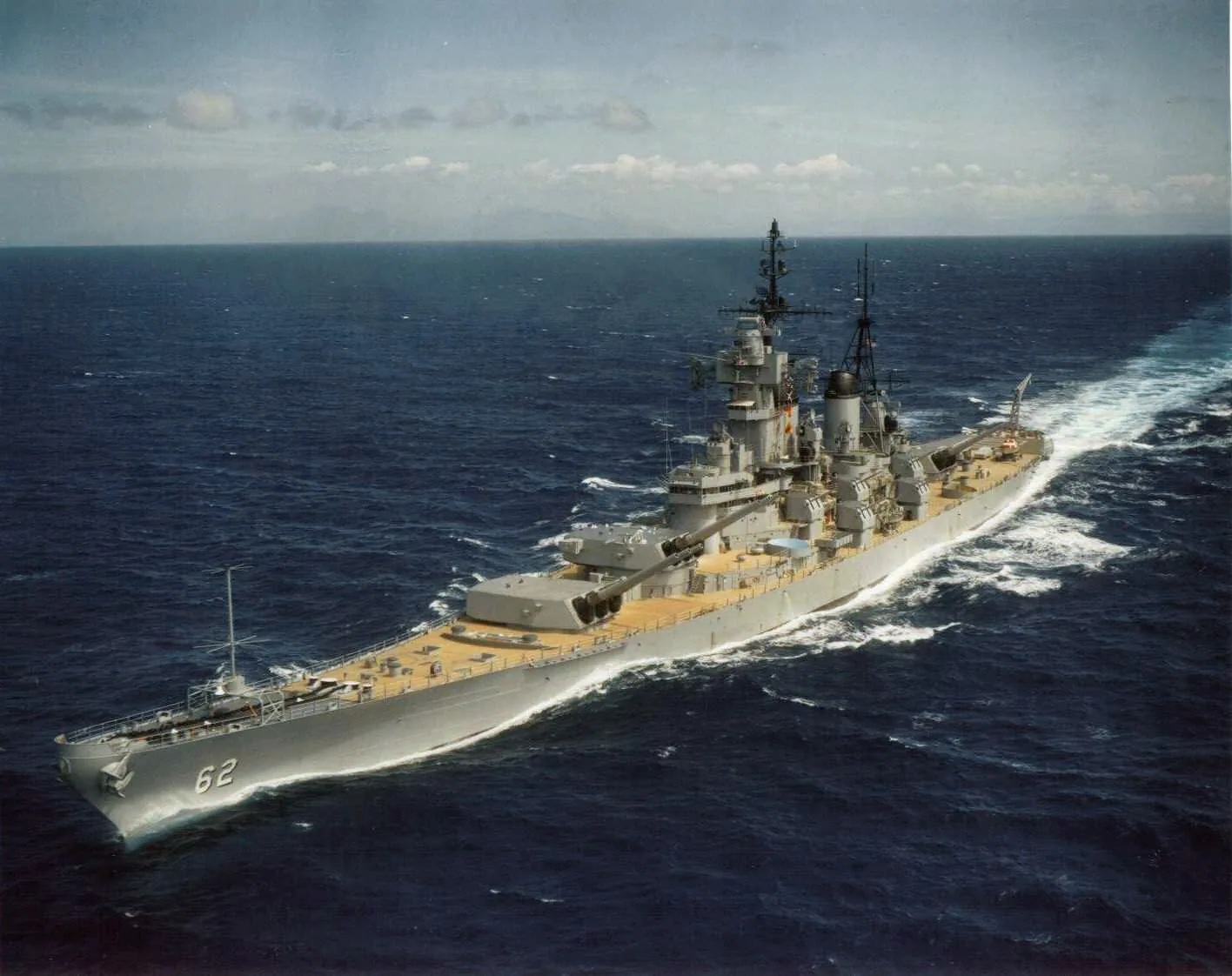
New Jersey's third career began 6 April 1968 when she recommissioned at Philadelphia Naval Shipyard, Captain J. Edward Snyder in command. Fitted with improved electronics and a helicopter landing pad and with her 40-millimeter battery removed, she was tailored for use as a heavy bombardment ship. Her 16-inch guns, it was expected, would reach targets in Vietnam inaccessible to smaller naval guns and, in foul weather, safe from aerial attack.
New Jersey, now the world's only active battleship, departed Philadelphia 16 May, calling at Norfolk and transiting the Panama Canal before arriving at her new home port of Long Beach, California, 11 June. Further training off Southern California followed. On 24 July New Jersey received 16-inch shells and powder tanks from Mount Katmai (AE-16) by conventional highline transfer and by helicopter lift, the first time heavy battleship ammunition had been transferred by helicopter at sea.
Departing Long Beach 3 September, New Jersey touched at Pearl Harbor and Subic Bay before sailing 25 September for her first tour of gunfire support duty along the Vietnamese coast. Near the 17th Parallel on 30 September, the dreadnought fired her first shots in battle in over sixteen years. Firing against Communist targets in and near the so-called Demilitarized Zone (DMZ), her big guns destroyed two gun positions and two supply areas. She fired against targets north of the DMZ the following day, rescuing the crew of a spotting plane forced down at sea by antiaircraft fire.
The next six months fell into a steady pace of bombardment and fire support missions along the Vietnamese coast, broken only by brief visits to Subic Bay and replenishment operations at sea. In her first two months on the gun line, New Jersey directed nearly ten thousand rounds of ammunition at Communist targets; over 3,000 of these shells were 16-inch projectiles.
1969
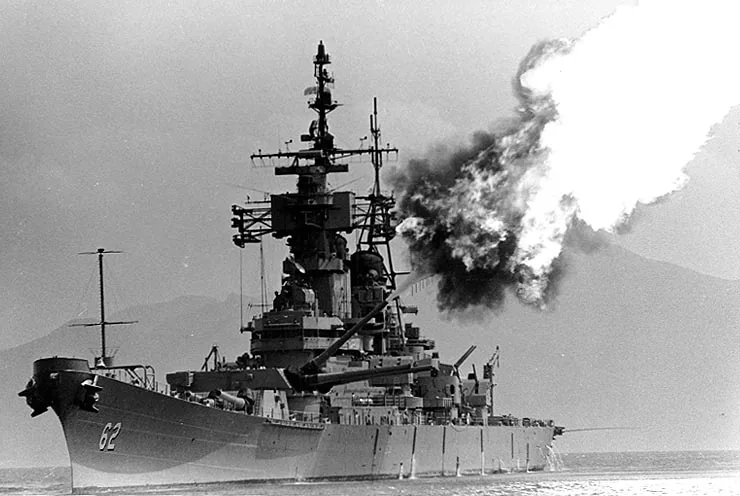
Her first Vietnam combat tour completed, New Jersey departed Subic Bay 3 April 1969 for Japan. She arrived at Yokosuka for a two-day visit, sailing for the United States 9 April. Her homecoming, however, was to be delayed. On the 15th, while New Jersey was still at sea, North Korean jet fighters shot down an unarmed EC-121 "Constellation" electronic surveillance plane over the Sea of Japan, killing its entire crew. A carrier task force was formed and sent to the Sea of Japan, while New Jersey was ordered to come about and steam toward Japan. On the 22nd she arrived once more at Yokosuka, and immediately put to sea in readiness for what might befall. As the crisis lessened, New Jersey was released to continue her interrupted voyage. She anchored at Long Beach 5 May 1969, her first visit to her home port in eight months.
Through the summer months, New Jersey's crew toiled to make her ready for another deployment. Deficiencies discovered on the gun line were remedied, as all hands looked forward to another opportunity to prove the mighty warship's worth in combat. Reasons of economy were to dictate otherwise. On 22 August 1969 the Secretary of Defense released a list of names of ships to be inactivated; at the top of the list was New Jersey. Five days later, Captain Snyder was relieved of command by Captain Robert C. Peniston.
Assuming command of a ship already earmarked for the "mothball fleet," Captain Peniston and his crew prepared for their melancholy task. New Jersey got underway on her last voyage 6 September, departing Long Beach for Puget Sound Naval Shipyard. She arrived on the 8th, and began preinactivation overhaul to ready herself for decommissioning. On 17 December 1969 New Jersey's colors were hauled down and she entered the inactive fleet, still echoing the words of her last commanding officer: "Rest well, yet sleep lightly; and hear the call, if again sounded, to provide fire power for freedom."
New Jersey earned the Navy Unit Commendation for Vietnam service. She has received nine battle stars for World War II; four for the Korean conflict; and two for Vietnam.
Other photographs
Held for this vessel, and not tied to any part of the account above.


References
Every work this entry draws on. There are no numbered markers in the text above: what we hold is the provenance of the page — this history, this article, these photographs.
- History New Jersey II (BB-62) Dictionary of American Naval Fighting Ships, Naval History and Heritage Command. A work of the United States Government, in the public domain — the only text on this site reproduced verbatim.
- Facts USS New Jersey (BB-62) Structured facts only — dates, dimensions, armament and fate. No wording is taken from it. Harvested 1 August 2026.
- Photograph New Jersey Sails Camera Operator: PH3 BRYANT — Defense Visual Information Center — Public domain — Wikimedia Commons
- Photograph 80-G-82700 USS NEW JERSEY (BB-62) Naval History and Heritage Command — Rear admiral Donald B. Beary and Captain Carl F. Holden, USN — Public domain — Wikimedia Commons
- Photograph USS New Jersey (BB-62) and French battleship Richelieu at anchor on 7 September 1943 (80-G-204842) U.S. Navy photo 80-G-204842 — Public domain — Wikimedia Commons
- Photograph USS Intrepid CV-11 kamikaze strike U.S. Navy Photo — (1) Photo located on this website , specifically this link . (2) Taringa.net [1] — Public domain — Wikimedia Commons
- Photograph New Jesery Mothballed (1948) USN — Official U.S. Navy photo [1] released from the Public Information Office, 3rd Naval District at New York, available at Navsource.org — Public domain — Wikimedia Commons
- Photograph New Jersey in Korea U.S. Navy, Photographed by Chief Aviation Photographer's Mate Patrick Cady & submitted by Robert M. Cieri. — Official U.S. Navy Photograph # 80-G-435681 from the Chief of Information, Navy Department, Washington, DC. & now in the collections of the National Archives Source Specifically ; U.S. DefenseImagery [1] photo VIRIN: HD-SN-50-00955 — Public domain — Wikimedia Commons
- Photograph New Jersey in Korea II Official U.S. Navy Photograph, now in the collections of the National Archives. — http://www.history.navy.mil/photos/images/k16000/k16282c.htm http://www.history.navy.mil/photos/images/k16000/k16282.jpg — Public domain — Wikimedia Commons
- Photograph USS New Jersey BB-62 salvo Jan 1953 USN — U.S. DefenseImagery [1] photo VIRIN: 80-G-433953/HN-SN-98-07219 — Public domain — Wikimedia Commons
- Photograph New Jersey Underway Official US Navy Photograph from the U.S. Naval Photographic Center, courtesy of Robert M. Cieri. Text courtesy of U.S. Battleships: An Illustrated Design History by Norman Friedman. — navsource.org , Specifically — Public domain — Wikimedia Commons
- Photograph USS New Jersey Photographed by PH2 Monty L. Tipton. — Naval Historical Center — Public domain — Wikimedia Commons
- Photograph USS Missouri (BB-63) and USS New Jersey (BB-62) mothballed Camera Operator: JO1 CALLAGHAN — http://www.dodmedia.osd.mil/DVIC_View/Still_Details.cfm?SDAN=DNST8201715&JPGPath=/Assets/Still/1982/Navy/DN-ST-82-01715.JPG — Public domain — Wikimedia Commons
- Photograph New Jersey Modernized Unknown author — Public domain — Wikimedia Commons
- Photograph BGM-109 Tomahawk Cruise Missiles Steven Fine — Own work — CC BY-SA 4.0 — Wikimedia Commons
- Photograph USS Fletcher (DD-992) alongside USS New Jersey (BB-62) PH1 S. SMITH — DoDMedia — Public domain — Wikimedia Commons
- Photograph USS New Jersey firing in Beirut, 1984 Ron Garrison — US Navy — Public domain — Wikimedia Commons
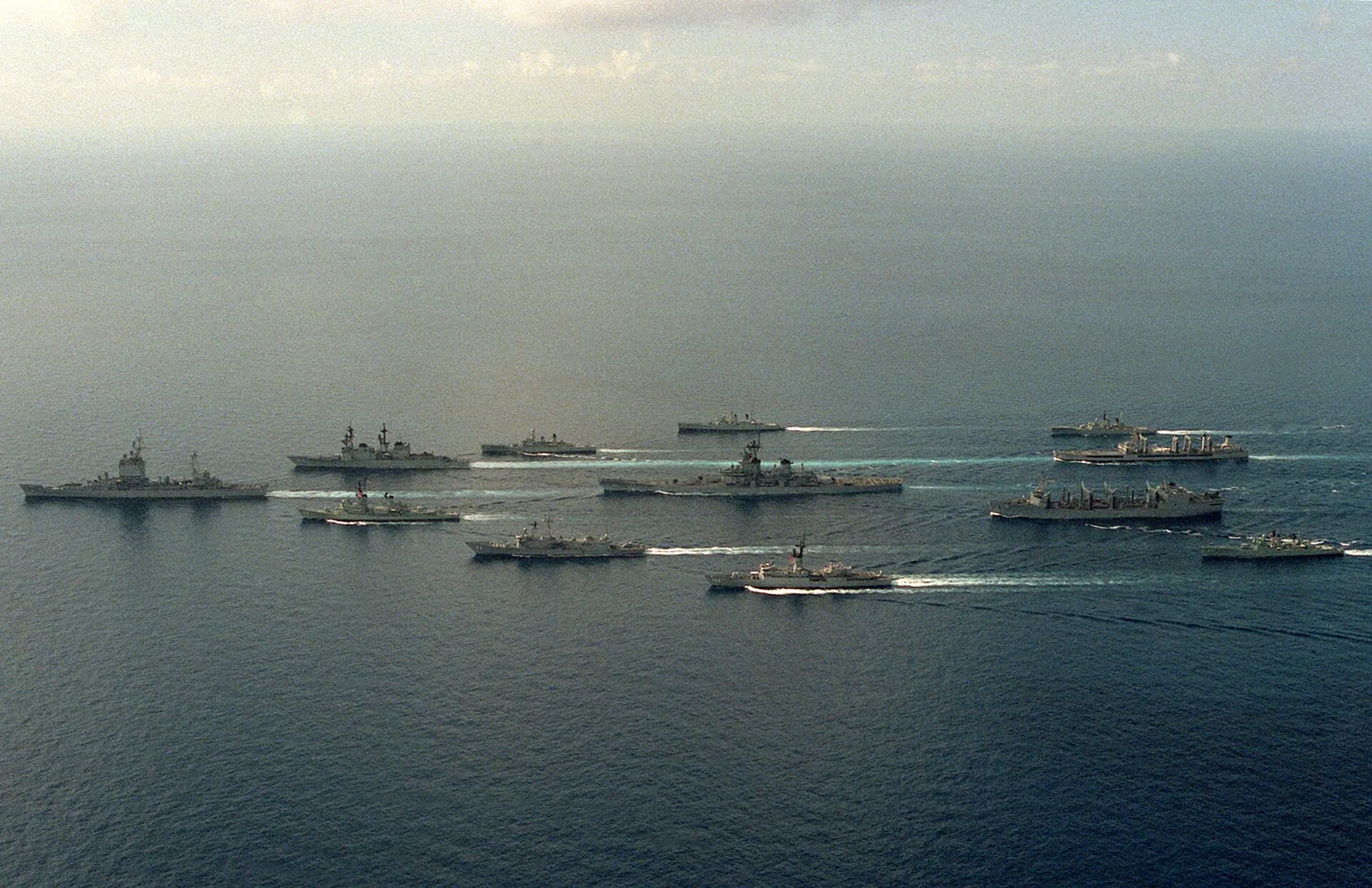
- Photograph USS New Jersey (BB-62) battle group with Australian ships 1986 PH2 Orell, USN — U.S. DefenseImagery photo VIRIN: DN-SC-87-00354 — Public domain — Wikimedia Commons
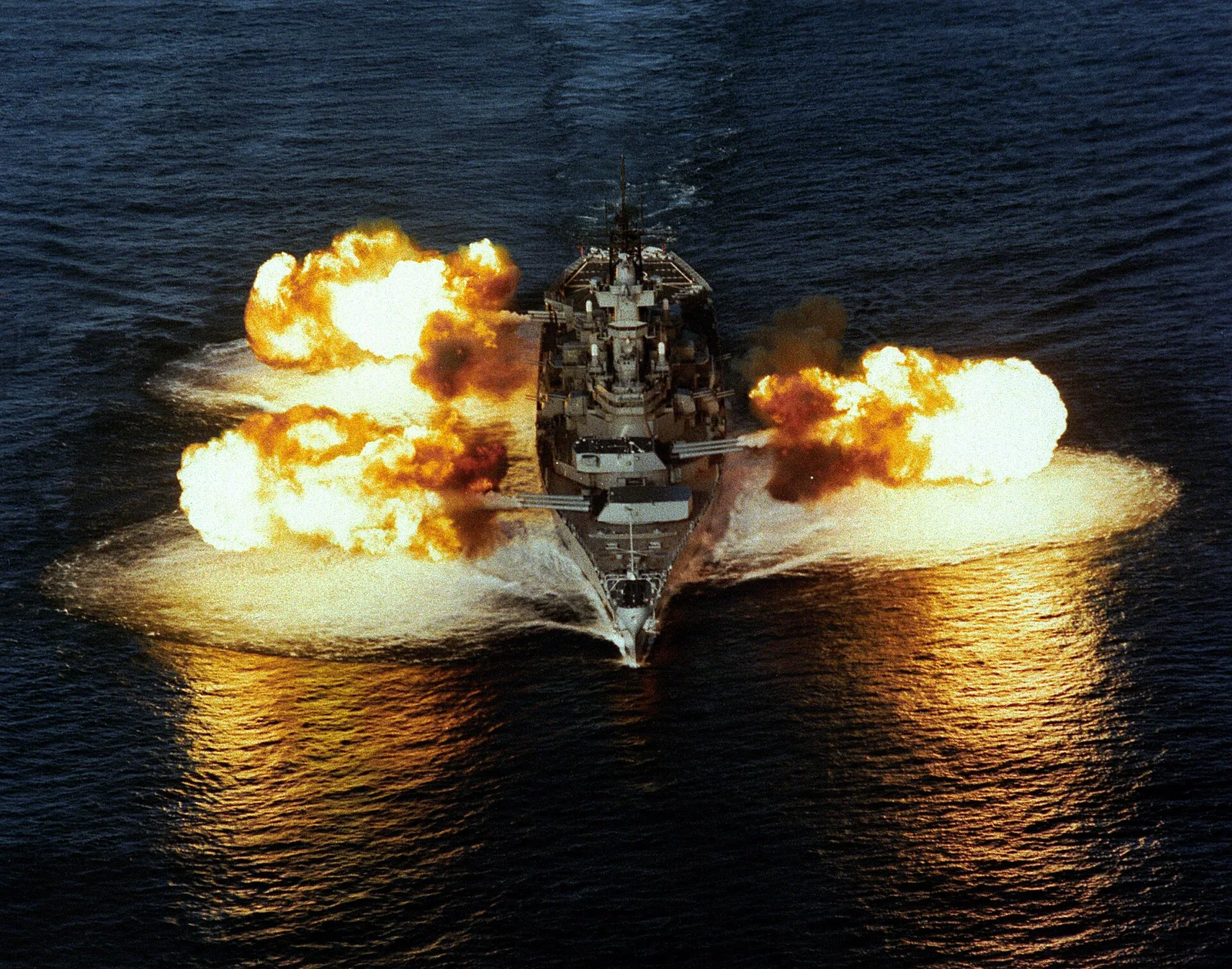
- Photograph New Jersey Shoots US Navy — [ dead link ] — Public domain — Wikimedia Commons
- Photograph USS New Jersey Night Sdwelch1031 — Own work — CC BY 3.0 — Wikimedia Commons
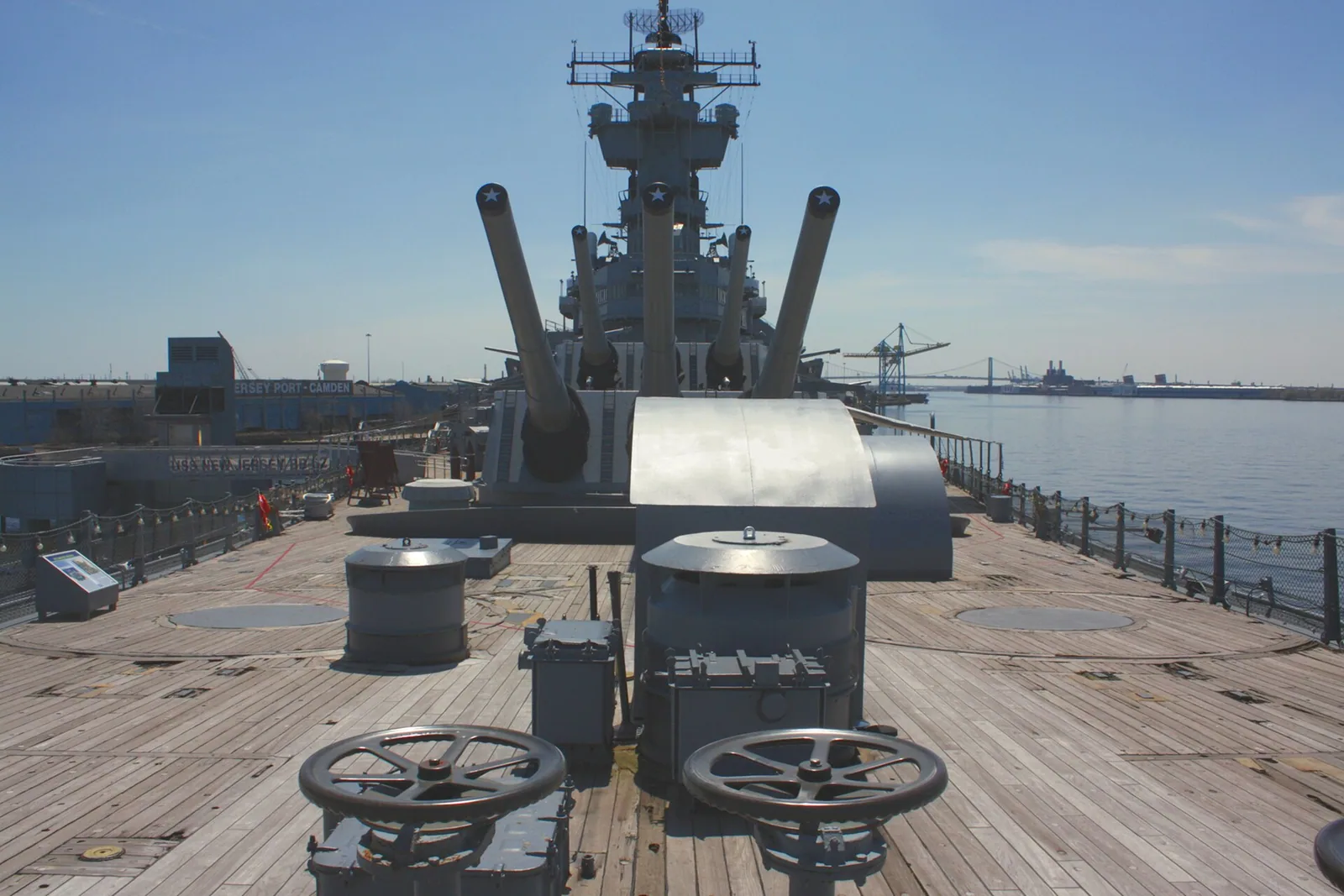
- Photograph A637, USS New Jersey, forward guns and deck, Camden, New Jersey, United States, 2018 Brian W. Schaller — Own work — FAL — Wikimedia Commons
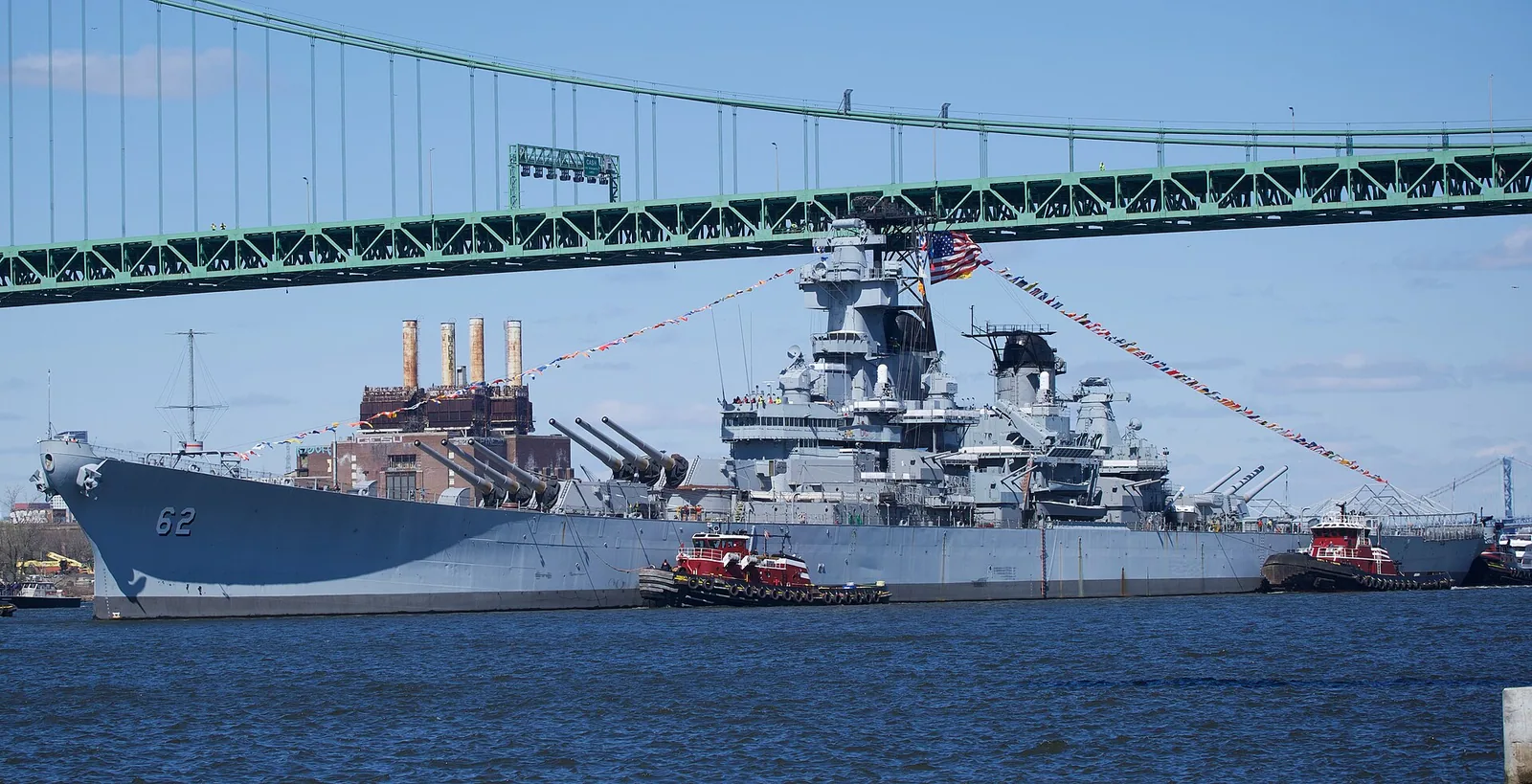
- Photograph March 21, 2024 moving of the USS New Jersey 4 (cropped) QuincyMorgan — Own work — CC0 — Wikimedia Commons