USS Pensacola (CA-24)
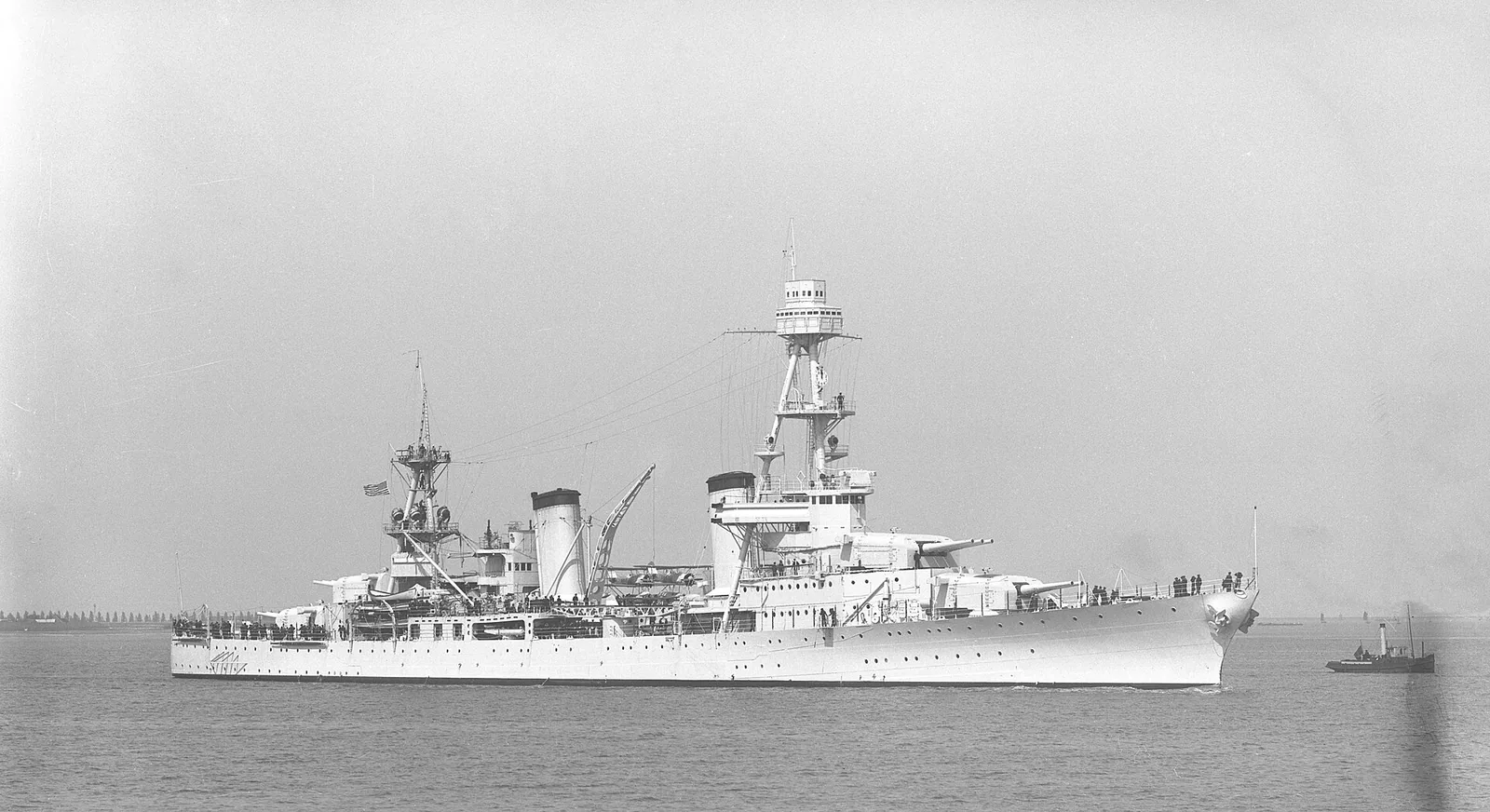
Service
- as Pensacola6 February 1930 — 26 August 19462,193 days of the war
- Name
- USS Pensacola
- Pennant / hull number
- CA-24
- Namesake
- City of Pensacola, Florida
- Builder
- New York Navy Yard, Brooklyn, New York
- Ordered
- 18 December 1924
- Laid down
- 27 October 1926
- Launched
- 25 April 1929
- Commissioned
- 6 February 1930
- Decommissioned
- 26 August 1946
- Struck
- 28 November 1945
- Fate
- Sunk as a target, 10 November 1948 (1948)
- Status
- Wreck
Specifications — As built
- Displacement, standard
- 9,100 long tons (9,246 t)
- Length
- 178.31 m (585 ft) OA
- Beam
- 19.81 m (65 ft)
- Draught
- 4.88 m (16 ft)
- Speed
- 32.7 knots (60.6 km/h, 37.6 mph)
- Range
- 10,000 nmi (18,520 km)
- Complement
- 530
- Main gun
- 203 mm (8 in)
The third Pensacola (CA-24) was laid down by the New York Navy Yard 27 October 1926; launched 25 April 1929; sponsored by Mrs. Joseph L. Seligman; and commissioned 6 February 1930, Capt. Alfred G. Howe in command.
Pensacola departed New York 24 March 1930, transited the Panama Canal to Callao, Peru, and Valparaiso, Chile, before returning to New York 5 June. For the next four years she operated along the eastern seaboard and in the Caribbean Sea, several times transiting the Panama Canal for combined Fleet battle practice ranging from California to Hawaii.
Pensacola departed Norfolk 15 January 1935 to join the Pacific Fleet arriving San Diego, her new home port, 30 January. Fleet problems ranged to Hawaii, one cruise took her to Alaska, and combined fleet maneuvers returned her briefly to the Caribbean Sea before she sailed 5 October 1939 to base at Pearl Harbor, arriving the 12th. Maneuvers frequently found the cruiser off Midway and French Frigate Shoals, and she made one voyage to Guam.
Continue to the full service history About 2,522 words
From the Dictionary of American Naval Fighting Ships, compiled by the Naval History and Heritage Command (Pensacola III (CA-24)). A work of the United States Government, in the public domain.
Armament and machinery
This vessel is recorded in 3 configurations. Wartime refits changed armament and complement substantially, so each is kept separately rather than averaged into one set of figures. The figures above are as built.
As built
- Propulsion
- 4 × Parsons reduction steam turbines
- 4 × screws
- Power
- 12 × White-Forster boilers
- 107000 shp
- Armament
- 10 × 8 in/55 caliber guns (2×3, 2×2)
- 8 × 5 in/25 caliber anti-aircraft guns
- 2 × 3-pounder 47 mm saluting guns
- 6 × 21 in torpedo tubes (2×3)
- Armour
- Belt: 2+1/2 - 4 in
- Deck: 1 - 1+3/4 in
- Barbettes: 3/4 in
- Turrets: 3/4 - 2+1/2 in
- Conning Tower: 1+1/4 in
- Aircraft
- 4 × floatplanes
1942
- Main gun
- 203 mm (8 in)
- Armament
- 10 × 8 in/55 caliber guns (2×3, 2×2)
- 8 × 5 in/25 caliber anti-aircraft guns
- 2 × 3-pounder 47 mm saluting guns
- 4 × 1.1 in/75 anti-aircraft guns
- 8 × single 20 mm Oerlikon cannons
1945
- Main gun
- 203 mm (8 in)
- Armament
- 10 × 8 in/55 caliber guns (2×3, 2×2)
- 8 × 5 in/25 caliber anti-aircraft guns
- 7 × quad 40 mm Bofors guns
- 9 × twin 20 mm Oerlikon cannons
Sister ships
Sources
- Facts harvested from USS Pensacola (CA-24) on Wikipedia. Figures only — no wording is taken from it.
- Service history reproduced verbatim from Pensacola III (CA-24) , Dictionary of American Naval Fighting Ships — public domain, a work of the United States Government.
- Photograph: Louis Claes — File:Pensacola Kruiser, asset zF8SvdD6jnVTSGlIY2FoSnA6.jpg — CC0 — Wikimedia Commons