USS Porter (DD-356)
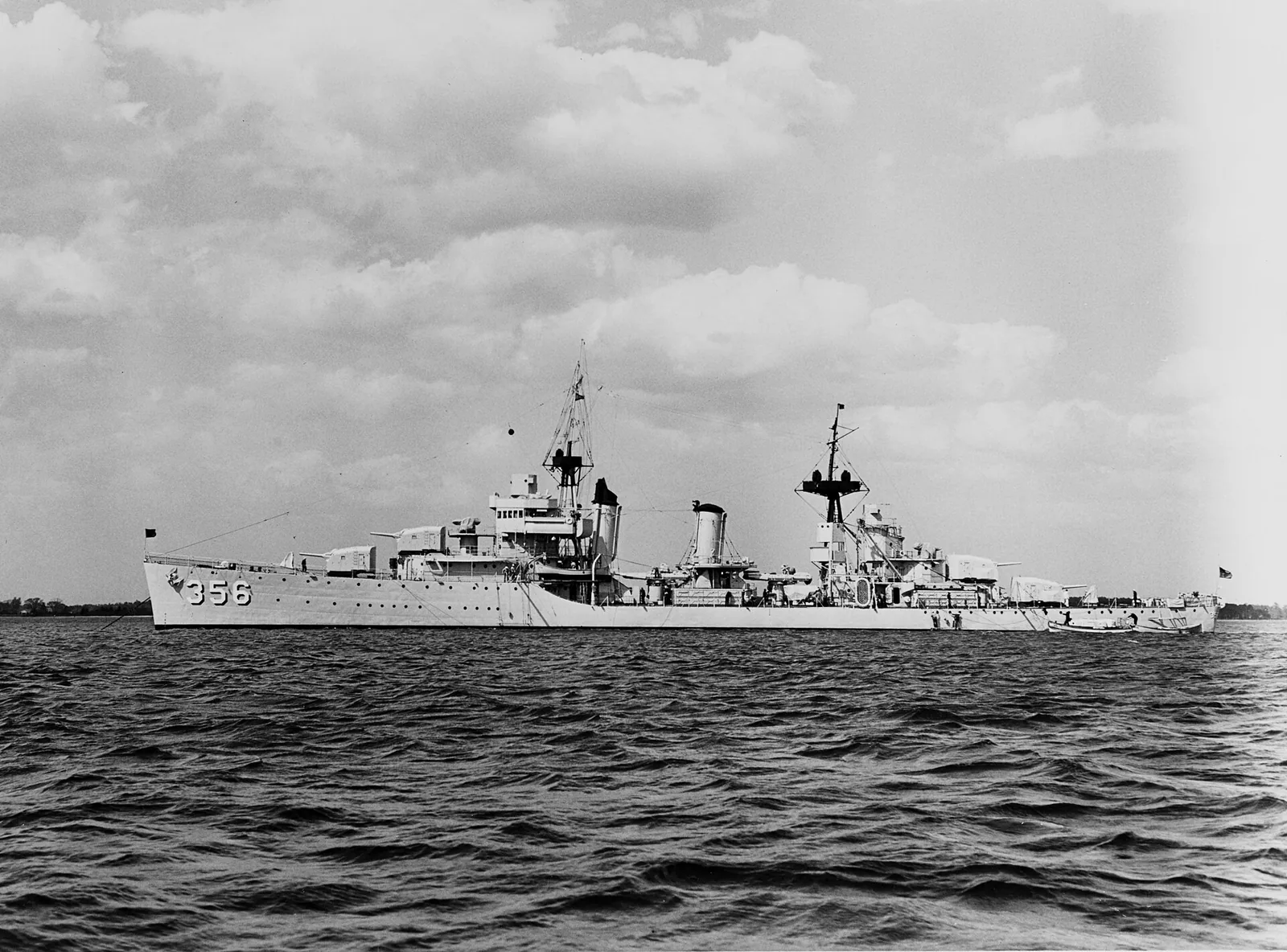
Service
- as Porter25 August 1936 — 2 November 19421,158 days of the war
- Name
- USS Porter
- Pennant / hull number
- DD-356
- Builder
- New York Shipbuilding Corporation
- Laid down
- 18 December 1933
- Launched
- 12 December 1935
- Commissioned
- 25 August 1936
- Struck
- 2 November 1942
- Fate
- Scuttled following Battle of the Santa Cruz Islands
26 October 1942 - Status
- Wreck
Specifications
- Displacement, standard
- 1,850 long tons (1,880 t)
- Length
- 116.13 m (381 ft)
- Beam
- 10.97 m (36 ft)
- Draught
- 3.05 m (10 ft)
- Speed
- 35 knots (64.8 km/h, 40.3 mph)
- Range
- 6,500 nmi (12,038 km)
- Complement
- 194
- Main gun
- 127 mm (5 in)
The third Porter (DD–356) was laid down on 18 December 1933 at Camden, N.J., by the New York Shipbuilding Corp.; launched on 12 December 1935; sponsored by Miss Carlile Patterson Porter; and commissioned at Philadelphia on 25 August 1936, Cmdr. Forrest B. Royal in command.
After shakedown in waters off northern Europe, Porter visited St. John’s, Newfoundland, for coronation ceremonies in honor of George VI in May 1937 and was at the Washington Navy Yard during the Boy Scout Jamboree, June–July 1937. Then reassigned to the Pacific Fleet, she transited the Panama Canal and arrived at San Francisco on 5 August 1937. She operated continuously with the Pacific Fleet until the outbreak of World War II , homeported at San Diego, California.
On 5 December 1941, Porter got underway from Pearl Harbor, escaping the Japanese attack by two days. She patrolled with cruisers and destroyers in Hawaiian waters before steaming in convoy 25 March 1942 for the west coast.
She operated off the west coast with TF 1 for the next four months. Returning to Pearl Harbor in mid-August, she trained in Hawaiian waters until 16 October when she sortied with TF 16 and headed for the Solomons. On 26 October 1942, TF 16 exchanged air attacks with strong Japanese forces northeast of Guadalcanal in the Battle of the Santa Cruz Islands .
After the ensuing action, Porter was torpedoed by a Grumman TBF-1 Avenger that had had to make a forced landing near the task group, Enterprise (CV-6) not wanting to bring a plane on board still carrying her torpedo. The weapon became fully armed after the ditching, and hit the destroyer in her engineering spaces. After the crew had abandoned ship, Porter was scuttled by gunfire from Shaw (DD-373). Porter was stricken from the Navy Register on 2 November 1942.
Porter earned one battle star for her World War II service, for her participation in the Battle of Santa Cruz (26 October 1942) in which she was lost.
From the Dictionary of American Naval Fighting Ships, compiled by the Naval History and Heritage Command (Porter III (DD-356)). A work of the United States Government, in the public domain.
Armament and machinery
Armament and machinery
- Propulsion
- 50,000 shp (37,285 kW) geared turbines
- 2 screws
- Armament
- As built:
- 2 × Mk33 Gun Fire Control System
- 8 × 5" (127mm)/38cal SP guns (4×2)
- 8 × 1.1" (28mm) AA (2x4)
- 8 × 21"(533mm) torpedo tubes (2x4)
- Circa 1942:
- 1 × Mk33 Gun Fire Control System
- 8 × 5" (127mm)/38cal SP guns (4×2)
- 2 × 40mm Bofors AA (1x2)
- 6 × 20mm Oerlikon AA (6x1)
- 2 × stern depth charge racks
Sister ships
Sources
- Facts harvested from USS Porter (DD-356) on Wikipedia. Figures only — no wording is taken from it.
- Service history reproduced verbatim from Porter III (DD-356) , Dictionary of American Naval Fighting Ships — public domain, a work of the United States Government.
- Photograph: Unknown author — U.S. Navy photo NH 66338 — Public domain — Wikimedia Commons