USS Selfridge (DD-357)
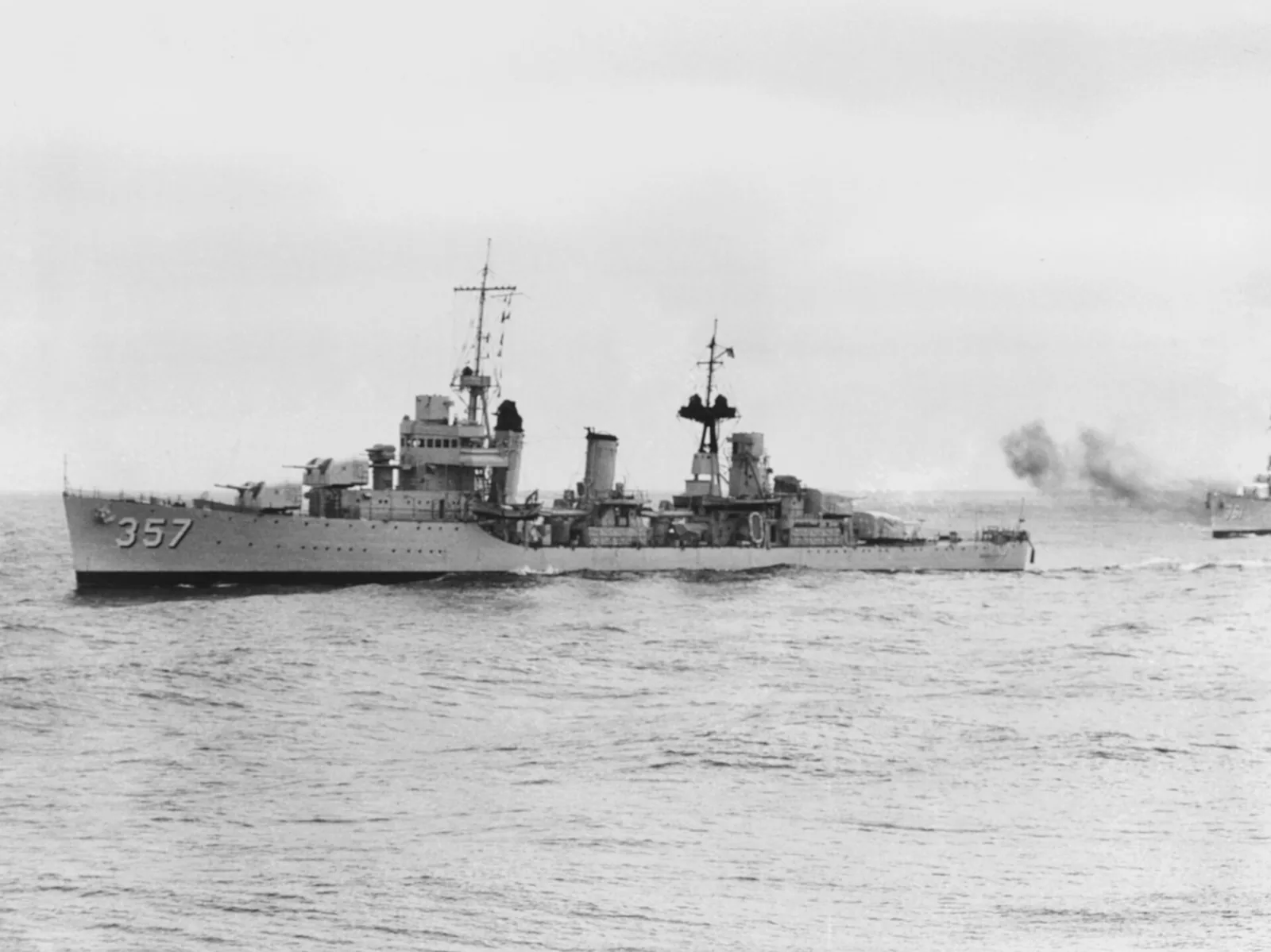
Service
- 25 November 1936 — 15 October 19452,193 days of the war
- Name
- USS Selfridge
- Pennant / hull number
- DD-357
- Builder
- New York Shipbuilding Corporation
- Laid down
- 18 December 1933
- Launched
- 18 April 1936
- Commissioned
- 25 November 1936
- Decommissioned
- 15 October 1945
- Struck
- 1 November 1945
- Fate
- Sold 20 December 1946 and scrapped (1946)
- Status
- Scrapped
Specifications
- Displacement, standard
- 1,850 long tons (1,880 t)
- Length
- 116.13 m (381 ft)
- Beam
- 10.97 m (36 ft)
- Draught
- 3.05 m (10 ft)
- Speed
- 35 knots (64.8 km/h, 40.3 mph)
- Range
- 6,479 nmi (11,999 km)
- Complement
- 194
- Main gun
- 127 mm (5 in)
Thomas O. Selfridge was born on 24 April 1804 and was appointed midshipman on 1 January 1818. Promoted to Lieutenant in 1827, he served in the East India, Mediterranean, and Pacific squadrons. He took command of sloop, Dale, in May 1847 and participated in the capture of Mazatlan and Guaymas. Badly wounded in the latter engagement, he was invalided home in June 1848. He was subsequently assigned to the Boston Navy Yard, where he remained until 1861. He commanded Mississippi, flagship of the Gulf Squadron, on blockade duty off Mobile and off the passes of the Mississippi. His old wound forced him to relinquish his command in February 1862, and he served ashore until retiring in 1866. Rear Admiral Selfridge died in Waverly, Mass., on 15 October 1902.
Thomas O. Selfridge, Jr., son of the above, was born in Charlestown, Mass., on 6 February 1836 and graduated from the Naval Academy in 1854. At the beginning of the Civil War, he helped with efforts to destroy the untenable Norfolk Navy Yard; and he then escaped from that burning and beleaguered base in Cumber land, helping to save the sloop of war for the Union Navy. He participated in the capture of the Hatteras forts and was on board Cumberland on 8 March 1862 when she was sunk by Confederate ironclad, Virginia. He then briefly commanded Monitor, after Lt. Worden was wounded; and commanded Alligator, an experimental submarine, in testing operations based at the Washington Navy Yard.
In August, he joined the Mississippi Squadron, and subsequently commanded Cairo and Conestoga when those ships were sunk in action. Late in the war, he returned to the Atlantic where he commanded Huron in the attacks on Fort Fisher; and he participated in the ensuing bombardment of Fort Anderson and the capture of Wilmington. His postwar service included command of Nipsic, Enterprise, and Omaha, the last two on the Asiatic Station, and duty as Commander in Chief of the European Squadron from 1895 to 1898. He retired on 6 February 1898 and died on 4 February 1924.
Continue to the full service history About 1,622 words
From the Dictionary of American Naval Fighting Ships, compiled by the Naval History and Heritage Command (Selfridge II (DD-357)). A work of the United States Government, in the public domain.
Armament and machinery
Armament and machinery
- Propulsion
- 50,000 shp (37,285 kW); geared turbines, 2 screws
- Armament
- As built:
- 1 × Mk35 Gun Fire Control System
- 8 × 5″ (127 mm)/38 cal SP (4×2)
- 8 × 1.1″ (28 mm) AA (2×4)
- 8 × 21-inch (533 mm) T Tubes (2×4)
- c. 1944:
- 1 × Mk37 Gun Fire Control System
- 5 × 5″ (127mm)/38 cal DP (2×2, 1×1)
- 1 × Mk51 Gun Director
- 4 × Bofors 40mm AA (1×4)
- 8 × Oerlikon 20mm AA (8×1)
- 2 × Depth charge stern racks
Sister ships
Sources
- Facts harvested from USS Selfridge (DD-357) on Wikipedia. Figures only — no wording is taken from it.
- Service history reproduced verbatim from Selfridge II (DD-357) , Dictionary of American Naval Fighting Ships — public domain, a work of the United States Government.
- Photograph: U.S. Navy. Original uploader was User: at en.wikipedia — Official U.S. Navy photo NH 74280 from the U.S. Navy Naval History and Heritage Command — Public domain — Wikimedia Commons