United States Navy — Destroyer
USS Selfridge (DD-357) — service history
This is the full service history. For the vessel's particulars, photograph and specifications, see the entry.
In the words of the US Navy. The account below is reproduced verbatim from the Dictionary of American Naval Fighting Ships, compiled by the Naval History and Heritage Command — a work of the United States Government, in the public domain, and the only text on this site not written here.
Before commissioning
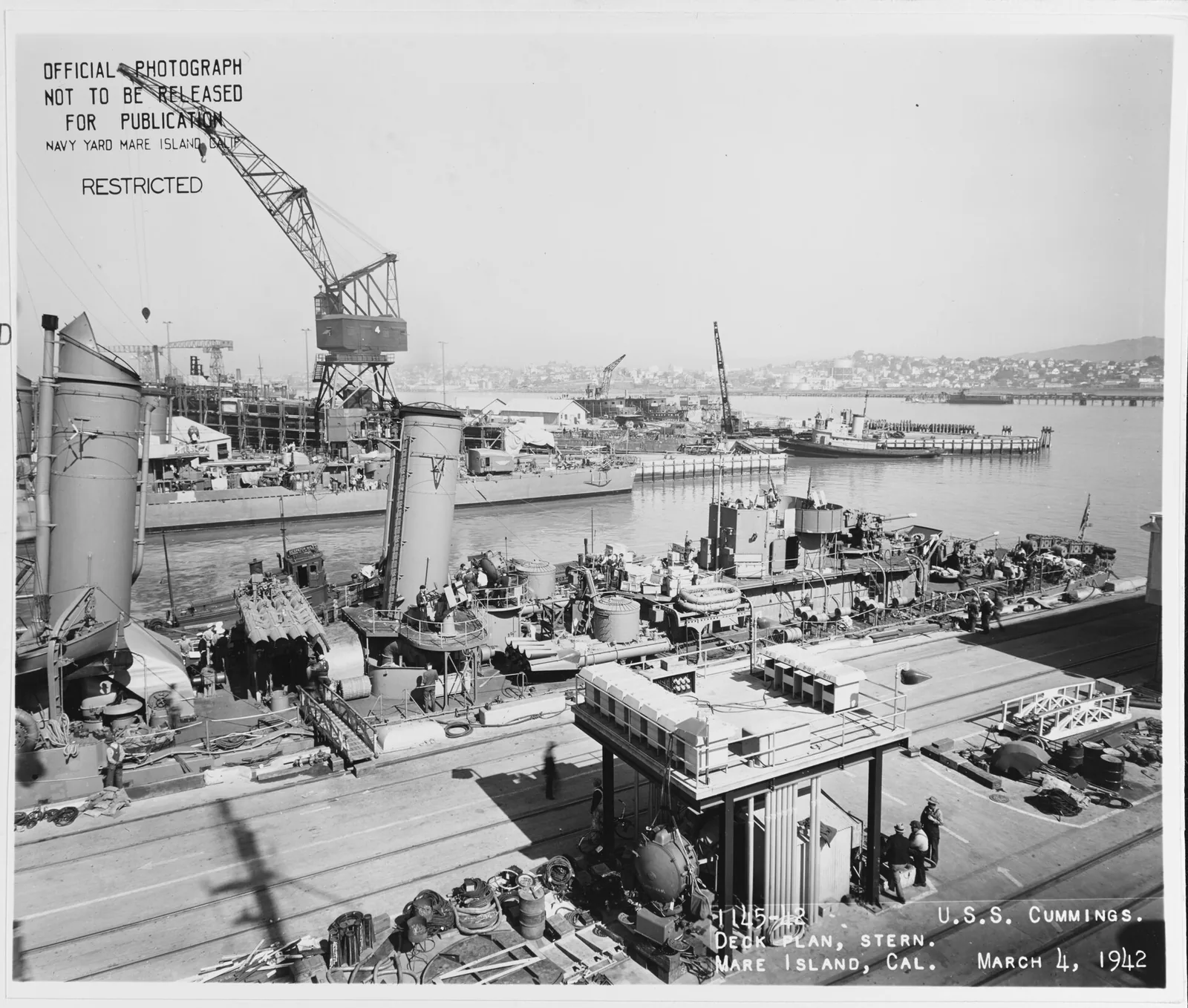
Thomas O. Selfridge was born on 24 April 1804 and was appointed midshipman on 1 January 1818. Promoted to Lieutenant in 1827, he served in the East India, Mediterranean, and Pacific squadrons. He took command of sloop, Dale, in May 1847 and participated in the capture of Mazatlan and Guaymas. Badly wounded in the latter engagement, he was invalided home in June 1848. He was subsequently assigned to the Boston Navy Yard, where he remained until 1861. He commanded Mississippi, flagship of the Gulf Squadron, on blockade duty off Mobile and off the passes of the Mississippi. His old wound forced him to relinquish his command in February 1862, and he served ashore until retiring in 1866. Rear Admiral Selfridge died in Waverly, Mass., on 15 October 1902.
Thomas O. Selfridge, Jr., son of the above, was born in Charlestown, Mass., on 6 February 1836 and graduated from the Naval Academy in 1854. At the beginning of the Civil War, he helped with efforts to destroy the untenable Norfolk Navy Yard; and he then escaped from that burning and beleaguered base in Cumber land, helping to save the sloop of war for the Union Navy. He participated in the capture of the Hatteras forts and was on board Cumberland on 8 March 1862 when she was sunk by Confederate ironclad, Virginia. He then briefly commanded Monitor, after Lt. Worden was wounded; and commanded Alligator, an experimental submarine, in testing operations based at the Washington Navy Yard.
In August, he joined the Mississippi Squadron, and subsequently commanded Cairo and Conestoga when those ships were sunk in action. Late in the war, he returned to the Atlantic where he commanded Huron in the attacks on Fort Fisher; and he participated in the ensuing bombardment of Fort Anderson and the capture of Wilmington. His postwar service included command of Nipsic, Enterprise, and Omaha, the last two on the Asiatic Station, and duty as Commander in Chief of the European Squadron from 1895 to 1898. He retired on 6 February 1898 and died on 4 February 1924.
Interwar 1919–1938
1933
The second Selfridge (DD-357) was laid down on 18 December 1933 by the New York Shipbuilding Corp., Camden, N.J.; launched on 18 April 1936; sponsored by Mrs. Duncan I. Selfridge; and commissioned on 25 November 1936, Comdr. H.D. Clarke in command.
1937
Commissioned just after the proclamation of the Rome-Berlin Axis and the beginning of the siege of Madrid, Selfridge conducted her shakedown cruise in the Mediterranean in January and February 1937 and returned to the east coast, via the Caribbean, in March. From April into August, she underwent post- shakedown overhaul at, and conducted training exercises out of Philadelphia. In September, Presidential escort duties took her to Poughkeepsie, N.Y.; and, in October, she proceeded to Norfolk, whence she got underway for the Panama Canal Zone and duty with the Battle Force in the Pacific. Diverted back to Norfolk for another Presidential escort mission in early November, she got underway again for the west coast on 9 December.
Second World War 1939–1945
1941
Selfridge transited the Panama Canal and joined the Battle Force as flagship of Destroyer Squadron (Des-Ron) 4 on 13 December and reached San Diego on the 22d. Except for fleet problems and exercises, she remained in the southern California area for the next two years. In 1940, she was reassigned to Pearl Harbor, whence she operated until after the Japanese attack on 7 December 1941. That day, Selfridge, having just completed an escort run from Palmyra Island, was moored in berth X-9. Within five minutes of the start of hostilities, Selfridge's guns were firing on the enemy planes. By 1300, manned by a mixed crew from various ships, she was underway and soon thereafter joined other ships in patrolling off Oahu.
1942 Savo Island
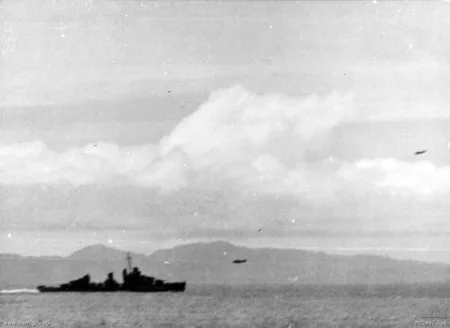
During the remainder of the month, Selfridge patrolled the Hawaiian area and, screening Saratoga, participated in the abortive attempt to reinforce Wake Island. In January 1942, she continued operations in the Saratoga group until that carrier was torpedoed some 500 miles southwest of Oahu on the 11th. Selfridge then screened the carrier back to Pearl Harbor. Exercises and patrols in the Hawaiian area followed until 20 January when she assumed escort duty for a merchant ship on a Canton Island run. After arriving at Canton on the 27th, she patrolled off the island until the merchant ship completed offloading, then started back to Hawaii. En route, on the 30th, Selfridge depth charged and probably damaged an enemy submarine.
Selfridge returned to Pearl Harbor on 6 February and was underway again on the 9th to escort Saratoga to Bremerton for permanent repairs. In mid-March, she returned to Hawaii in the screen of a convoy and, by the end of the month, had escorted more supplies to Canton. In April, she carried Marine Corps personnel and mail to Palmyra and Christmas islands, then proceeded to Bora Bora in the Society Islands, to rendezvous with and escort convoys carrying reinforcements to the Samoan and Tonga groups. On 21 May, she departed the latter group for the New Hebrides and Australia; where, by the end of the month, she had commenced coastal escort work. A unit of TF 44, she remained in Australian waters into July; then, with others of the force, proceeded to the Fiji Islands to rehearse for Operation "Watchtower," the assault and occupation of Guadalcanal and Tulagi.
Soon after 0120 on 7 August, TF 44, now designated TG 62.6, the screening group for the transports, arrived in the Guadalcanal area. At 0620, Selfridge opened fire on a small gasoline carrier entering Tulagi harbor. A few hours later, the transports moved in toward the beaches. At 1320, the Japanese sent in a high level bombing attack. Shortly thereafter, they followed that strike with a dive bomber attack. On the 8th, Selfridge continued to screen the transports and, after a noon bombing attack, picked up two Japanese airmen. On the morning of the 9th, she assisted survivors of the Battle of Savo Island and, with Ellet, sank the badly-damaged Australian cruiser, Canberra; then, toward evening, departed the area to escort the transports to Noumea.
For the remainder of the month, the Australian group (TF-44) screened the carriers of the air support group. On the 31st, the ships headed back to Brisbane; and, for the next nine months, Selfridge continued to operate with that force as it plied the waters of the Coral Sea to prevent a Japanese landing at Port Moresby and to cover Allied shipping to the Papuan peninsula.
In May, Selfridge was reassigned to the 3d Fleet. On the 12th, she arrived at Noumea. Through the summer, she operated with cruisers of TF 36, later TF 37, and participated in exercises with TF's 38, 39, and 34. In late September, as a unit of the 3d Fleet's amphibious force, she escorted an LST convoy to Vella Layella, then commenced nighttime patrols up -the Slot- to intercept Japanese shipping.
On the night of 6 October, Selfridge, O'Bannon, and Chevalier intercepted an enemy force of six destroyers, three destroyer transports, and smaller armed craft some 12 miles off Marquana Bay as it attempted to evacuate land forces from Vella Lavella. In the ensuing Battle of Vella Lavella, Chevalier was torpedoed and damaged beyond repair. She was sunk on the 7th by an American torpedo. Selfridge and O'Bannon were both heavily damaged; Selfridge by an enemy torpedo, O'Bannon by enemy action compounded by collision with Chevalier just after the latter had gone dead in the water.
1944 Philippine Sea
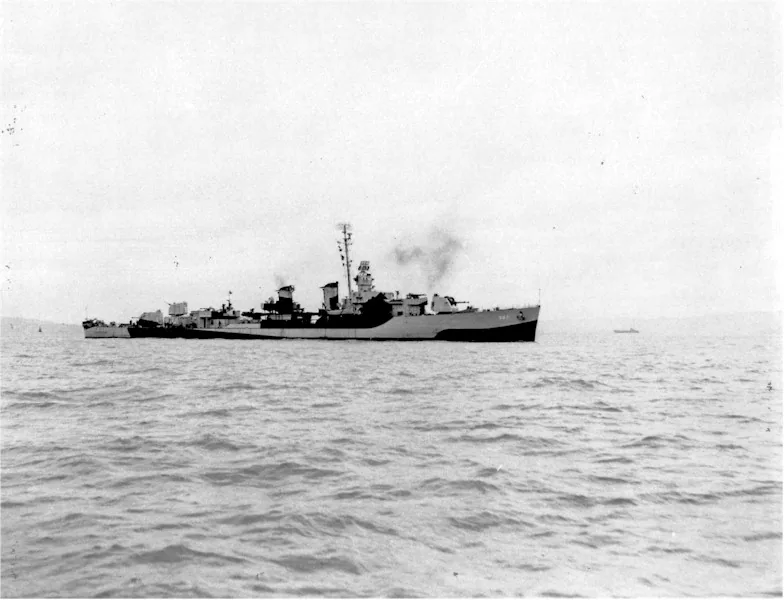
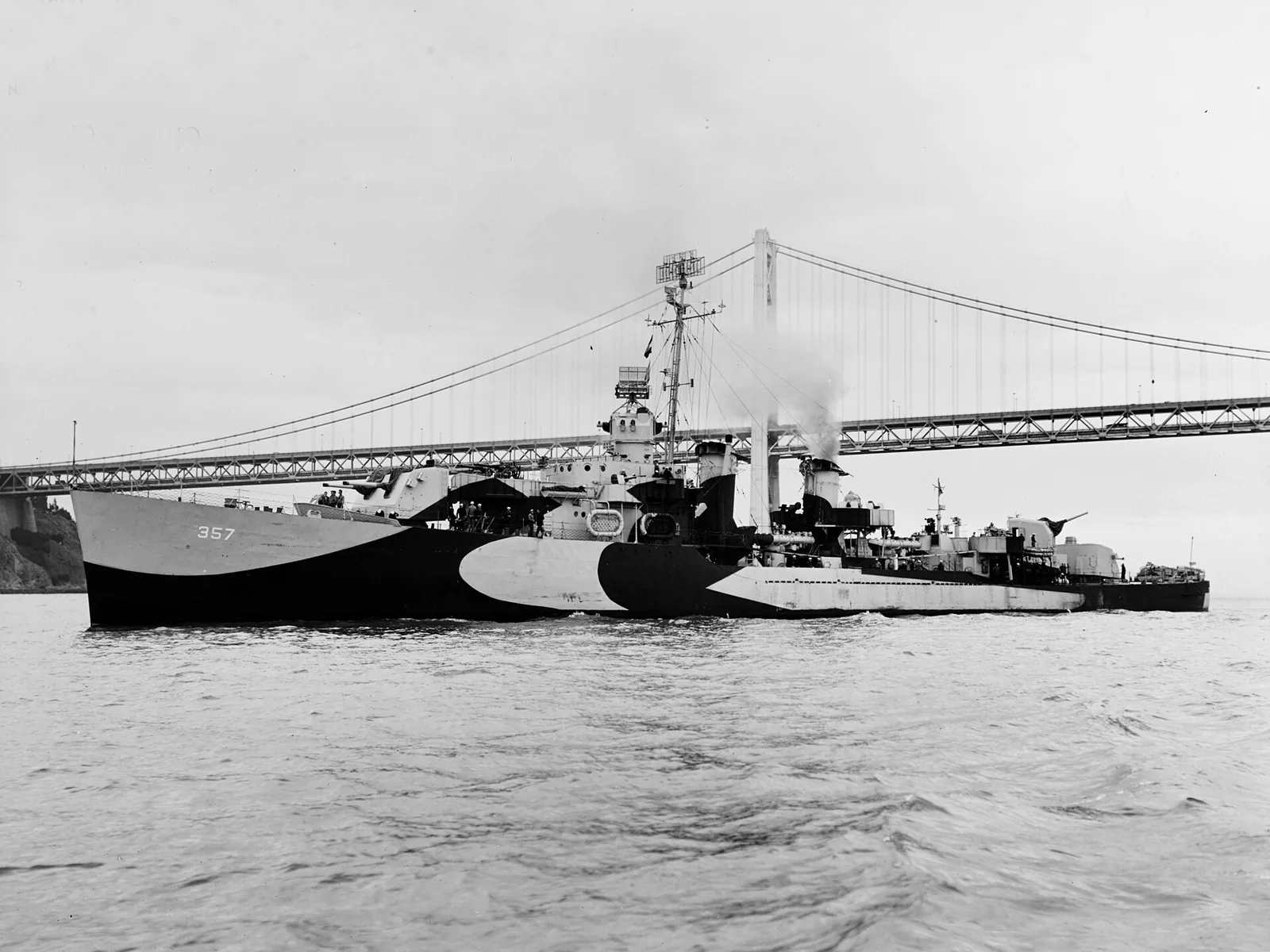
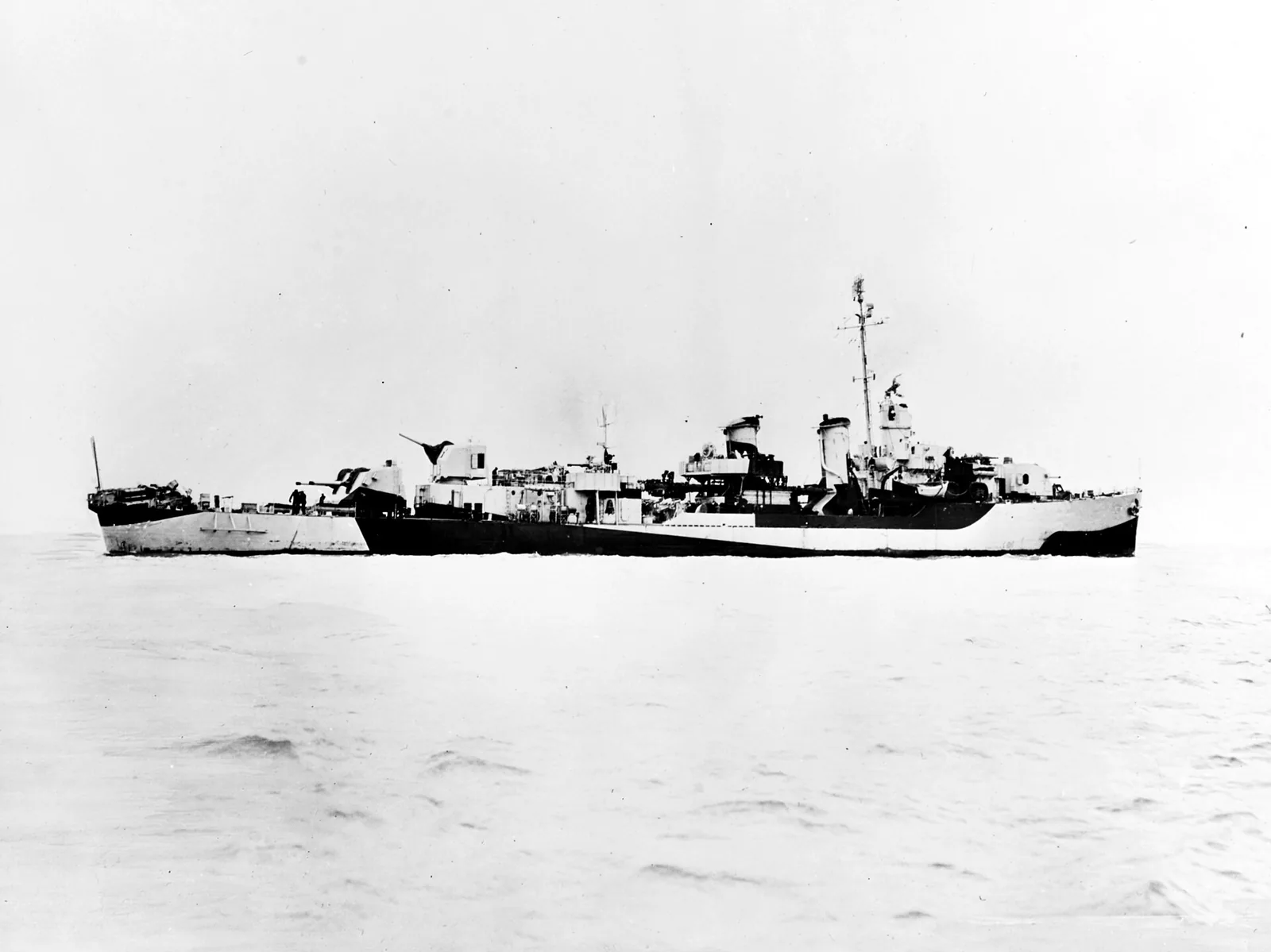
Temporary repairs to Selfridge were made at Purvis Bay and at Noumea. Permanent repairs, including the installation of a new bow, were made at Mare Island; and, after refresher training out of San Diego, she returned to Pearl Harbor on 10 May 1944 in time to join the forces staging for the invasion of the Marianas. Initially assigned to TG 50.11, she joined TF 58, the fast carrier force, at Majuro in early June; and, on the 11th, screened Bunker Hill as sweeps were conducted over Guam. On the 13th, she participated in a shore bombardment of Saipan to cover minesweeping operations off that target island; then shifted to night harassing fire. On the 14th, she joined the fire support unit; and, on the 15th, screened the transport area as the assault troops landed on Saipan. From then to the 17th, she rotated between daytime screening activities and nightime harassment duty. On the latter date, word of a Japanese force moving in from the Philippines reached the assault force, and Selfridge rejoined TF 58 and took station as the linking vessel between TG's 58.7 and 58.3. On the 19th, the Battle of the Philippine Sea raged; but none of the enemy's aircraft came within range of Selfridge's guns. On the 20th and 21st, the Japanese were chased westward. On the 24th, Selfridge rejoined the transport screen off Saipan; and, on the 26th, resumed fire support duties.
Selfridge departed Saipan on 11 July; and, screening the transports, arrived at Eniwetok on the 15th. Three days later, she was underway again to return to the Marianas with reinforcements for the Guam assault. She arrived off Agat on the 22d, the day after the initial assault and, for the next three weeks, provided screening and fire support services and conducted anti-boat and barge patrols. On 10 August, she sailed for Eniwetok, whence, she returned to Pearl Harbor. On 21 August, she received orders back to the Atlantic.
1945
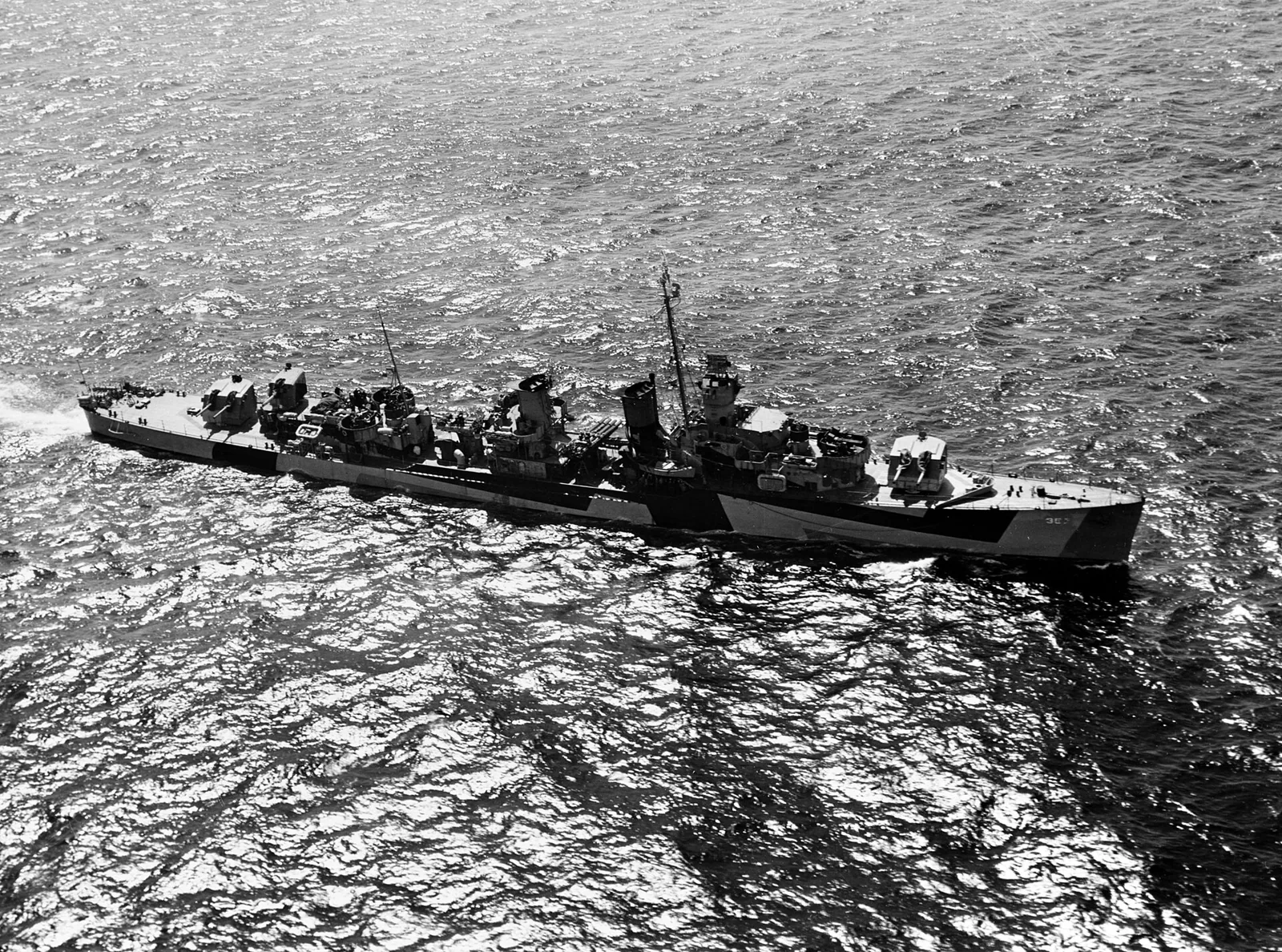
Transiting the Panama Canal on 7 September, Self ridge proceeded to New York for an abbreviated overhaul after which she joined TF 65; and, serving as flagship, commenced transatlantic escort duty for convoys plying between the east coast and Tunisia. Continuing that duty until after the fall of Germany in May 1945, she completed her last run at New York on 7 June. Upkeep and training exercises in the Caribbean and off the Maine coast took her through August; and, on 15 September, she returned to New York to prepare for inactivation.
Decommissioned on 15 October 1945, Selfridge was struck from the Navy list on 1 November 1945; sold to George H. Nutman, Inc., Brooklyn, N.Y.; removed from Navy custody on 20 December 1946; and scrapped in October 1947.
Other photographs
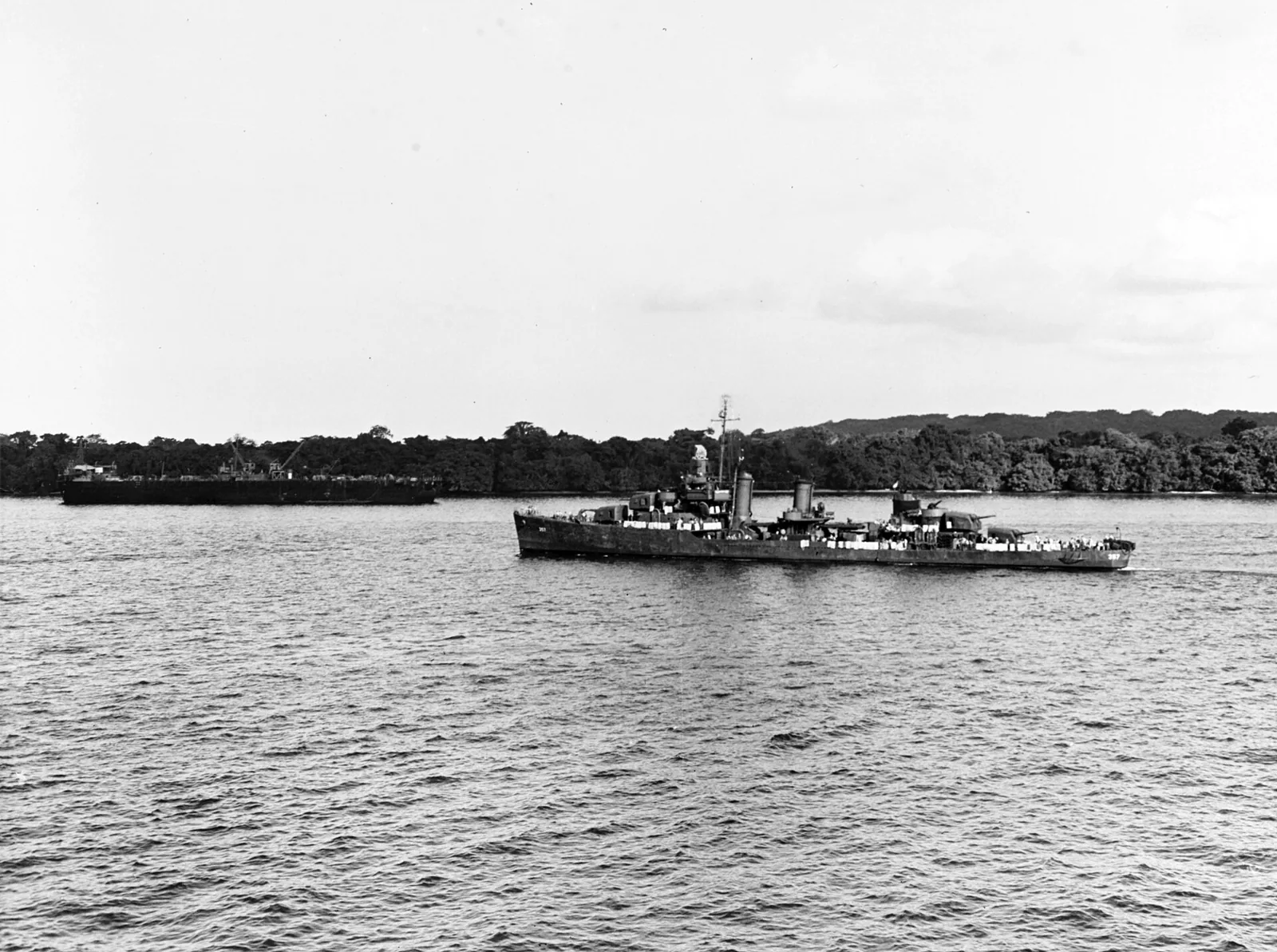
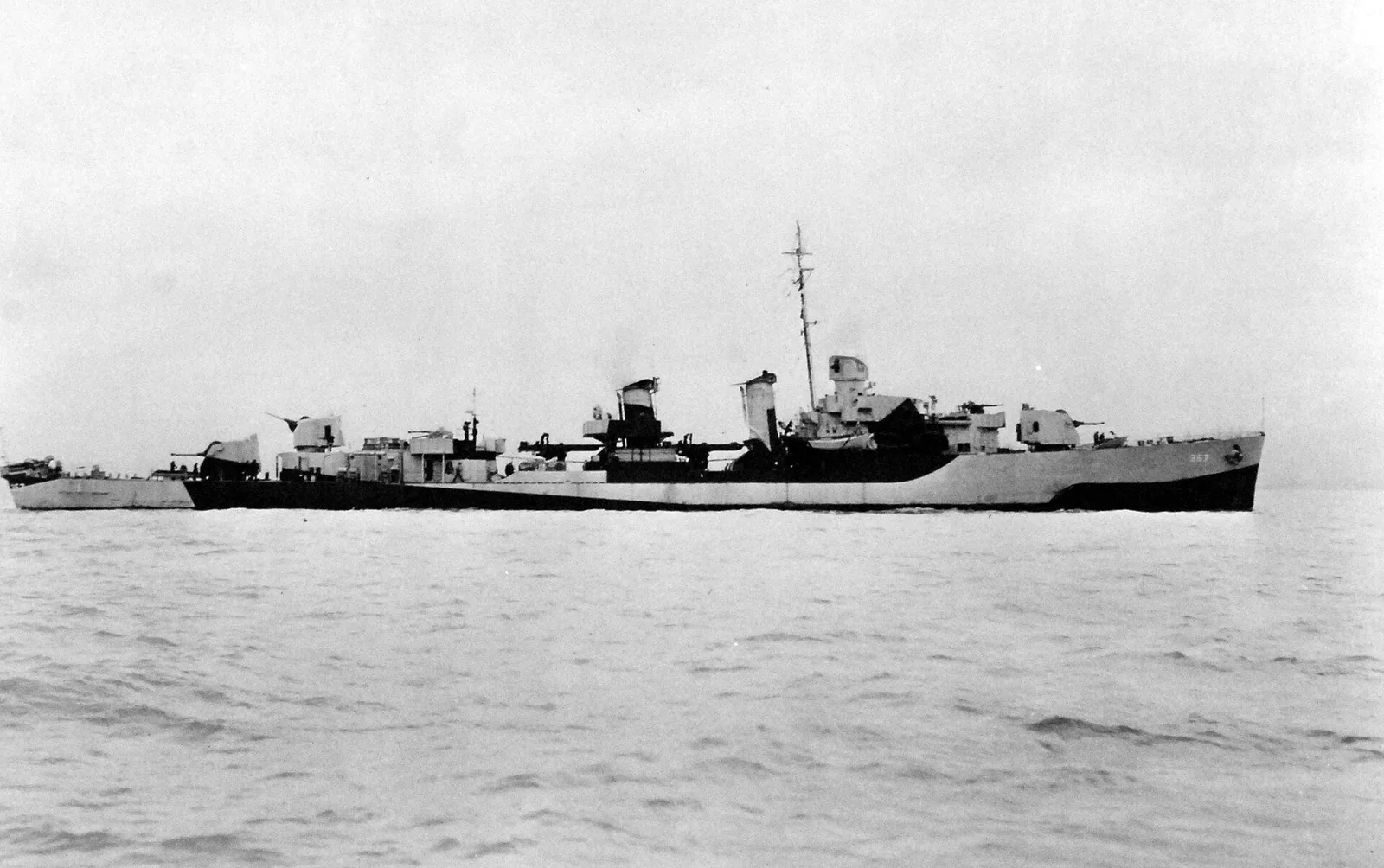
Held for this vessel, and not tied to any part of the account above.


References
Every work this entry draws on. There are no numbered markers in the text above: what we hold is the provenance of the page — this history, this article, these photographs.
- History Selfridge II (DD-357) Dictionary of American Naval Fighting Ships, Naval History and Heritage Command. A work of the United States Government, in the public domain — the only text on this site reproduced verbatim.
- Facts USS Selfridge (DD-357) Structured facts only — dates, dimensions, armament and fate. No wording is taken from it. Harvested 1 August 2026.
- Photograph USS Selfridge (DD-357) during exercises at sea in the later 1930s U.S. Navy. Original uploader was User: at en.wikipedia — Official U.S. Navy photo NH 74280 from the U.S. Navy Naval History and Heritage Command — Public domain — Wikimedia Commons
- Photograph USS Selfridge and OBannon damaged Oct 1943 USN — U.S. Navy photo in Samuel Eliot Morison: Breaking the Bismarcks Barrier (History of US Naval Operations in WWII, Vol VI), Castle Books, Edison (New Jersey, USA), 2001, p. 253 (reprint from 1950) — Public domain — Wikimedia Commons
- Photograph USS Selfridge (DD-357) off the Mare Island Naval Shipyard, California (USA), on 10 April 1944 (2240-44) U.S. Navy — Mare Island Naval Shipyard photo 2240-44 available on navsource.org — Public domain — Wikimedia Commons
- Photograph Destroyer with Japanese bombers off Guadalcanal 1942 Australian armed forces — Public domain — Wikimedia Commons
- Photograph USS Cummings (DD-365) - 19-N-28671 Unknown author — 19-N-28671 — Public domain — Wikimedia Commons
- Photograph USS Cummings (DD-365) at the Mare Island Naval Shipyard on 4 March 1942 (19-N-28671) Unknown author — This image has been extracted from another file — Public domain — Wikimedia Commons
- Photograph USS Cummings (DD-365) at the Mare Island Naval Shipyard on 4 March 1942 (19-N-28672) Unknown author — This image has been extracted from another file — Public domain — Wikimedia Commons
- Photograph USS Lake (DE-301) at the Mare Island Naval Shipyard on 5 April 1944 (NH 83887) Unknown author — U.S. Navy photo NH 83887 — Public domain — Wikimedia Commons
- Photograph USS Selfridge (DD-357) fitted with temporary bow, 24 January 1944 (80-G-316295) U.S. Navy — National Museum of the U.S. Navy photo 80-G-316295 — Public domain — Wikimedia Commons
- Photograph USS Selfridge (DD-357) in San Francisco Bay, California (USA) on 10 April 1944 (19-N-63614) Unknown author — U.S. Navy Bureau of Ships photo 19-N-63614 — Public domain — Wikimedia Commons
- Photograph USS Selfridge (DD-357) in the Solomon Islands, 5 August 1943 (80-G-266036) Unknown author — U.S. Navy photo 80-G-266036 — Public domain — Wikimedia Commons
- Photograph USS Selfridge (DD-357) off the Mare Island Naval Shipyard, California (USA), 10 April 1944 (80-G-316296) U.S. Navy — National Museum of the U.S. Navy photo 80-G-316296 — Public domain — Wikimedia Commons
- Photograph USS Selfridge (DD-357) on 1 May 1944 (NH 45693) Unknown author — U.S. Navy photo NH 45693 — Public domain — Wikimedia Commons
- Photograph USS Selfridge (DD-357) underway in the Atlantic Ocean on 19 April 1945 (80-G-325491) Unknown author — U.S. Navy photo 80-G-325491 — Public domain — Wikimedia Commons