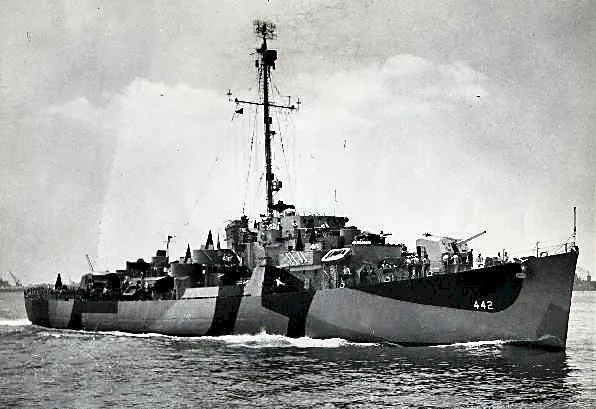
USS Ulvert M. Moore
Service
- as Ulvert M. Moore18 July 1944 — 22 May 1946411 days of the war
- Name
- USS Ulvert M. Moore
- Pennant / hull number
- DE-442
- Namesake
- Ulvert M. Moore
- Builder
- Federal Shipbuilding & Drydock Company, Port Newark, New Jersey
- Laid down
- 2 December 1943
- Launched
- 7 March 1944
- Commissioned
- 18 July 1944
- Decommissioned
- 22 May 1946
- Struck
- 1 December 1965
- Fate
- Sunk as target off San Nicholas Isle, California on 13 July 1966 (1966)
- Status
- Wreck
Specifications
- Displacement, standard
- 1,350 long tons (1,372 t)
- Displacement, full load
- 1,745 long tons (1,773 t)
- Length
- 93.27 m (306 ft) OA
- Beam
- 10.97 m (36 ft)
- Draught
- 3.96 m (13 ft)
- Speed
- 24 knots (44.4 km/h, 27.6 mph)
- Range
- 6,000 nmi (11,112 km)
- Complement
- 215
- Main gun
- 127 mm (5 in)
Ulvert Mathew Moore, born on 26 August 1917 at Williamson, W.Va., enlisted in the Naval Reserve on 15 October 1940 at Washington, D.C., and served as a seaman 2nd class until appointed an aviation cadet on 14 January 1941. After flight training at Jacksonville and Miami, Fla., into the summer of 1941, Moore then received advanced carrier training at Norfolk, Va.
Assigned to Torpedo Squadron (VT) 8, embarked in Hornet (CV-8), soon thereafter, Moore was killed in action on 4 June 1942, during the Battle of Midway. Flying a Douglas TBD-1 Devastator , side number T-8 (BuNo 0324) Ens. Moore and ARM3c W.F. Sawhill, his radiio gunner, perished in VT-8's gallant torpedo attack, led by Lt. Cmdr. John C. Waldron, against the Japanese carrier Akagi of the Midway-bound task force under Vice Admiral Nagumo Chuichi. Moore was awarded a posthumous Navy Cross for pressing home his attack despite being grimly aware that VT-8 had neither fighter cover nor enough fuel to return to Hornet. However, the sacrifice of the torpedo squadrons was not in vain. The attack drew down the Japanese combat air patrol and left the skies above open for the attack of the dive bombers which soon crippled three Japanese carriers on the first day of the battle (the fourth carrier would be mortally wounded that afternoon) and thus paved the way to an American victory.
Ulvert M. Moore (DE-442) was laid down on 2 December 1943 at Houston, Tex., by the Brown Shipbuilding Co.; launched on 7 March 1944; sponsored by Mrs. L. E. Moore, mother of Ens. Moore; and commissioned on 18 July 1944, Lt. Cmdr. Franklin D. Roosevelt, Jr., USNR, the son of the President, in command.
Continue to the full service history About 2,502 words
From the Dictionary of American Naval Fighting Ships, compiled by the Naval History and Heritage Command (Ulvert M. Moore (DE-442)). A work of the United States Government, in the public domain.
Armament and machinery
Armament and machinery
- Propulsion
- 2 × geared steam turbines
- 2 × screws
- Power
- 2 × boilers
- 12000 shp
- Armament
- 2 × 5 in/38 caliber guns
- 4 × 40 mm Bofors guns (2×2)
- 10 × 20 mm Oerlikon cannons
- 3 × 21-inch (533 mm) Torpedo tubes
- 1 × Hedgehog, 8 × Mk6 depth charge projectors
- 2 × Mk9 stern depth charge tracks
Sister ships
- USS Abercrombie
- USS Albert T. Harris
- USS Bivin
- USS Cecil J. Doyle
- USS Charles E. Brannon
- USS Chester T. O’Brien
- USS Conklin
- USS Corbesier (DE-438)
- USS Cross
- USS Dennis
- USS Douglas A. Munro
- USS Doyle C. Barnes
- USS Dufilho
- USS Edmonds
- USS Edward H. Allen
- USS Edwin A. Howard
- USS Eversole (DE-404)
- USS Formoe
- USS French
- USS Gentry
- USS George E. Davis
- USS Gilligan
- USS Goss
- USS Grady
Sources
- Facts harvested from USS Ulvert M. Moore on Wikipedia. Figures only — no wording is taken from it.
- Service history reproduced verbatim from Ulvert M. Moore (DE-442) , Dictionary of American Naval Fighting Ships — public domain, a work of the United States Government.
- Photograph: U.S. Navy — U.S. Navy Bureau of Ships photo BS 68165 from usndazzle.com — Public domain — Wikimedia Commons