USS Douglas H. Fox
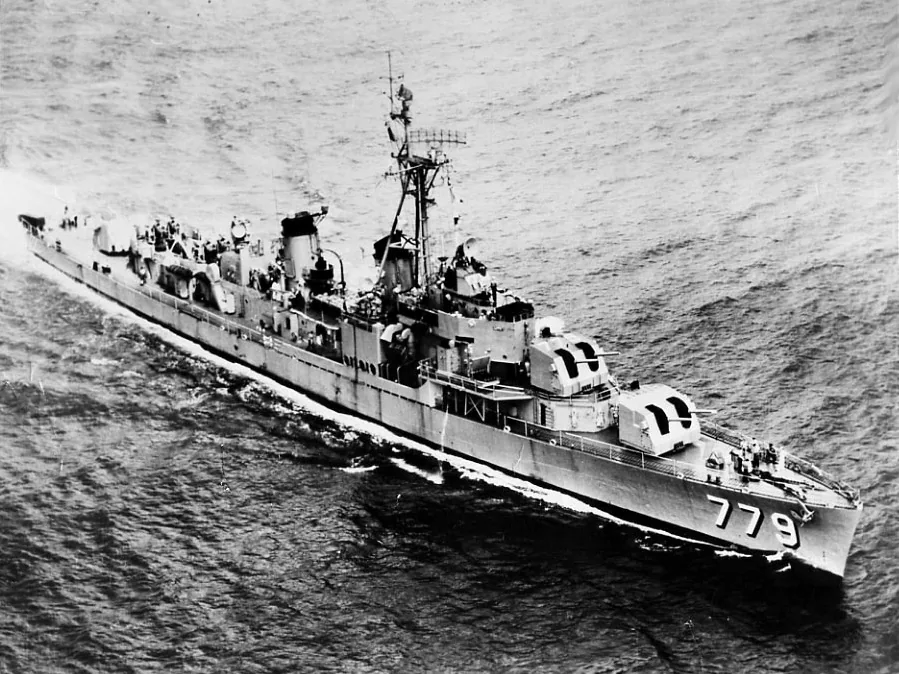
Service
- as USS Douglas H. Fox26 December 1944 — 15 December 1973250 days of the war
- as Chilean destroyer Ministro Portales (DD-17)8 January 1974 — 11 November 1998
- Name
- USS Douglas H. Fox
- Pennant / hull number
- DD-17
- Namesake
- Douglas H. Fox
- Builder
- Todd Pacific Shipyards, Seattle
- Laid down
- 31 January 1944
- Launched
- 30 September 1944
- Commissioned
- 26 December 1944
- Decommissioned
- 15 December 1973
- Struck
- 15 December 1973
- Fate
- Scuttled off Cape Horn on 11 November 1998 (1998)
- Status
- Wreck
Specifications
- Displacement, standard
- 2,200 long tons (2,235 t)
- Length
- 114.6 m (376 ft)
- Beam
- 12.19 m (40 ft)
- Draught
- 4.57 m (15 ft)
- Speed
- 34 knots (63 km/h, 39.1 mph)
- Range
- 6,500 nmi (12,038 km)
- Complement
- 336
- Main gun
- 127 mm (5 in)
Joseph B. Smith was born in Belfast, Maine, in 1826 and was appointed midshipman in the United States Navy on 19 October 1841. He cruised on various stations from 1841 to 1860, when he was ordered to frigate, Congress. He was in command of Congress on 8 March 1861 when she was attacked and destroyed by the Confederate ironclad, Virginia, and lost his life in the action. When his father, Commodore Joseph Smith, heard of the surrender of Congress, he said, "Then Joe is dead," feeling that she never would have surrendered while his son lived.
The first Smith (DD-17) was laid down on 18 March 1908 by William Cramp and Sons, Philadelphia, Pa.; launched on 20 April 1909; sponsored by Mrs. Edward Bridge Richardson; and commissioned on 26 November 1909, Lt. Comdr. D.F. Boyd in command.
Smith was attached to the Atlantic Torpedo Fleet upon commissioning and, after three years of active service, was placed in reserve in October 1912. Reactivated with reduced complements in December 1915 for neutrality patrol duty off Boston, Smith arrived in New Orleans on 10 December 1916 for recruiting duty with the Naval Auxiliary Reserve. She arrived at Key West on 12 February 1916 and at New York on 15 February to continue recruiting duty.
With war imminent, Smith was ordered on 1 April 1917 to anchor in the North River to assist the Collector of Customs in preventing the German ships at New York from escaping or destroying themselves. She departed New York on 4 April and operated with the Patrol Force along the east coast from 10 April to 14 May. On 17 April, she reported sighting a submarine which submerged, and then saw a torpedo wake cross her bow; however, neither inflicted damage on the ether. Smith underwent overhaul at the Charleston Navy Yard from 17 May to 16 July, during which time she prepared for distant service.
Smith departed Charleston on 16 July; and, after a stop at Bermuda from 18 to 20 July and three months of patrols in the Azores from 26 July to 5 October, she arrived at Brest, France, on 20 October. For the remainder of the war, Smith escorted eastbound and westbound convoys through the submarine danger area extending about 500 miles to the westward of Brest. Her escort missions were largely uneventful and, despite several sightings of suspected submarines, she made no confirmed kills. She was called upon twice, however, to rescue survivors of torpedoed transports. On 31 May1918, she rescued 240 men from President Lincoln; and, while carrying them into port, unsuccessfully attacked a submarine on 1 June. On 1 July 1918, she rescued survivors from Covington while other destroyers circled the two ships at high speed to deter submarine attack.
Smith underwent repairs in England from 16 September to 3 November 1918 and, after the end of the war, at Brest from 7 March to 2 April 1919. She sailed for the United States on 11 May; and, after arriving at Philadelphia, was decommissioned there on 2 September1919. She was ordered sold on 28 February 1920 but was withdrawn from sale on 9 June 1920 in response to a request from the Bureau of Construction and Repair for a destroyer, a submarine, and a battleship for exhaustive bombing experiments. On 18 September, Smith was anchored in Chesapeake Bay with battleship, Indiana, and submarine, G-1, for the tests, which were completed on 5 November. Smith was then towed back to Philadelphia and, after again being designated a bombing target on 20 July 1921, was sold on 20 December 1921 to James G. Hitner of Philadelphia for scrapping.
From the Dictionary of American Naval Fighting Ships, compiled by the Naval History and Heritage Command (Smith I (Destroyer No. 17)). A work of the United States Government, in the public domain.
Armament and machinery
Armament and machinery
- Propulsion
- 60000 shp
- 2 propellers
- Armament
- 6 × 5 in/38 guns
- 12 × 40 mm AA guns
- 11 × 20 mm AA guns
- 10 × 21 inch (533 mm) torpedo tubes
- 6 × depth charge projectors
- 2 × depth charge tracks
Sister ships
- USS Alfred A. Cunningham
- USS Allen M. Sumner
- USS Ault
- USS Barton (DD-722)
- USS Blue (DD-744)
- USS Borie (DD-704)
- USS Bristol (DD-857)
- USS Brush
- USS Charles S. Sperry
- USS Collett
- USS Compton
- USS Cooper
- USS De Haven (DD-727)
- USS Drexler
- USS English
- USS Frank E. Evans
- USS Gainard
- USS Hank
- USS Harlan R. Dickson
- USS Harry E. Hubbard
- USS Haynsworth
- USS Hugh Purvis
- USS Hugh W. Hadley
- USS Hyman
Sources
- Facts harvested from USS Douglas H. Fox on Wikipedia. Figures only — no wording is taken from it.
- Service history reproduced verbatim from Smith I (Destroyer No. 17) , Dictionary of American Naval Fighting Ships — public domain, a work of the United States Government.
- Photograph: U.S. Navy — Official U.S. Navy photo NH 54553 from the U.S. Navy Naval History and Heritage Command — Public domain — Wikimedia Commons