USS De Haven (DD-727)
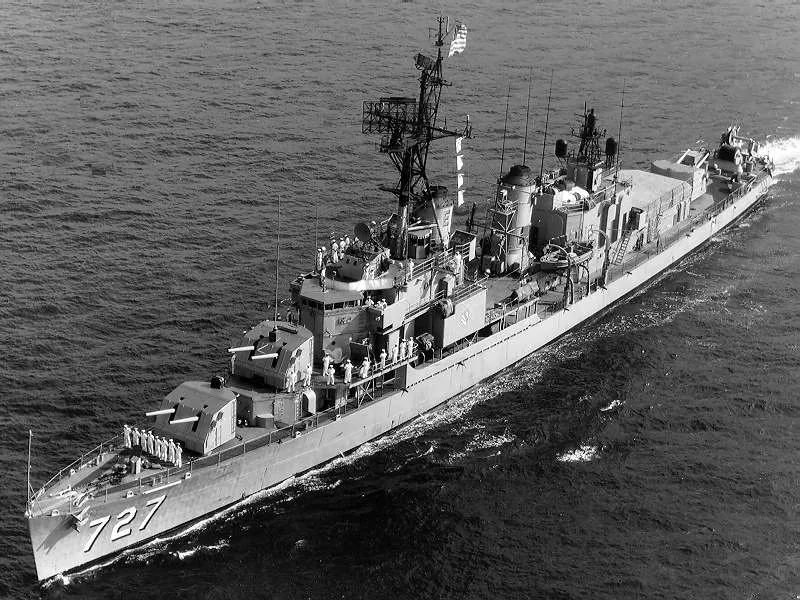
Service
- as De Haven31 March 1944 — 3 December 1973523 days of the war
- as Incheon5 December 1973 — 1993
- Name
- USS De Haven
- Pennant / hull number
- DD-727
- Namesake
- Edwin De Haven
- Builder
- Bath Iron Works
- Laid down
- 9 August 1943
- Launched
- 9 January 1944
- Commissioned
- 31 March 1944
- Decommissioned
- 3 December 1973
- Struck
- 3 December 1973
- Fate
- Scrapped, 1993 (1993)
- Status
- Scrapped
Specifications
- Displacement, standard
- 2,200 long tons (2,235 t)
- Length
- 114.6 m (376 ft)
- Beam
- 12.19 m (40 ft)
- Draught
- 4.57 m (15 ft)
- Speed
- 34 knots (63 km/h, 39.1 mph)
- Range
- 6,500 nmi (12,038 km)
- Complement
- 336
- Main gun
- 127 mm (5 in)
Edwin Jess De Haven, born in 1819 in Pennsylvania was appointed Acting Midshipman at the age of 10 and Passed Midshipman 5 years later. He served in Vin cennes, flagship of the Wilkes Exploring Expedition in its historic cruise of 1838 to 1842 to the Antarctic and among the Pacific Islands. De Haven served in the Mexican War, assisting in the capture of the Mexican schooner Creole. In command of the Grinnell Rescue Expedition in 1850, he led the search for Sir John Franklin lost in the Arctic. Only traces of the party were found, but De Haven discovered and named Grinnell Land, and was commended for the valuable scientific data he collected concerning the winds and currents of the ocean. He served in the Coast Survey Service until placed on the retired list in February 1862. He died at Philadelphia, Pa., 1 May 1865.
The second De Haven was launched 9 January 1944 by Bath Iron Works Corp., Bath, Maine; sponsored by Miss H. N. De Haven, sponsor of the first De Haven; and commissioned 31 March 1944, Commander J. B. Dimmick in command
De Haven escorted Ranger (CV-4) from Norfolk to Pearl Harbor, arriving 3 August 1944. She screened a convoy to Eniwetok between 16 and 30 August, and returned to Eniwetok 5 October. A week later she got underway for Ulithi to join TF 38. Operating from this base she screened the fast carriers striking Luzon in support of the invasion of Leyte during November and December. In coordination with the invasion of Lingayen Gulf, Luzon, the force hit Formosa, Luzon, Camranh Bay, Hong Kong, Hainan, and Okinawa in a score of strikes extending from 30 December 1944 to 26 January 1945.
Continue to the full service history About 770 words
From the Dictionary of American Naval Fighting Ships, compiled by the Naval History and Heritage Command (De Haven II (DD-727)). A work of the United States Government, in the public domain.
Armament and machinery
Armament and machinery
- Propulsion
- 60000 shp
- 2 propellers
- Armament
- 6 × 5 in/38 cal guns
- 12 × 40 mm AA guns
- 11 × 20 mm AA guns
- 10 × 21 inch (533 mm) torpedo tubes
- 6 × depth charge projectors
- 2 × depth charge tracks
Sister ships
- USS Alfred A. Cunningham
- USS Allen M. Sumner
- USS Ault
- USS Barton (DD-722)
- USS Blue (DD-744)
- USS Borie (DD-704)
- USS Bristol (DD-857)
- USS Brush
- USS Charles S. Sperry
- USS Collett
- USS Compton
- USS Cooper
- USS Douglas H. Fox
- USS Drexler
- USS English
- USS Frank E. Evans
- USS Gainard
- USS Hank
- USS Harlan R. Dickson
- USS Harry E. Hubbard
- USS Haynsworth
- USS Hugh Purvis
- USS Hugh W. Hadley
- USS Hyman
Sources
- Facts harvested from USS De Haven (DD-727) on Wikipedia. Figures only — no wording is taken from it.
- Service history reproduced verbatim from De Haven II (DD-727) , Dictionary of American Naval Fighting Ships — public domain, a work of the United States Government.
- Photograph: PH3 C.P. Weston, U.S. Navy — U.S. Navy photo NH 107136 — Public domain — Wikimedia Commons