USS Guam (CB-2)
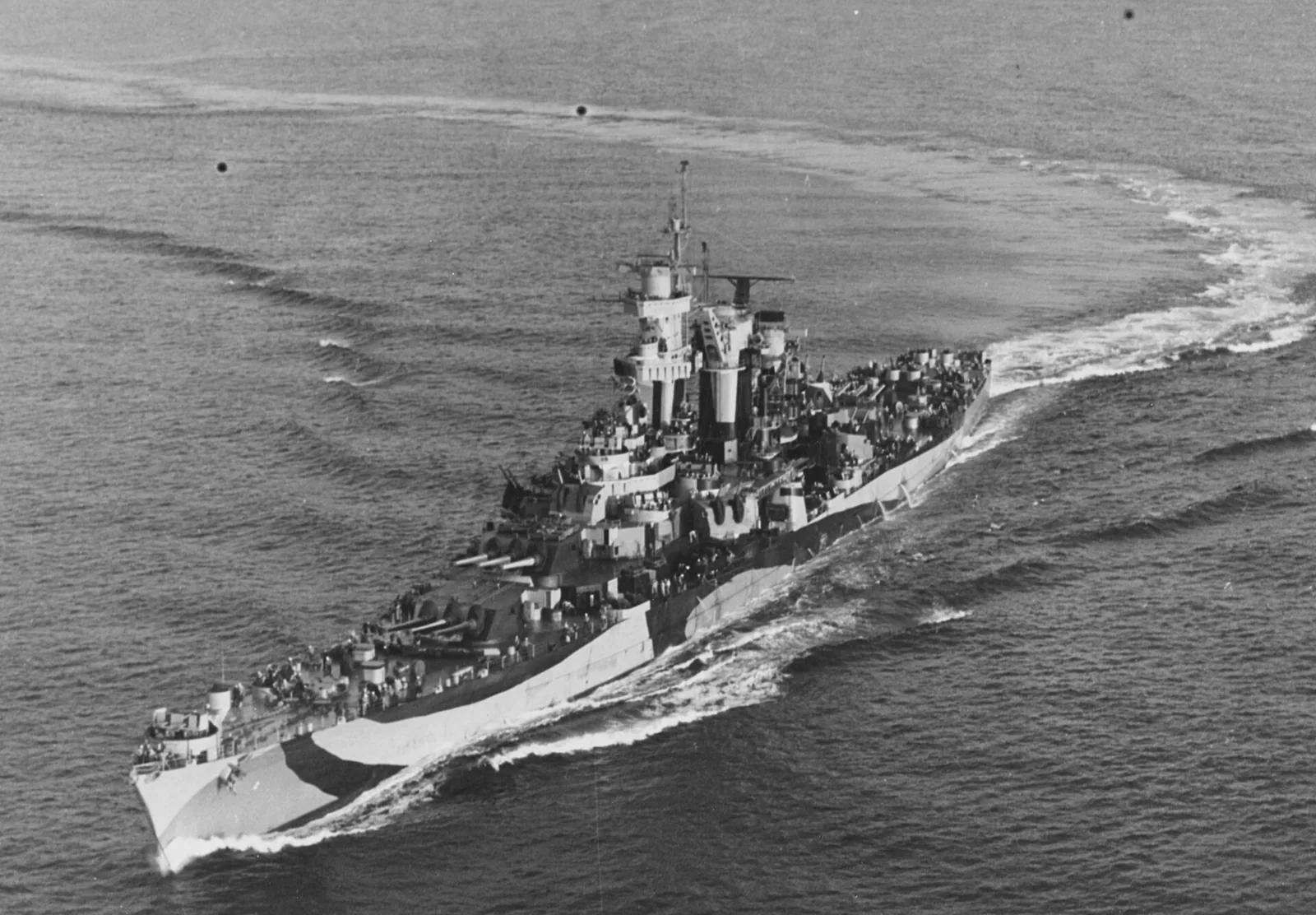
Service
- as Guam17 September 1944 — 17 February 1947350 days of the war
- Name
- USS Guam
- Pennant / hull number
- CB-2
- Namesake
- Guam
- Builder
- New York Shipbuilding Corporation
- Ordered
- 9 September 1940
- Laid down
- 2 February 1942
- Launched
- 12 November 1943
- Commissioned
- 17 September 1944
- Decommissioned
- 17 February 1947
- Struck
- 1 June 1960
- Fate
- Scrapped in May 1961 (1961)
- Status
- Scrapped
Specifications
- Displacement, standard
- 29,779 long tons (30,257 t)
- Displacement, full load
- 34,253 long tons (34,803 t)
- Length
- 246.28 m (808 ft)
- Beam
- 27.74 m (91 ft)
- Draught
- 9.45 m (31 ft)
- Speed
- 33 knots (61.1 km/h, 38 mph)
- Range
- 12,000 nmi (22,224 km)
- Main gun
- 305 mm (12 in)
The second Guam (CB-2) was launched 12 November 1943 by the New York Shipbuilding Corp., Camden, N.J.; sponsored by Mrs. George Johnson McMillan, wife of Captain McMillan, former governor of Guam; and commissioned 17 September 1944, Captain Leland P. Lovette in command.
After shakedown off Trinidad Guam departed Philadelphia 17 January 1945 and joined the Pacific Fleet at Pearl Harbor 8 February via the Canal Zone. Shortly thereafter Guam was visited by Secretary of the Navy Forrestal. Clearing Pearl Harbor 3 March Guam sailed into Ulithi 13 March where she joined forces with her sister ship Alaska and other fleet units to form another of Admiral Marc Mitscher's famed task groups.
Sortie was made from Ulithi next day and Admiral A. W. Radford's Task Force 58, one of the most powerful task forces in naval history, proceeded to vicinity of Kyushu and Shikoku, arriving the morning of 18 March. In her group sailed some of the most gallant ships ever to go in harm's way: carriers Yorktown, Intrepid, Inde pendence, and Langley; battleships Missouri and Wisconsin; cruisers Alaska, St. Louis, San Diego, Flint; and 15 destroyers in the screen. Guam's battle debut soon came. The fight began with five kamikaze attacks on the carriers. Guam's guns were directed at the raiders. During this first battle, the carriers Enterprise and Intrepid, both in Guam's force, were damaged but continued to operate. Enterprise took a bomb hit near her island structure; a suicide plane crashed Intrepid's flight deck aft and glanced off and plunged into the sea. Continued air attacks during the afternoon resulted in the destruction of four enemy planes by Guam's group, one of which she splashed. The next afternoon Guam was despatched to escort damaged Franklin from the combat area. This lasted until 22 March.
Continue to the full service history About 605 words
From the Dictionary of American Naval Fighting Ships, compiled by the Naval History and Heritage Command (Guam II (CB-2)). A work of the United States Government, in the public domain.
Armament and machinery
Armament and machinery
- Propulsion
- 4 × General Electric steam turbines
- 4 × screw propellers
- Power
- 8 × Babcock & Wilcox water-tube boilers
- 153000 shp
- Armament
- 9 × 12 inch guns
- 12 × 5 in dual-purpose guns
- 56 × 40 mm guns
- 34 × 20 mm guns
- Armour
- Belt: 9 in
- Deck: 4 in
- Conning tower: 10.6 in
- Turrets: 12.8 in
- Aircraft
- 4
Sister ships
Sources
- Facts harvested from USS Guam (CB-2) on Wikipedia. Figures only — no wording is taken from it.
- Service history reproduced verbatim from Guam II (CB-2) , Dictionary of American Naval Fighting Ships — public domain, a work of the United States Government.
- Photograph: Unknown author — U.S. Navy photo NH 97131 — Public domain — Wikimedia Commons