USS Winslow (DD-359)
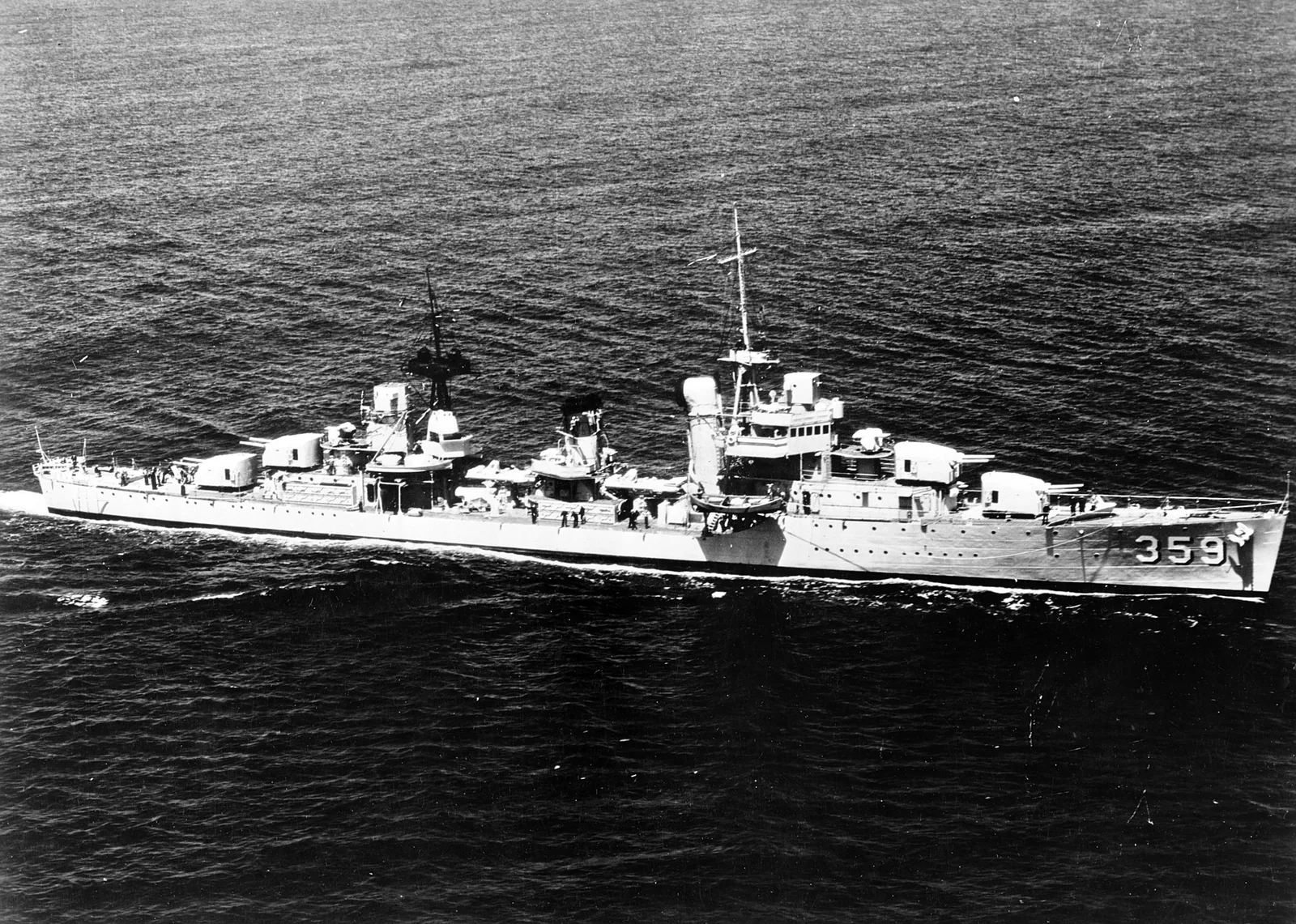
Service
- as Winslow17 February 1937 — 28 June 19502,193 days of the war
- Name
- USS Winslow
- Pennant / hull number
- DD-359
- Namesake
- Rear Admiral John Ancrum Winslow and Cameron McRae Winslow
- Builder
- New York Shipbuilding Corporation, Camden, New Jersey
- Laid down
- 18 December 1933
- Launched
- 21 September 1936
- Commissioned
- 17 February 1937
- Decommissioned
- 28 June 1950
- Struck
- 5 December 1957
- Fate
- Sold for scrapping, 23 February 1959 (1959)
- Status
- Scrapped
Specifications
- Displacement, standard
- 1,850 long tons (1,880 t)
- Length
- 116.13 m (381 ft)
- Beam
- 10.97 m (36 ft)
- Draught
- 4.88 m (16 ft)
- Speed
- 35 knots (64.8 km/h, 40.3 mph)
- Complement
- 238
- Main gun
- 127 mm (5 in)
John Ancrum Winslow, born in 1811 in Wilmington, N.C., became a midshipman in 1827. While serving at Tobasco during the Mexican War, he was commended for gallantry in action by Commodore Matthew Perry.
The outbreak of the Civil War found Winslow serving ashore as commanding officer of the 2d Lighthouse District. After Flag Officer A. H. Foote relieved Comdr. John Rodgers in command of the Western Flotilla, he requested that Winslow be sent west to assist him as executive officer. At Cairo, III., Winslow labored to fit out and man gunboats for service on the Mississippi and its tributaries. In October 1861, he assumed command of Benton at St. Louis. As that deep-draft gunboat was steaming down river to Cairo, she ran aground on a sandbar. While attempting to refloat the ship, Winslow was injured by a flying chain link and forced to return home late in the year to recover. When he was able to return to duty in the summer of 1862, Winslow was given comparatively minor assignments. He contracted malaria, became discontented, and asked to be reassigned to other duty.
Detached from the Mississippi Squadron, Winslow returned to his home in Roxbury, Mass., early in November and was confined to bed there for a month attempting to regain his health. On 5 December, orders arrived directing him to proceed via New York to the Azores where he was to assume command of screw sloop Kearsarge. Two days later, he went to New York where he embarked in Vanderbilt for passage to Fayal. However, when he reached that island on Christmas Eve, he found that Kearsarge had sailed to Spain for repairs; and he was forced to remain at Fayal until spring. When the screw sloop finally returned early in April 1863, he assumed command.
Continue to the full service history About 1,296 words
From the Dictionary of American Naval Fighting Ships, compiled by the Naval History and Heritage Command (Winslow III (DD-359)). A work of the United States Government, in the public domain.
Armament and machinery
Armament and machinery
- Armament
- As built:
- 2 × Mk33 Gun Fire Control System
- 8 × 5-inch (127 mm)/38 cal. SP (4x2)
- 8 × 21-inch (533 mm) torpedo tubes (2x4)
- 8 × 1.1-inch (28 mm)/75 cal. AA (2x4)
- 2 × .50-caliber (12.7 mm) machine guns
- 2 depth charge stern racks
- 1944:
- 1 × Mk37 Gun Fire Control System
- 5 × 5-inch (127mm)/38 cal. DP (2x2,1x1)
- 16 × Bofors 40 mm AA (8x2)
- 4 × Oerlikon 20 mm AA (4x1)
- 2 × depth charge stern racks
Sister ships
Sources
- Facts harvested from USS Winslow (DD-359) on Wikipedia. Figures only — no wording is taken from it.
- Service history reproduced verbatim from Winslow III (DD-359) , Dictionary of American Naval Fighting Ships — public domain, a work of the United States Government.
- Photograph: Unknown author — U.S. Navy photo NH 60344 — Public domain — Wikimedia Commons