HMS Gurkha (F20)
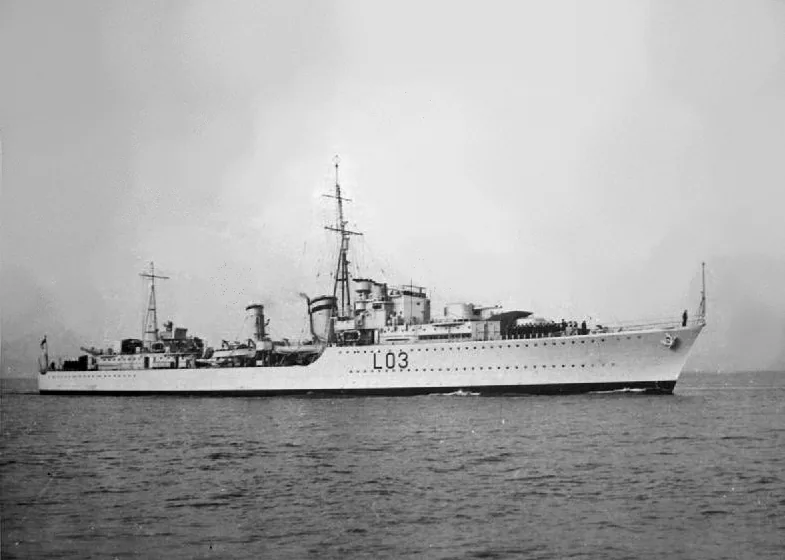
Service
- as Gurkha? — 9 April 1940221 days of the war
- Name
- HMS Gurkha
- Pennant / hull number
- F20
- Namesake
- Gurkha
- Builder
- Fairfield Shipbuilding and Engineering, Govan
- Ordered
- 10 March 1936
- Laid down
- 6 July 1936
- Launched
- 7 July 1937
- Fate
- Sunk by aircraft, 9 April 1940
By aircraft (1940) - Status
- Wreck
Specifications
- Displacement, standard
- 1,891 long tons (1,921 t)
- Displacement, full load
- 2,519 long tons (2,559 t)
- Length
- 114.91 m (377 ft) OA
- Beam
- 10.97 m (36 ft)
- Draught
- 3.35 m (11 ft)
- Speed
- 36 knots (66.7 km/h, 41.4 mph)
- Range
- 5,700 nmi (10,556 km)
- Complement
- 190
- Main gun
- 120 mm (4.7 in)
HMS Gurkha was a Tribal-class destroyer in service with the Royal Navy. She carried the pennant number F20. The ship was named after Gurkha. Her keel was laid at Fairfield Shipbuilding and Engineering, Govan on 6 July 1936. She was launched on 7 July 1937.
Her class ran to 24 ships. The class followed the I-class destroyer and was succeeded by the J class.
Displacement was 1,891 long tons standard and 2,519 long tons at full load. She measured 114.9 m (377 ft) long with a beam of 11.0 m (36 ft). Her designed speed was 36 knots, and she carried a complement of 190.
Her main battery was eight 119 mm (4.7 in) guns in four twin mountings. Her machinery developed 44,000 shp.
She was in commission for 221 days of the Second World War.
She was sunk on 9 April 1940 by aircraft, at 59°13′N 4°00′E. The wreck survives.
Written from the harvested record. Every figure above is sourced; the wording is this site's own.
Armament and machinery
Armament and machinery
- Propulsion
- 2 × shafts; 2 × geared steam turbines
- Power
- 3 × Admiralty 3-drum boilers
- 44000 shp
- Armament
- 4 × twin 4.7 in (120 mm) guns
- 1 × quadruple 2-pdr (40 mm) AA guns
- 2 × quadruple 0.5 in (12.7 mm) anti-aircraft machineguns
- 1 × quadruple 21 in (533 mm) torpedo tubes
- 20 × depth charges, 1 × rack, 2 × throwers
Sister ships
- HMAS Arunta (I30)
- HMAS Bataan
- HMAS Warramunga (I44)
- HMCS Athabaskan (G07)
- HMCS Haida
- HMCS Huron (G24)
- HMCS Iroquois (G89)
- HMCS Nootka (R96)
- HMS Afridi (F07)
- HMS Ashanti (F51)
- HMS Bedouin
- HMS Cossack (F03)
- HMS Eskimo (F75)
- HMS Maori (F24)
- HMS Mashona
- HMS Matabele
- HMS Mohawk (F31)
- HMS Nubian (F36)
- HMS Punjabi
- HMS Sikh (F82)
- HMS Somali
- HMS Tartar (F43)
- HMS Zulu (F18)
Sources
- Facts harvested from HMS Gurkha (F20) on Wikipedia. Figures only — no wording is taken from it.
- Photograph: Royal Navy official photographer — This photograph FL 1657 comes from the collections of the Imperial War Museums (collection no. 8308-29 [1] ) — Public domain — Wikimedia Commons