USS Boise (CL-47)
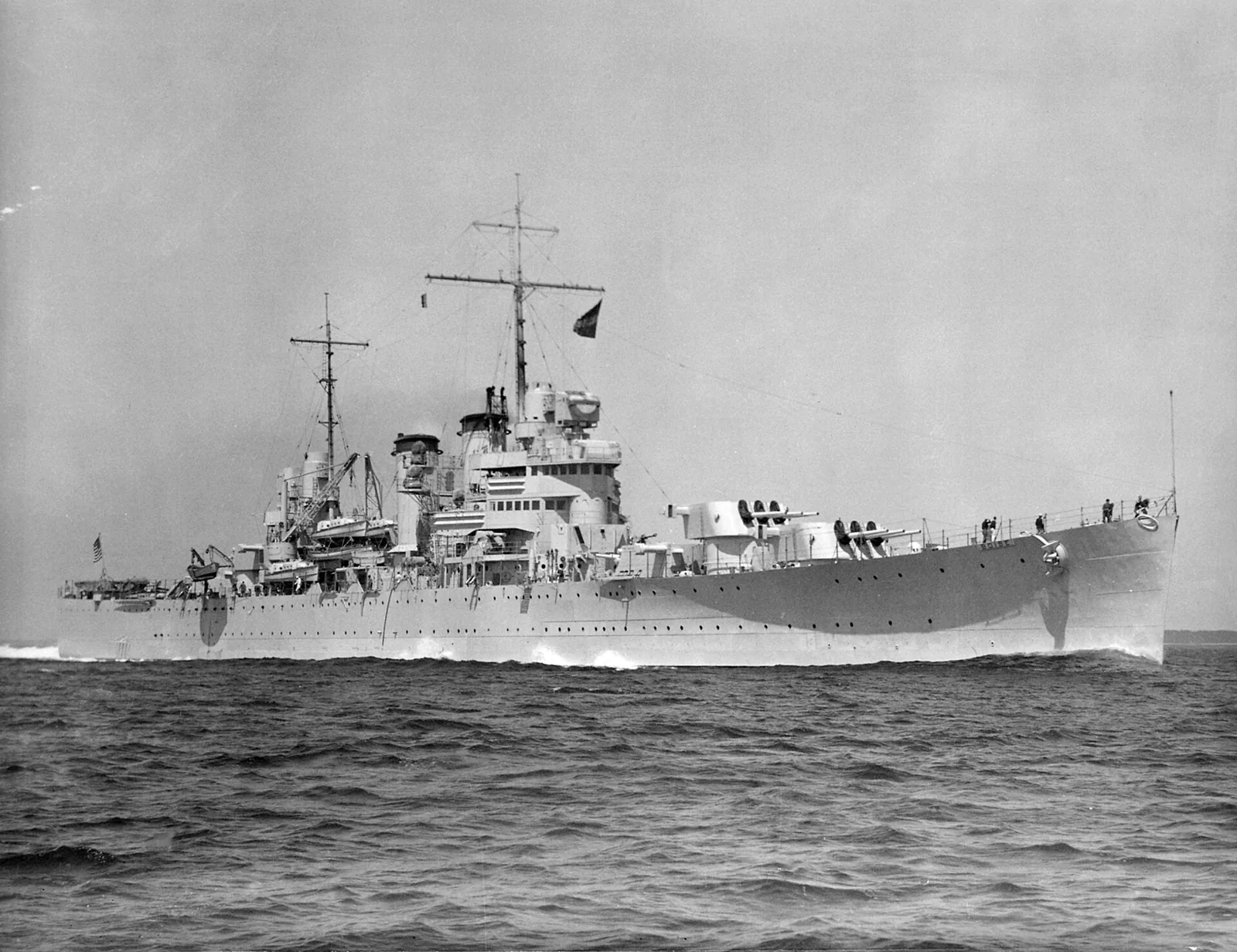
Service
- as Boise12 August 1938 — 1 July 19462,193 days of the war
- as Nueve de Julio11 March 1952 — 1979
- Name
- USS Boise
- Pennant / hull number
- CL-47
- Namesake
- City of Boise, Idaho
- Builder
- Newport News Shipbuilding and Drydock Company, Newport News, Virginia
- Ordered
- 13 February 1929
- Laid down
- 1 April 1935
- Launched
- 3 December 1936
- Commissioned
- 12 August 1938
- Decommissioned
- 1 July 1946
- Struck
- 25 January 1951
- Fate
- Sold for scrap August 1981
Scrapped 1983 at Brownsville, Texas (1981) - Status
- Scrapped
Specifications — As built
- Displacement, standard
- 10,000 long tons (10,160 t)
- Displacement, full load
- 12,207 long tons (12,403 t)
- Length
- 185.32 m (608 ft) OA
- Beam
- 18.59 m (61 ft)
- Draught
- 5.79 m (19 ft)
- Speed
- 32.5 knots (60.2 km/h, 37.4 mph)
- Complement
- 868
- Main gun
- 152 mm (6 in)
Boise (CL-47) was launched 3 December 1936 by Newport News Shipbuilding and Dry Dock Co., Newport News , Va.; sponsored by Miss Salome Clark, daughter of Governor Clark of Idaho; and commissioned 12 August 1938, Captain B. V. McCandlish in command.
In February 1939, following a shakedown cruise to Monrovia, Liberia; and Cape Town, Union of South Africa, Boise joined Division 9, Cruisers, Battle Force, at San Pedro, Calif. Until November 1941 she operated alternately off the west coast and in Hawaiian waters. She then escorted a convoy to Manila, Philippine Islands, arriving 4 December 1941.
The outbreak of war in the Philippines , 8 December 1941, found Boise off Cebu. She joined TF 5 in the East Indies, but on 21 January 1942 struck an uncharted shoal in Sape Strait and had to retire to Colombo, Ceylon; Bombay, India; and Mare Island Navy Yard for repairs. Her repairs completed, she sailed 22 June 1942 to escort a convoy to Auckland, New Zealand. She then returned to Pearl Harbor and during 31 July-10 August 1942 conducted a raiding cruise in Japanese waters as a feint to draw attention away from the Guadalcanal landings. In August, she escorted a convoy to the Fiji and New Hebrides islands. During 14-18 September she helped cover the landing of Marine reinforcements on Guadalcanal . In the succeeding hard fighting she was hit by Japanese shells in the American victory of Cape Esperance after taking six planes under fire. She made her way to Philadelphia Navy Yard where she underwent repairs (19 November 1942-20 March 1943).
Boise departed 8 June 1943 for the Mediterranean, arriving at Algiers, Algeria , 21 June. Between 10 July and 18 August 1943 she acted as a cover and fire support ship during the landing on Sicily. In September she took part in the Italian mainland landings at Taranto (9-10 September) and Salerno (12-19 September). She returned to New York 15 November 1943 and once again steamed to the South Pacific, arriving at Milne Bay, New Guinea, 31 December.
During January-September 1944 she took part in operations along the northern shore of New Guinea, including: Madang-Alexishafen bombardment (25-26 January); Humboldt Bay landings (22 April); Wakde-Sawar bombardment (29-30 April); Wakde-Toem landings (15-25 May); Biak landings (25 May-10 June); Noemfoor landings (1-2 July); Cape Sansapor landings (27 July-31 August); and the occupation of Morotai (1-30 September). The cruiser moved northward as the battle front advanced into the Philippines taking part in: Leyte invasion (20-24 October); Battle of Surigao Strait (25 October); Mindoro landings (12-17 December); Leyte-Mindoro covering action (26-29 December); Lingayen Gulf landings, with General D. MacArthur embarked (9-13 January 1945); Luzon covering force (14-31 January); Bataan-Corregidor occupation (13-17 February); and Zamboanga landings (8-12 March). She then moved to Borneo for the Tarakan landings (27 April-3 May). During 3-16 June she carried General MacArthur on a 3,500 mile tour of the Central and Southern Philippines and Brunei Bay, Borneo, and then returned to San Pedro, Calif. , arriving 7 July.
The cruiser remained in San Pedro area undergoing overhaul and training until October. She sailed 3 October for the east coast, arriving at New York 20 October. Boise remained there until decommissioned 1 July 1946. She was sold to Argentina 11 January 1951.
From the Dictionary of American Naval Fighting Ships, compiled by the Naval History and Heritage Command (Boise I (CL-47)). A work of the United States Government, in the public domain.
Armament and machinery
This vessel is recorded in 2 configurations. Wartime refits changed armament and complement substantially, so each is kept separately rather than averaged into one set of figures. The figures above are as built.
As built
- Propulsion
- 4 × geared turbines
- 4 × screws
- Power
- 8 × Steam boilers
- 100000 shp
- Armament
- 15 × 6 in/47 caliber Mark 16 guns (5x3)
- 8 × 5 in/25 caliber anti-aircraft guns (8×1)
- 8 × caliber 0.50 in machine guns
- Armour
- Belt: 3+1/4 - 5 in
- Deck: 2 in
- Barbettes: 6 in
- Turrets: 1+1/4 - 6 in
- Conning tower: 2+1/4 - 5 in
- Aircraft
- 4 × SOC Seagull floatplanes
1945
- Main gun
- 152 mm (6 in)
- Armament
- 15 × 6 in/47 caliber Mark 16 guns (5x3)
- 8 × 5 in/25 caliber anti-aircraft guns (8×1)
- 4 × quad 40 mm Bofors anti-aircraft guns
- 2 × twin 40 mm Bofors anti-aircraft guns
- 18 × single 20 mm Oerlikon anti-aircraft cannons
Sister ships
Sources
- Facts harvested from USS Boise (CL-47) on Wikipedia. Figures only — no wording is taken from it.
- Service history reproduced verbatim from Boise I (CL-47) , Dictionary of American Naval Fighting Ships — public domain, a work of the United States Government.
- Photograph: U.S. Navy Bureau of Ships photo 19-N-19153 — Public domain — Wikimedia Commons