USS Nashville (CL-43)
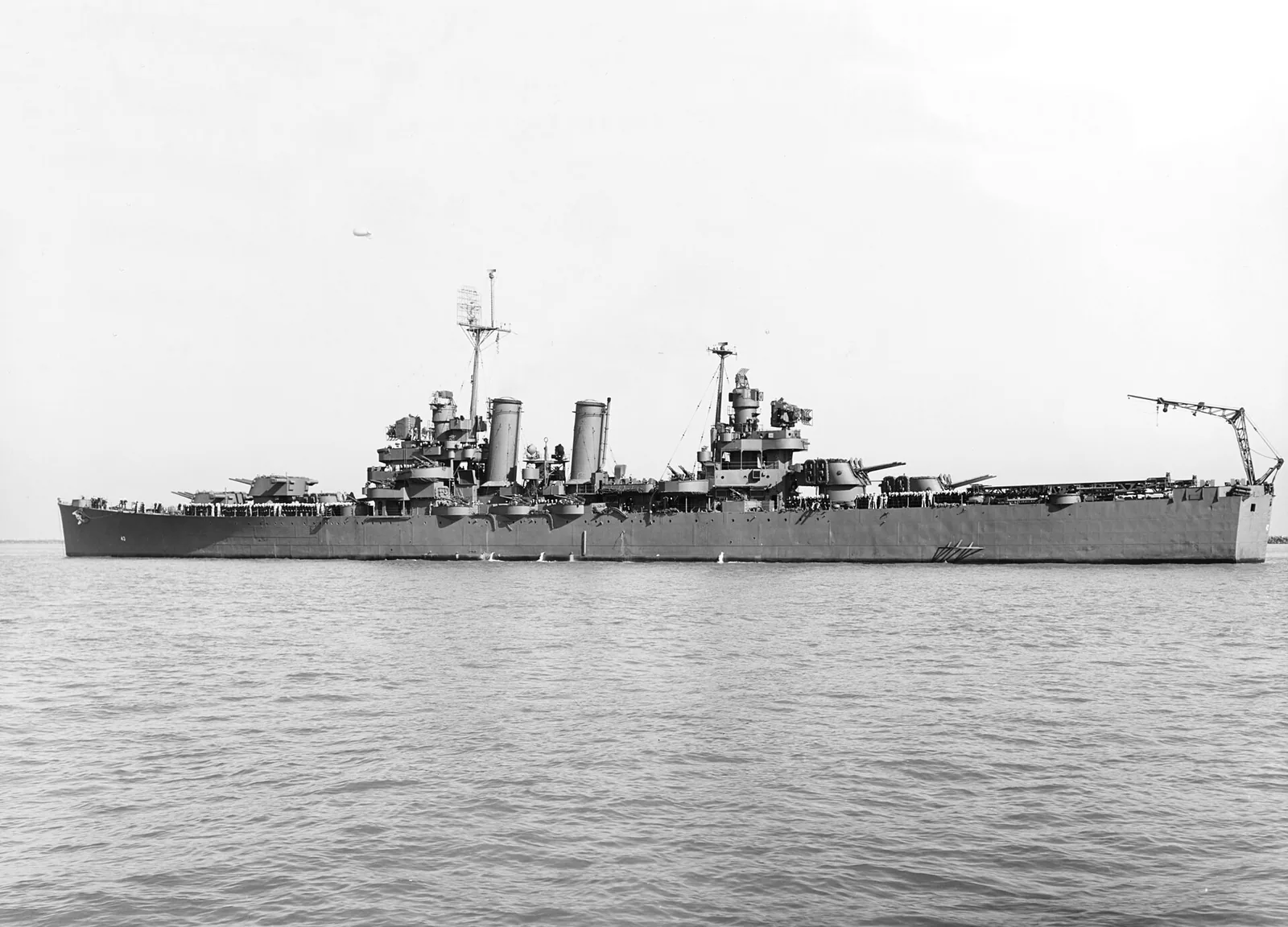
Service
- as Nashville6 June 1938 — 24 June 19462,193 days of the war
- as Capitan Prat (1951–1982)9 January 1951 — 10 May 1982
- Name
- USS Nashville
- Pennant / hull number
- CL-43
- Namesake
- City of Nashville, Tennessee
- Builder
- New York Shipbuilding Corporation, Camden, New Jersey
- Ordered
- 16 June 1933
- Laid down
- 24 January 1935
- Launched
- 2 October 1937
- Commissioned
- 6 June 1938
- Decommissioned
- 24 June 1946
- Struck
- 9 January 1951
- Fate
- Scrapped 1985 in Taiwan (1985)
- Status
- Scrapped
Specifications — As built
- Displacement, standard
- 10,000 long tons (10,160 t)
- Displacement, full load
- 12,207 long tons (12,403 t)
- Length
- 182.88 m (600 ft) OA
- Beam
- 18.59 m (61 ft)
- Draught
- 5.79 m (19 ft)
- Speed
- 32.5 knots (60.2 km/h, 37.4 mph)
- Complement
- 868
- Main gun
- 152 mm (6 in)
The second Nashville (CL-43) was laid down on 24 January 1935 at Camden, N.J., by the New York Shipbuilding Corp.; launched on 2 October 1937; sponsored by Misses Ann and Mildred Stahlman, daughters of James G. Stahlman, President of The Nashville Banner ; and commissioned at the Philadelphia [Pa.] Navy Yard on 6 June 1938, Capt. William W. Wilson in command.
After fitting out, Nashville departed Philadelphia on 19 July 1938 for her shakedown cruise, pausing at Norfolk, Va., on 23 July to take on stores and load ammunition. She operated from Guantanamo Bay, Cuba (1-11 August), punctuating that period of training with a visit to Gonaives, Haiti, on 8 August. Subsequently, she sailed for European waters on a good will visit, arriving at Cherbourg, France, on 24 August 1938. She then visited Stockholm (3 September) and Göteborg (7 September), Sweden, before continuing on to the British Isles, visiting Portland (12 September) and Gravesend (14 September). Ultimately, she got underway on 21 September from Portland, with 25 million dollars in British gold bullion aboard, arriving at the New York Navy Yard, Brooklyn, N.Y., on 30 September, offloaded the gold, and returned to Philadelphia on 5 October for post-shakedown repairs and alterations.
Nashville cleared Philadelphia on 4 January 1939, reaching Norfolk the following day. She conducted battle practice out of Gonaives (10 January), then Guantanamo (13 January), Port of Spain, Trinidad (16 February), then, between 27 February and 12 March, from Culebra, Gonaives, and Guantanamo. Returning to Norfolk on 1 April, she proceeded to the Philadelphia Navy Yard for an overhaul (13-29 April), after which, at New York, N.Y., she embarked Brig. Gen. George C. Marshall, the Chief of Staff of the U.S. Army, and a staff of five officers and 10 enlisted men, on 29 April, bound for the Pan American Defense Conference, and sailed for Rio de Janeiro, Brazil. Steaming via San Juan, Puerto Rico (14 May), and Port of Spain (16 May), she arrived at her destination on 25 May, remaining there until 10 June, when she got underway to return to the U.S., with Gen. Goes Monteiro, Chief of Staff of the Brazilian Army and a staff of five embarked as passengers, disembarking the Brazilian military delegation at Annapolis, Md., on 20 June. On the 23rd Nashville sailed from Norfolk for the Pacific, proceeding via the Panama Canal (5-6 July), and arriving at San Pedro, Calif., on 16 July to begin two years of operations, with her home port changed from Philadelphia to San Pedro.
Continue to the full service history About 2,458 words
From the Dictionary of American Naval Fighting Ships, compiled by the Naval History and Heritage Command (Nashville II (CL-43)). A work of the United States Government, in the public domain.
Armament and machinery
This vessel is recorded in 2 configurations. Wartime refits changed armament and complement substantially, so each is kept separately rather than averaged into one set of figures. The figures above are as built.
As built
- Propulsion
- 4 × geared turbines
- 4 × screws
- Power
- 8 × Steam boilers
- 100000 shp
- Armament
- 15 × 6 in/47 caliber guns (5x3)
- 8 × 5 in/25 caliber anti-aircraft guns (8×1)
- 8 × caliber 0.50 in machine guns
- Armour
- Belt: 3+1/4 - 5 in
- Deck: 2 in
- Barbettes: 6 in
- Turrets: 1+1/4 - 6 in
- Conning tower: 2+1/4 - 5 in
- Aircraft
- 4 × SOC Seagull floatplanes
1945
- Main gun
- 152 mm (6 in)
- Armament
- 15 × 6 in/47 caliber guns (5x3)
- 8 × 5 in/25 caliber anti-aircraft guns (8×1)
- 4 × quad 40 mm Bofors anti-aircraft guns
- 2 × twin 40 mm Bofors anti-aircraft guns
- 18 × single 20 mm Oerlikon cannons
Sister ships
Sources
- Facts harvested from USS Nashville (CL-43) on Wikipedia. Figures only — no wording is taken from it.
- Service history reproduced verbatim from Nashville II (CL-43) , Dictionary of American Naval Fighting Ships — public domain, a work of the United States Government.
- Photograph: U.S. Navy — Official U.S. Navy photo 19-N-49135 from Bureau of Ships Collection of the U.S. Navy Naval History and Heritage Command — Public domain — Wikimedia Commons