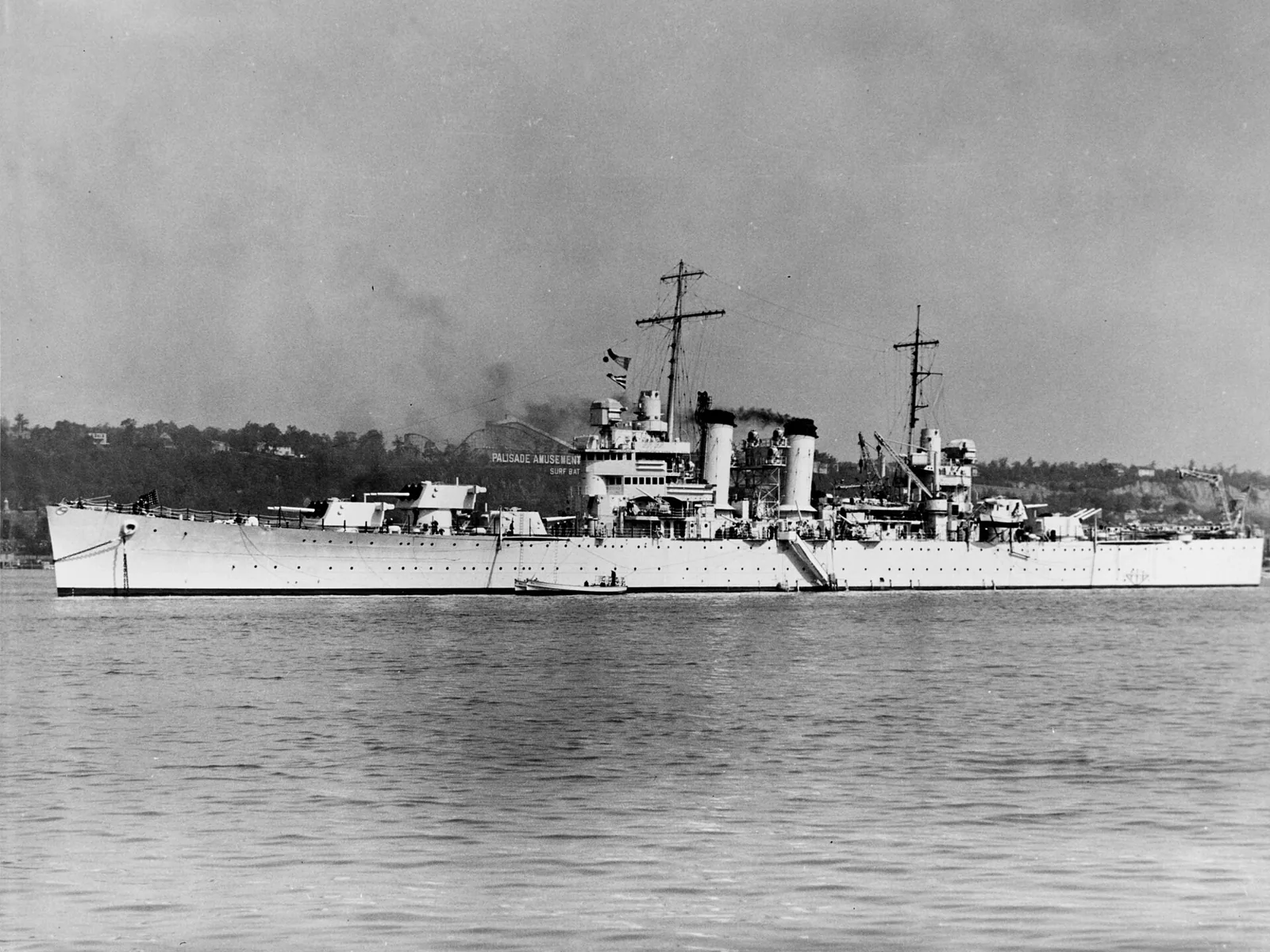
USS Brooklyn (CL-40)
Service
- as Brooklyn30 September 1937 — 3 January 19472,193 days of the war
- as O'Higgins9 January 1951 — 14 January 1992
- Name
- USS Brooklyn
- Pennant / hull number
- CL-40
- Namesake
- Borough of Brooklyn, New York City, New York
- Builder
- Brooklyn Navy Yard, Brooklyn, New York
- Ordered
- 13 February 1929
- Laid down
- 12 March 1935
- Launched
- 30 November 1936
- Commissioned
- 30 September 1937
- Decommissioned
- 3 January 1947
- Struck
- 22 January 1951
- Fate
- Sold for scrap in 1992
Sunk 3 November 1992, under tow to breakers in India (1992) - Status
- Scrapped
Specifications — As built
- Displacement, standard
- 10,000 long tons (10,160 t)
- Displacement, full load
- 12,207 long tons (12,403 t)
- Length
- 185.32 m (608 ft) OA
- Beam
- 18.59 m (61 ft)
- Draught
- 5.79 m (19 ft)
- Speed
- 32.5 knots (60.2 km/h, 37.4 mph)
- Complement
- 868
- Main gun
- 152 mm (6 in)
The third U.S. Navy ship named for the city located on the southwestern end of Long Island, N.Y., that was incorporated into New York City in 1898 as one of six boroughs. During the American War of Independence, the British defeated the Americans during the Battle of Long Island (27–30 August 1776) on land that now constitutes Brooklyn. The British victory enabled them to occupy the strategically vital city of New York, however, Gen. George Washington and most of his army escaped to continue the struggle. The New York Navy Yard was established on the area’s waterfront in 1801.
The Brooklyn Cruiser Committee, a special committee of the Brooklyn Chamber and headed by President John E. Ruston, circulated several thousand copies of a petition addressed to Secretary of the Navy Charles F. Adams III: “The name BROOKLYN has been closely associated with military and naval exploits since the time of the American Revolution…Because Brooklyn is an historic place and a major community, it is fitting that a cruiser should bear its name.”
The lead ship of what was to become the Brooklyn class of light cruisers was authorized by an Act of Congress on 13 February 1929; and classified as CL-44 on 5 July 1933. The contract for the ship’s construction was awarded on 3 August 1933; she was assigned the name Brooklyn on 6 September 1933; reclassified to CL-40 on 5 October 1933; and her construction was fittingly allocated to the New York Navy Yard, Brooklyn, N.Y., on 1 November 1933. The ship was laid down there on 12 March 1935; launched on 30 November 1936; sponsored by Miss. Kathryn J. Lackey, a member of the Daughters of the American Revolution and daughter of Rear Adm. Frank R. Lackey, Commander, New York Naval Militia; and commissioned on 30 September 1937, Capt. William D. Brereton Jr., in command.
Continue to the full service history About 14,964 words
From the Dictionary of American Naval Fighting Ships, compiled by the Naval History and Heritage Command (Brooklyn III (CL-40)). A work of the United States Government, in the public domain.
Armament and machinery
This vessel is recorded in 2 configurations. Wartime refits changed armament and complement substantially, so each is kept separately rather than averaged into one set of figures. The figures above are as built.
As built
- Propulsion
- 4 × geared turbines
- 4 × screws
- Power
- 8 × Steam boilers
- 100000 shp
- Armament
- 15 × 6 in/47 caliber guns (5 × 3)
- 8 × 5 in/25 caliber guns (8 × 1)
- 8 × .50 caliber machine guns (8 × 1)
- Armour
- Belt: 3+1/4 - 5 in
- Deck: 2 in
- Barbettes: 6 in
- Turrets: 1+1/4 - 6 in
- Conning tower: 2+1/4 - 5 in
- Aircraft
- 4 × floatplanes
1945
- Beam
- 21.03 m (69 ft)
- Main gun
- 152 mm (6 in)
- Armament
- 15 × 6 in/47 caliber guns (5 × 3)
- 8 × 5 in/25 caliber guns (8 × 1)
- 6 × quad 40 mm Bofors anti-aircraft guns
- 2 × twin 40 mm Bofors guns
- 18 × single 20 mm Oerlikon anti-aircraft cannons
Sister ships
Sources
- Facts harvested from USS Brooklyn (CL-40) on Wikipedia. Figures only — no wording is taken from it.
- Service history reproduced verbatim from Brooklyn III (CL-40) , Dictionary of American Naval Fighting Ships — public domain, a work of the United States Government.
- Photograph: Unknown author — U.S. Navy photo 80-G-1023215 — Public domain — Wikimedia Commons