USS Dyess
Service
- as USS Dyess21 May 1945 — 27 January 1981104 days of the war
- Name
- USS Dyess
- Pennant / hull number
- DD-880
- Namesake
- Aquilla J. Dyess
- Builder
- Consolidated Steel Corporation
- Ordered
- 19 July 1940
- Laid down
- 17 August 1944
- Launched
- 26 January 1945
- Commissioned
- 21 May 1945
- Decommissioned
- 27 January 1981
- Fate
- Sold to Greece for spare parts, 8 July 1981 (1981)
- Status
- Unknown
Specifications
- Displacement, standard
- 2,616 long tons (2,658 t)
- Displacement, full load
- 3,460 long tons (3,516 t)
- Length
- 119.05 m (390.6 ft)
- Beam
- 12.22 m (40.1 ft)
- Draught
- 4.39 m (14.4 ft)
- Speed
- 36.8 knots (68.2 km/h, 42.3 mph)
- Range
- 4,500 nmi (8,334 km)
- Complement
- 336
- Main gun
- 127 mm (5 in)
Aquilla James Dyess, born 11 January 1909 in Augusta, Ga., served in the Army, then he was appointed first lieutenant in the Marine Corps Reserve 4 November 1936. He was assigned to active duty at Norfolk 8 November 1940. He was killed in action at Namur Island, Marshall Islands, 2 February 1944. Lieutenant Colonel Dyess was posthumously awarded the Medal of Honor for his daring and forceful leadership in the face of fierce opposition on the day of his death.
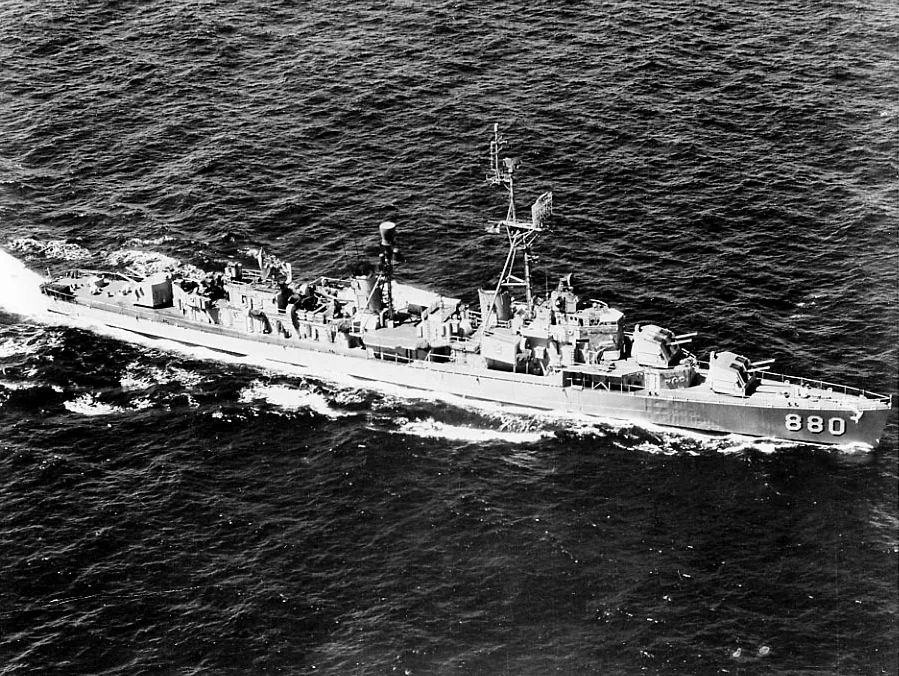
Dyess (DD-880) was launched 26 January 1945 by Consolidated Steel Corp., Orange, Tex.; sponsored by Mrs. A. J. Dyess, widow of Lieutenant Colonel Dyess; and commissioned 21 May 1945, Commander R. L. Fulton in command. She was reclassified DDR-880 18 March 1949.
After her shakedown cruise and conversion to a radar picket destroyer, Dyess sailed from Norfolk 7 November 1945 to join the 5th Fleet at Tokyo Bay 19 December for occupation duty in the Far East. She returned to San Diego 16 December 1946, and on 6 January 1947, got underway for the east coast, arriving at Norfolk 23 January. She served in local training cruises until August of that year when she sailed to Rio de Janiero, Brazil, to escort President H. S. Truman embarked in Missouri (BB-63) as far as Norfolk when he transferred to the Presidential yacht Williamsburg (AGC-369) which Dyess escorted to Washington, D.C.
Dyess arrived at Newport, R.I., 27 September 1947 for local training operations. After a tour of duty with the 6th Fleet in the Mediterranean from 29 October to 14 February 1948, she returned to her home port of Norfolk. Until the end of 1958 Dyess made nine tours of duty with the 6th Fleet in the Mediterranean, patrolling to preserve peace and engaging in exercises with NATO forces. She also sailed on two midshipman cruises, one to southern Europe in the summer of 1948 and one to Halifax, Nova Scotia, in the summer of 1951. The remainder of her service has been as varied as her capabilities. She has acted as plane guard during the qualifying of pilots in carrier operations and has joined in hunter-killer exercises, amphibious training, and large-scale fleet exercises. She assisted in the evacuation of American nationals from Suez during the tense situation which developed during her 1956 Mediterranean cruise. In the summer of 1958 she joined in strengthening the free world's defenses with NATO operations in northern Europe.
Dyess operated along the east coast and off Cuba in 1959, and on 25 July arrived at Charleston, S.C., her new home port. On 29 January 1960 she sailed on her tenth deployment to the Mediterranean.
Dyess returned to Charleston, S.C. in August, and in October entered Charleston Naval Ship Yard, where she remained until the end of 1960.
From the Dictionary of American Naval Fighting Ships, compiled by the Naval History and Heritage Command (Dyess (DD-880)). A work of the United States Government, in the public domain.
Armament and machinery
Armament and machinery
- Propulsion
- 2 shafts
- General Electric steam turbines
- 4 boilers
- 60000 shp
- Armament
- 6 x 5 in/38 dual purpose guns
- 12 x 40 mm anti-aircraft guns
- 11 x 20 mm anti-aircraft guns
- 10 x 21-inch (533 mm) torpedo tubes
Sister ships
- USS Abner Read (DD-769)
- USS Benner (DD-807)
- USS Bordelon
- USS Charles P. Cecil
- USS Charles R. Ware (DD-865)
- USS Chevalier (DD-805)
- USS Corry (DD-817)
- USS Dennis J. Buckley (DD-808)
- USS Duncan (DD-874)
- USS Eugene A. Greene
- USS Everett F. Larson (DD-830)
- USS Floyd B. Parks
- USS Frank Knox
- USS Fred T. Berry
- USS Furse
- USS Gearing
- USS George K. MacKenzie
- USS Goodrich
- USS Gurke
- USS Gyatt
- USS Hanson
- USS Harold J. Ellison (DD-864)
- USS Hawkins
- USS Henderson (DD-785)
Sources
- Facts harvested from USS Dyess on Wikipedia. Figures only — no wording is taken from it.
- Service history reproduced verbatim from Dyess (DD-880) , Dictionary of American Naval Fighting Ships — public domain, a work of the United States Government.
- Photograph: U.S. Navy — Official U.S. Navy photo NH 106987 from the U.S. Navy Naval History and Heritage Command — Public domain — Wikimedia Commons