USS Ingraham (DD-694)
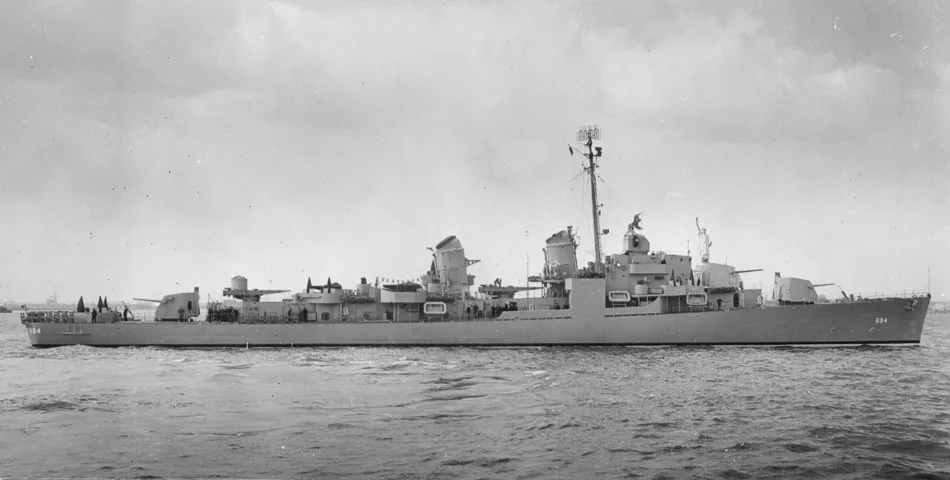
Service
- as USS Ingraham10 March 1944 — 15 June 1971541 days of the war
- as Miaoulis16 July 1971 — 1992
- Name
- USS Ingraham
- Pennant / hull number
- DD-694
- Namesake
- Duncan Ingraham
- Builder
- Federal Shipbuilding and Drydock Company
- Laid down
- 4 August 1943
- Launched
- 16 January 1944
- Commissioned
- 10 March 1944
- Decommissioned
- 15 June 1971
- Struck
- 16 July 1971
- Fate
- Sunk as target, 9 October 2001 (2001)
- Status
- Wreck
Specifications
- Displacement, standard
- 2,200 long tons (2,235 t)
- Length
- 114.6 m (376 ft)
- Beam
- 12.19 m (40 ft)
- Draught
- 4.57 m (15 ft)
- Speed
- 34 knots (63 km/h, 39.1 mph)
- Range
- 6,500 nmi (12,038 km)
- Complement
- 336
- Main gun
- 127 mm (5 in)
Captain Duncan Nathaniel Ingraham was born in Charleston, S.C., 6 December 1802. He was appointed Midshipman 18 June 1812 at the age of 10 and, after distinguished service, was commissioned Captain 14 September 1855. While in command of the sloop-of-war St. Louis in the Mediterranean, in July 1853, he interfered at Smyrna with the detention by the Austrian consul of Martin Koszta, a Hungarian who had declared in New York his intention of becoming an America citizen, and, who had been seized and confined in the Austrian ship Hussar. For his conduct in this matter he was voted thanks and a medal by Congress. Captain Ingraham served as Chief of the Bureau of Ordnance and Hydrographer of the Navy from 1856 until 1860. He resigned from the Navy 4 February 1861 to enter the Confederate States Navy with the rank of captain. He was commandant of the Charleston station 1862 to 1865. He died at Charleston 16 October 1891.
The third Ingraham (DD-694) was launched 16 January 1944 by Federal Shipbuilding & Drydock Co., Kearny, N.J.; sponsored by Mrs. George Ingraham Hutchinson; and commissioned 10 March 1944, Comdr. H. W. Gordon in command.
After shakedown in Bermuda and training out of Norfolk, Ingraham sailed for duty with the Pacific Fleet, arriving Eniwetok 31 October in time to begin the final push of the enemy to its home islands. In mid-November she commenced screening carriers during strikes on Luzon in which considerable damage was done to the dwindling Japanese navy and air force. The destroyer continued patrol and antisubmarine duty until 12 December when she sailed for the assault and landings on Mindoro. Three days later in company with Barton, she sank a Japanese cargo ship off the southwest tip of Mindoro.
Continue to the full service history About 1,214 words
From the Dictionary of American Naval Fighting Ships, compiled by the Naval History and Heritage Command (Ingraham III (DD-694)). A work of the United States Government, in the public domain.
Armament and machinery
Armament and machinery
- Propulsion
- 60000 shp
- 2 propellers
- Armament
- 6 × 5 in/38 cal. guns
- 12 × 40 mm AA guns
- 11 × 20 mm AA guns
- 10 × 21 inch (533 mm) torpedo tubes
- 6 × depth charge projectors
- 2 × depth charge tracks
Sister ships
- USS Alfred A. Cunningham
- USS Allen M. Sumner
- USS Ault
- USS Barton (DD-722)
- USS Blue (DD-744)
- USS Borie (DD-704)
- USS Bristol (DD-857)
- USS Brush
- USS Charles S. Sperry
- USS Collett
- USS Compton
- USS Cooper
- USS De Haven (DD-727)
- USS Douglas H. Fox
- USS Drexler
- USS English
- USS Frank E. Evans
- USS Gainard
- USS Hank
- USS Harlan R. Dickson
- USS Harry E. Hubbard
- USS Haynsworth
- USS Hugh Purvis
- USS Hugh W. Hadley
Sources
- Facts harvested from USS Ingraham (DD-694) on Wikipedia. Figures only — no wording is taken from it.
- Service history reproduced verbatim from Ingraham III (DD-694) , Dictionary of American Naval Fighting Ships — public domain, a work of the United States Government.
- Photograph: Edited by Destroyer History Foundation from photo 19-N-62588 scanned at the National Archives and Records Administration. — Originally from en.wikipedia ; description page is/was here (Original source: photo 19-N-62588 - US Navy photo ) — Public domain — Wikimedia Commons