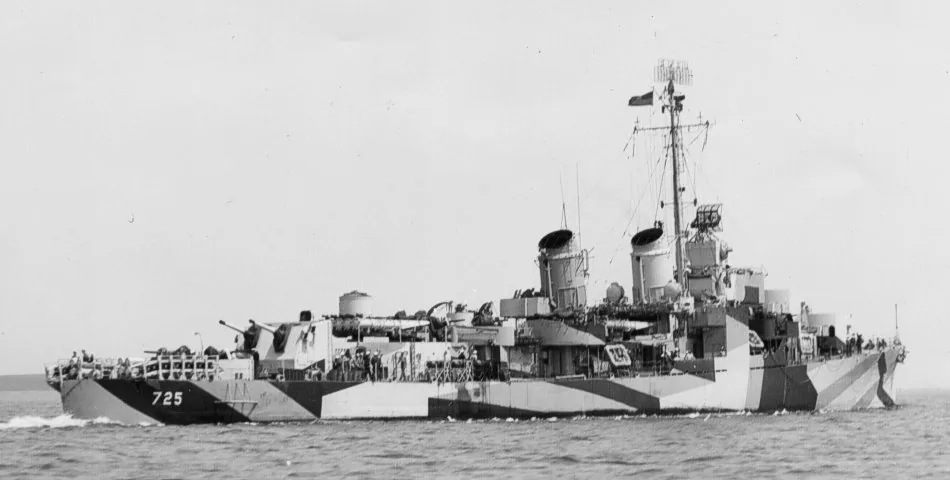
USS O’Brien (DD-725)
Service
- as O'Brien25 February 1944 — 18 February 1972555 days of the war
- Name
- USS O'Brien
- Pennant / hull number
- DD-725
- Namesake
- Jeremiah O'Brien
- Builder
- Bath Iron Works
- Laid down
- 12 July 1943
- Launched
- 8 December 1943
- Commissioned
- 25 February 1944
- Decommissioned
- 18 February 1972
- Struck
- 18 February 1972
- Fate
- Sunk as target off California on 13 July 1972 (1972)
- Status
- Wreck
Specifications
- Displacement, standard
- 2,200 long tons (2,235 t)
- Length
- 114.6 m (376 ft)
- Beam
- 12.19 m (40 ft)
- Draught
- 4.57 m (15 ft)
- Speed
- 34 knots (63 km/h, 39.1 mph)
- Range
- 6,500 nmi (12,038 km)
- Complement
- 336
- Main gun
- 127 mm (5 in)
Captain Jeremiah O'Brien and his five brothers, Gideon, John, William, Dennis and Joseph, were crewmembers of the sloop Unity which captured HMS Margaretta at the entrance to the harbor at Machias, Mass. (now Maine), 12 June 1775. Under the command of Jeremiah O'Brien, thirty-one townsmen armed with guns, swords, axes, and pitch forks captured the British armed schooner in an hour long battle after Margaretta had threatened to bombard the town for interference with the shipment of lumber to British troops in Boston.
The fourth O'Brien (DD-725) was laid down by Bath Iron Works, Bath, Maine, 8 December 1943 and launched 12 July 1943; sponsored by Miss Josephine O'Brien Campbell greatgreat-great granddaughter of Gideon O'Brien and commissioned at Boston Naval Shipyard, Comdr. P. F. Heerbrandt in command 25 February 1944.
After shakedown out of Bermuda, B.W.I. and Norfolk, Va. O'Brien joined convoy forces 14 May 1944 enroute to Scotland and England. Following patrol and escort duty near England, she participated in shore bombardment of Cherbourg, and the invasion of Normandy. On 25 June while supporting minesweeps well inshore of Texas (BB-35), which was engaging German shore batteries at Cape Levi, near Cherbourg, O'Brien's own gunfire was so accurate that enemy gunnery positions shifted from Texas to O'Brien. She received a direct hit just abaft the bridge, but was able to stay on station long enough to lay a smoke screen for Texas. Thirteen men were killed and nineteen wounded. Following temporary repairs in Portland, England, O'Brien escorted a convoy to the Boston Naval Shipyard where she underwent extensive work.
Continue to the full service history About 1,915 words
From the Dictionary of American Naval Fighting Ships, compiled by the Naval History and Heritage Command (O'Brien IV (DD-725)). A work of the United States Government, in the public domain.
Armament and machinery
Armament and machinery
- Propulsion
- 60000 shp
- 2 propellers
- Armament
- 6 × 5 in/38 cal. guns
- 12 × 40 mm AA guns
- 11 × 20 mm AA guns
- 10 × 21 inch (533 mm) torpedo tubes
- 6 × depth charge projectors
- 2 × depth charge tracks
Sister ships
- USS Alfred A. Cunningham
- USS Allen M. Sumner
- USS Ault
- USS Barton (DD-722)
- USS Blue (DD-744)
- USS Borie (DD-704)
- USS Bristol (DD-857)
- USS Brush
- USS Charles S. Sperry
- USS Collett
- USS Compton
- USS Cooper
- USS De Haven (DD-727)
- USS Douglas H. Fox
- USS Drexler
- USS English
- USS Frank E. Evans
- USS Gainard
- USS Hank
- USS Harlan R. Dickson
- USS Harry E. Hubbard
- USS Haynsworth
- USS Hugh Purvis
- USS Hugh W. Hadley
Sources
- Facts harvested from USS O'Brien (DD-725) on Wikipedia. Figures only — no wording is taken from it.
- Service history reproduced verbatim from O'Brien IV (DD-725) , Dictionary of American Naval Fighting Ships — public domain, a work of the United States Government.
- Photograph: U.S. Navy Bureau of Ships — Official U.S. Navy Bureau of Ships photo 19-N-130099 available at Destroyerhistory.org — Public domain — Wikimedia Commons