USS Rich (DE-695)
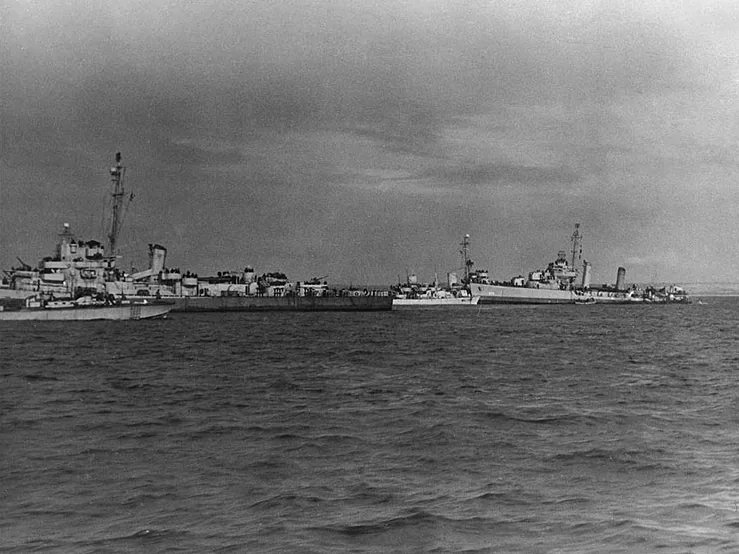
Service
- as USS Rich1 October 1943 — 8 June 1944251 days of the war
- Name
- USS Rich
- Pennant / hull number
- DE-695
- Namesake
- Ralph M. Rich
- Builder
- Defoe Shipbuilding Company, Bay City, Michigan
- Ordered
- 1942
- Laid down
- 27 March 1943
- Launched
- 22 June 1943
- Commissioned
- 1 October 1943
- Fate
- Sunk by mines, 8 June 1944 (1944)
- Status
- Wreck
Specifications
- Displacement, standard
- 1,400 long tons (1,422 t)
- Displacement, full load
- 1,740 long tons (1,768 t)
- Length
- 93.27 m (306 ft)
- Beam
- 11.28 m (37 ft)
- Draught
- 2.74 m (9 ft)
- Speed
- 23 knots (42.6 km/h, 26.5 mph)
- Range
- 3,700 nmi (6,852 km)
- Complement
- 213
Ralph McMaster Rich was born on 22 January 1916, in Denmark, Ward County, North Dakota, to Ralph W. Rich and Agnes H. Rich. Ralph attended college at the University of Minnesota, graduating in the summer of 1939, and then enlisting in the U.S. Naval Reserve on 12 October 1939 at Minneapolis, Minnesota. He received his initial flight training in Minnesota, and then on 28 December 1939, Aviation Cadet Rich reported for active duty at Pensacola, Florida. Rich, received designation as a Naval Aviator on 12 July 1940, and was then commissioned as an ensign on 16 August of that same year.
On 28 November 1940 Rich was assigned to Fighting Squadron (VF) 6, stationed on board the aircraft carrier Enterprise (CV-6). The carrier was operating with Task Force 8, west of the Hawaiian Islands on 7 December 1941, when Japan launched a surprise attack against U.S. forces at Oʻahu, T.H. Having been underway at the time of the attack, Enterprise and the other carriers of the Pacific Fleet avoided the initial onslaught, but were nonetheless quickly called upon to engage Japanese forces. For this reason, Rich participated in several of the initial actions of the war in the Pacific.
Rich flew his Grumman F4F Wildcat fighter in support of a raid on the Marshall Islands on 1 February 1942 and received credit for destroying a Mitsubishi G4M Type 1 land attack plane that was still on the ground. Toward the end of the month, on the 24th, he participated in the air raid on Wake Island as well. On 28 November 1942, Rich was promoted to the rank of Lieutenant (j.g.).
Continue to the full service history About 1,687 words
From the Dictionary of American Naval Fighting Ships, compiled by the Naval History and Heritage Command (Rich I (DE-695)). A work of the United States Government, in the public domain.
Armament and machinery
Armament and machinery
- Propulsion
- General Electric turbo-electric drive
- 2 × solid manganese-bronze 3600 lb 3-bladed propellers, 8 ft diameter, 7 ft pitch
- 2 × rudders
- Power
- 12000 shp
- Armament
- 3 × 3 in/50 cals dual purpose guns, 4 × 1.1 in/75 cal anti-aircraft guns (4×1), 8 × 20 mm cannons, 9 × 21 inch (533 mm) torpedo tubes (3×3), 1 × Hedgehog anti-submarine mortar, 8 × K-gun depth charge projectors, 2 × depth charge tracks
Sister ships
- HMS Bentinck (K314)
- HMS Bligh
- HMS Byron
- HMS Calder (K349)
- HMS Conn
- HMS Cosby
- HMS Dakins
- HMS Duff (K352)
- HMS Ekins
- HMS Fitzroy (K553)
- HMS Halsted (K556)
- HMS Hargood (K582)
- HMS Holmes (K581)
- HMS Hotham (K583)
- HMS Redmill (K554)
- HMS Retalick
- HMS Riou
- HMS Rowley
- HMS Rupert (K561)
- HMS Rutherford
- HMS Seymour (K563)
- HMS Spragge (K572)
- HMS Stockham
- HMS Thornborough
Sources
- Facts harvested from USS Rich (DE-695) on Wikipedia. Figures only — no wording is taken from it.
- Service history reproduced verbatim from Rich I (DE-695) , Dictionary of American Naval Fighting Ships — public domain, a work of the United States Government.
- Photograph: U.S. Navy — Official U.S. Navy photo NH 44311 from the U.S. Navy Naval History and Heritage Command — Public domain — Wikimedia Commons